Create the conditions for the "perfect moment"
· Vanya Kyndova - Dynamic Talent Management
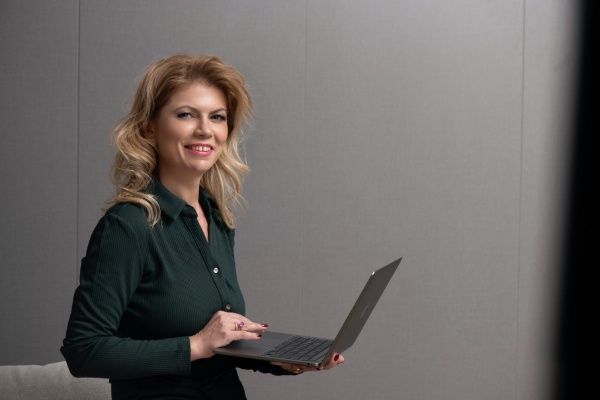
You don't need to know what you will be doing in 10 years – what matters is to know why you are doing what you are doing today. Every new choice, every step in your career should add not just experience, but meaning!
Introduce yourself
in a few words..
My name is Vanya Kyndova and I am the owner of Dynamic Talent Management, a company for outsourced HR
(outsource of services in the field of Human Resource Management and Development)
Tell us what
are the philosophy and values of the company you currently represent?
The philosophy and
values of our company are built on three key principles:
professionalism, development, and sustainability in a dynamic environment. For us, sustainability is not just
adaptability to changes, but a result of targeted investments in people. We believe that the brand starts from within — from the people. We cannot build a sustainable business if
we do not recognize and develop the potential of the team. Our professionalism is
expressed not only in high work standards but in respect for the person behind
every role. Development is a two-way process — the organization grows when its
people grow.
We believe that
true success comes when people not only fulfill their tasks but develop purposefully and adapt their skills to the needs of the business and the client.
That is why we invest in training, objective assessments, and methods for multiplying
knowledge, to build/develop a highly qualified team capable of handling the
challenges of the industry in which our clients operate.
Our core values
are:
✅ Professionalism and commitment – We expect awareness and responsibility
in every action.
✅ Development and learning – We strive for continuous improvement of
people and processes.
✅ Objectivity and transparency – We rely on real data and fair
assessment of performance.
✅ Adaptability – We prepare the people we work with to be resilient
in a rapidly changing environment.
Our branding
is not just a vision – it is a reflection of our values, culture, and aspiration for
long-term success.
How long have you
been developing your current company? What are the most valuable lessons that the
current situation has taught you during this period?
We started working
with our first clients in March 2023, and for the third year now we have been developing
fruitful and long-term partnerships with them. We are particularly proud of the fact that all our clients found us through referrals — this is the purest
form of recognition and trust for us.
The period so far has
taught us a lot – from operational lessons to deep insights into how to
build trust, how to adapt innovative solutions in an unfamiliar environment, and how
to lead people through change.
The most valuable
lesson?
That when you do
something new, you are not just selling a service – you are introducing a culture.
Our service is innovative and largely unknown in the Bulgarian market,
that is why in recent months we have been purposefully “educating” our audience — not with
aggressive marketing, but with understanding, with approach, with sustainable messages.
We realized that brand
communication is not just how we talk about ourselves, but how we create a common language with
those for whom we do what we do.
And one more important thing:
The best thing you can offer to the client is a well-selected and
supported team. That is why we invest in our internal culture with the same
commitment with which we care for our partnerships.
If you personally
had to write a job advertisement, how would you attract the attention of a future employee?
If I had to
write a job advertisement, I would start not with the job description, but with
a question: “Do you want to work in a place where you will be seen as a person, not
as a role?”
We are not just looking
for people with skills – we are looking for personalities with attitude. Those who believe in development,
in respect, in the fact that results come when you are part of a team with a mission, not
from a structure with control.
In the advertisement, I would
promise three things:
🔹 We will see you.
🔹 We will give you space.
🔹 We will give you feedback – even when it is
not easy.
I will attract
attention not with salary, but with opportunity: to belong to an environment where
you can think, make mistakes, and grow.
And I will finish with
what is actually at the core of our team:
You don’t come here just to work. You come here to matter and to do
things that are important to you.
It is important for me
that the people I am surrounded by are happy. I cannot give them
happiness, but I can provoke them to seek it. And if we already see life with
different eyes and our paths take different directions, it is better to part ways,
in order to preserve our human (at the expense of the roles) relationships.
What does your company do to organize a constructive and fruitful working environment for everyone? Should people in the collective be friends?
Our company
builds a working environment where the value of the person is paramount, and the principles
of respect, openness, and development are daily practice, not a formal
culture on paper.
We believe in creating an environment where people feel comfortable being
themselves, know what their role is and how they contribute, but also receive
space for growth, mistakes, and honest feedback.
The most valuable thing for
us is when people in the team consciously work on their areas for improvement and at
the same time have the opportunity to develop in directions that excite them.
We do not put people in boxes, but seek ways to expand their potential
– as they feel it.
And regarding
friendships:
People do not need to be friends to work well together. What they need to be is ethical, supportive, and mature enough to
respect their differences.
Friendships sometimes happen as a natural result of the environment, but they are not
a prerequisite.
The most important thing for
us is the commitment to development – personally and as part of a team.
We build an environment where people do not just complete tasks, but grow with
thought, purpose, and direction.
What makes you enjoy going to work? How do you deal with difficult and stressful moments?
What makes me enjoy going to work... a wonderful question?
It is that my work is an extension of myself.
Not in the sense of “I live to work,” but because my work has meaning,
movement, human stories, challenges, and opportunities to create an environment where
people meet their strength and vulnerability at the same time.
I enjoy going to work because I know that every day there is a chance for someone to leave
more confident, more aware, or just more at peace. And that is worth it.
And how do I deal with difficult and stressful moments – The truth is, it depends on what exactly we call
“difficult”.
There are situations where I engage my rational strength – I prioritize,
replan, rearrange. I have good timing, I can see clearly what is not
urgent, but is important, and what requires a reaction right now.
My body is an excellent ally – I know it well and I know that behind every reaction of it
lies a need that should not be ignored.
In other moments,
the difficulty is not logistical, but emotional – and that is where I am still learning.
I am learning not to let emotions govern my decisions, but also not to
suppress them.
I work on emotional replanning – that internal rearrangement that allows me to be both
adequate and compassionate at the same time.
I surround myself with
people who think critically but act humanely – this is also part of my
resilience.
And most importantly – I do not try to be strong despite the difficulties, but together with them.
What work model does your company adhere to – office or remote? What do you think about the possibility of
providing options for flexible working hours, within which employees have
greater freedom to allocate their personal and work commitments?
I believe that
the time and place where a person can unleash their potential is strictly
individual.
In this sense, flexibility according to personal rhythm and needs is not just
allowed – it is a priority.
Our focus is on achieving results, not on what time
or from where it happens.
Currently,
we are implementing an ERP system that will allow me to see the progress on tasks –
not for control, but so that I can support people exactly where and when they need it.
I am convinced that true trust is built on clarity, freedom, and shared
responsibility.
How do the continuous technological changes in the world affect your business?
Technologies
are neither good nor bad – it all depends on who uses them, how, and for
what purpose.
In our business – working with people, with teams, with the culture in companies – every
new technology is like a question: "Will this help people to be
more aware, more effective, and more connected?"
I do not chase every
novelty just because it is “innovation”. I do not believe in the hype – I believe in meaning.
That is why we are
currently implementing the ERP system – not because it is trendy, not because others are
doing it, but because it will save us time for operational meetings and reporting and we will be able to
invest that time in multiplying knowledge and experience.
For me, technologies are like a good assistant – always by your side, but never
instead of you.
Technological
changes will not stop – and we do not need to catch up with them, but to choose which
of them are worth walking with us.
How important is
hierarchy and what does it mean to you? What kind of communication do you advocate
in your company?
For me, hierarchy is
not a structure of titles, but a structure of responsibility.
In our company, there is no cult of positions, but there is a clear understanding of who carries what and
why.
I am the main bearer of the know-how, vision, and decisions – and yes, I have put my skin in the game.
(Literally. Nassim Taleb puts it beautifully: "You cannot talk about
risk if you have not put something of your own in the equation.")
This is the real reason for hierarchy to exist – not for control, but
for clarity and personal responsibility taken.
Our communication
is direct, candid, and maximally open in all directions – upward,
downward, and sideways.
I encourage critical thinking, as long as it goes hand in hand with a sense of respect. And I insist
that people should not be afraid to say:
“I have an idea,” “I disagree,” “I need help.”
True
authority is not imposed – it is chosen.
And when people know that you are there not only to lead but also to take
responsibility in difficult times – then hierarchy works. And it works well.
What is your
career advice for all people who are building a strategy for their professional
development?
My advice is
simple, but not easy: start with yourself. Not from the market, not from the demand, not from what “is in vogue”.
The career strategy is effective when it is based on awareness – what you can do,
what energizes you, and in what environment you can develop fully.
You don’t need to
know what you will be doing in 10 years – what matters is to know why you are doing what you do today.
Every new choice, every step in your career should add not just experience, but
meaning.
And one more thing:
Don’t wait for the “perfect moment”. Create the conditions for it.
Seek an environment where you can learn, make mistakes, develop, and be
seen as people, not just as functions. Professional development is not a vertical ladder, but
a winding path.
When you walk it with clarity, even the turns turn out to be the right lessons.