Every task must be performed with 100% dedication
· Reni Mitkova - EOS Matrix
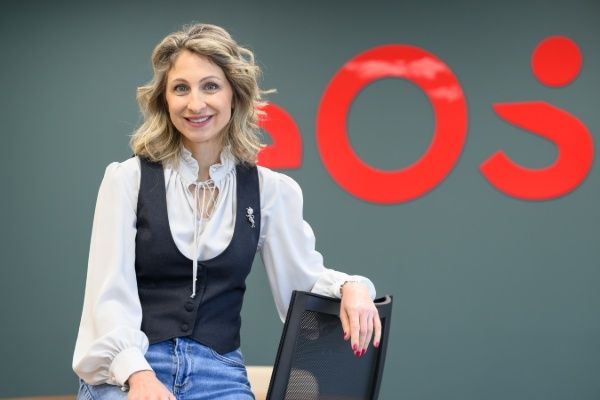
Friendships can improve the work environment, stimulate collaboration, and provide emotional support, but they can also blur professional boundaries and lead to conflicts or a sense of favoritism. To address this, it is important to set clear boundaries, communicate openly, and be inclusive!
Introduce yourself in a few words..
My name is Reni Mitkova, manager of “EOS Matrix” – a leading debt management company in Bulgaria, part of the German EOS Group. I define myself as a happy woman and a professional, realizing my dreams. I have been working in the financial sector for over 20 years, I hold a master's degree in international tourism from UNSS, an Executive MBA from Cotrugli Business School, Zagreb, and a specialization for senior managers at London Business School.
In 2022, my debut book was published – “You Always Pay”,
– and
in 2023.
the podcast “Djobnite” started on Youtube, as well as on social networks, focused on increasing financial literacy, a cause I have been personally and professionally committed to for many years on my social networks.
Tell us what the philosophy and values of the company you represent at the moment?
The collection of debts even today is associated with quite a few prejudices, although there are signs of positive change. For me, a turning point was 2010, when at “EOS Bulgaria” we went through a deep process of defining our mission, vision, and values. This was not just a formality or corporate clichés, but an authentic internal discussion about the meaning of our work and our connection as a team.
Thus, we formulated our mission: to support the financial health of our partners and clients through flexible tools and first-class services.
Our leading values are:
Trust – we take responsibility and fulfill our commitments. It is no coincidence that most of our clients sell us more than one of their portfolios, and today we successfully manage acquired debt portfolios with a total nominal value of over 4 billion BGN.
Personal commitment – we believe that every task should be performed with 100% dedication and faith in positive change.
Respect – we always see the person behind the overdue payment. Respect for dignity is what helps people to fully take advantage of their second chance.
These values not only unite us – they are meaningful and recognized by our entire team and drive us forward.
How long have you been developing your current company? What are the most valuable lessons that the events of this period have taught you?
More than 20 years ago, I became a co-owner of the company, which later joined EOS Group – one of the TOP 3 leading global companies in financial services. As a managing director, I continue to develop together with the company, and this is one of the most valuable lessons I have learned: that the ability to adapt and make decisions, firmly grounded in reality, is the key to success. Nothing is permanent – people, the market, technologies are constantly changing, and if you are not in step with that, you organically fall away. For example, at the moment EOS is undergoing yet another transformation, we are offering new services and developing technological solutions, thus ensuring stability, market advantage, and a leadership position in the sector.
If you personally had to write a job advertisement, how would you attract the attention of a future employee?
The success of our company is based on shared values. Respect, responsibility, and a desire for development are qualities without which a person would not fit into our team. At every interview, I explain not just what we do, but what we believe in – because we are looking for people who find meaning in working together as partners. A great advantage is transparency and shared responsibility; we treat our employees as partners and clients – everyone feels heard, seen, and understood; everyone is involved in the development of the company and everyone sees meaning and their role in what we do.
Compensation is not the leading factor for us – we have a flexible model that accounts for what is more important: commitment, belonging, and the desire for development. A candidate may have impressive qualifications, but if they do not have an attitude towards the cause and the people behind it – they are simply not “our person”. And if they possess the values we share, we are ready to invest in upgrading their skills. Because qualifications are acquired, but attitudes and mindsets are very difficult to change.
What does your company do to organize a constructive and beneficial work environment for everyone? Should people in the team be friends?
People work best when they see meaning and recognize the goals set and their contribution to achieving them. Therefore, we make special efforts to share and explain the big picture to employees, as well as what each one of them means for the success of the company. This, in turn, aligns with their personal aspirations for realization and career development, thus achieving long-term commitment. While the average turnover in the sector is 10%, ours is 0.
As for the decision whether to be friends with colleagues, it depends on personal comfort and the culture of the workplace. Friendships can improve the work environment, stimulate cooperation, and provide emotional support, but they can also blur professional boundaries and lead to conflicts or feelings of favoritism. To deal with this, it is important to set clear boundaries, communicate openly, and be inclusive.
What makes you enjoy going to work? How do you deal with difficult and stressful moments?
I love my job – helping people and companies get out of difficult financial situations, investing my expertise in increasing financial literacy, inspiring someone with the book I wrote, or with my podcast – that is what drives, excites, and motivates me. Of course, there are situations when I get frustrated – for example, if I am imposed from outside how to do something. But in our company, above all, we have a mutual exchange of energy and a supportive environment, and I easily cope with challenges.
What work model does your company adhere to – office or remote? What do you think about the possibility of offering options for flexible working hours, within which employees have greater freedom to allocate their personal and work commitments?
The pandemic has dramatically redefined many work processes – I think that even without it, sooner or later we would have discovered the advantages of the hybrid model we are currently following, but in this context, we had to quickly adopt it. Right from the start, our call center was the first to transition to a fully remote working mode, practically in three days. We achieved this by ensuring the continuity of our operations and securing services for thousands of clients. With the clear understanding that while physical isolation did not harm work results, but rather relationships, we now value personal contact and communication even more, which are irreplaceable for effective communication. Our habits have changed, and we literally changed the office to better reflect its new function as a place where we gather to talk, plan, and meet with our partners. At the same time, remote work provides valuable freedom, but it must go hand in hand with conscious responsibilities. The hybrid model and individual approach are a winning combination, and now is the time for legislation to catch up, reflecting the good practices that have been established.
How do ongoing technological changes worldwide affect your business?
They make us several times more productive, saving time to invest in ourselves and the company, as we learn, improve, or acquire new skills. Automated processes allow us to be more efficient, and at EOS we have seen the benefits of this for quite some time. In our accounting department, we have had a robot for several years that helps process documents – saving nearly 70% of the need for manual data entry. And one legal advisor at our company manages to process 10-12 thousand cases, while the norm is 1000-1500.
In this context, the question logically arises whether AI will replace people, taking their jobs. In my opinion, such concerns are unfounded, as long as we perceive it for what it actually is – a useful tool, but a tool that lacks creativity and combinatorics. Yes, some work activities will be able to be taken over entirely by it, but along with that, new professions for people will emerge, and we will have the opportunity and time to create the next innovations. I am confident that this is the future and that in the coming years there will be two types of companies – those that have integrated artificial intelligence into their processes and those that will not be able to function in the new reality.
How important is hierarchy and what does it mean to you? What kind of communication do you advocate in your company?
I perceive the work hierarchy as a degree of responsibility that you carry. And in our company, as long as you are ready for it, you organically rise.
The last crisis we faced – that of the global pandemic – turned me into a full-time communicator. In conditions of uncertainty and ambiguity about the future, I assessed that it was of utmost importance to make additional efforts to keep our team connected, even from a distance, and our partners and clients calm, knowing that we continue to be there for them as always. I am an advocate of open, constant, and constructive communication, not only in the company but in every aspect of life.
What is your career advice for all people who are building a strategy for their professional development?
To give the best of themselves, without compromises, without excuses. This is always noticed and appreciated. The attitude and contacts are also extremely important – no person is an island and having a supportive environment and acquaintances opens many doors. And, of course, continuous improvement – to challenge ourselves to learn and acquire new skills, so that we are adequate to the dynamic environment. If we are ready for our dreams and for the price we have to pay for them, nothing is impossible.