In Germany, what you can do and how much work you do is considered
· Atanas Bogojev
In Germany, bureaucracy is at a different level, and even within the first few days, you get used to the fact that you have to work with a huge amount of documents!
Introduce yourself in a few sentences. What does your work as daily commitments consist of?
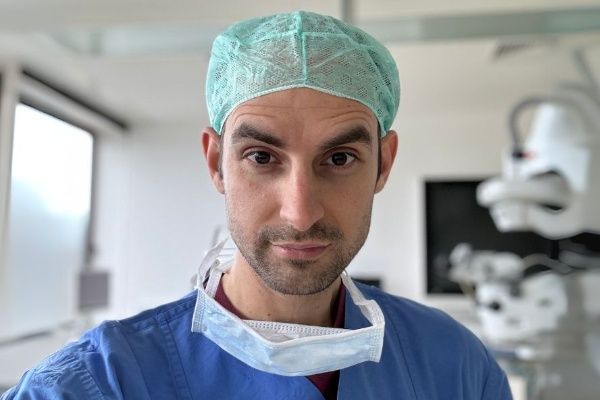
My name is Atanas Bogoев and I am a consultant ophthalmologist, a surgeon at a university clinic in Bochum, Germany. My work involves examination, diagnosis, treatment, and surgical activity for a large number of patients with complex eye diseases. In addition to clinical and surgical activities, I am a member of the board of three organizations for young ophthalmologists in Europe focused on developing future eye doctors. I am actively involved in health promotion and prevention through www.ophthalmology24.com and www.ochnozdrave.com, where we create educational content for patients and colleagues in the field of ophthalmology.
In which country and city do you currently live and how did you end up there?
I currently live and work in Germany. I chose this country in connection with an invitation from Prof. Dick, one of the most renowned professors in the field of eye diseases, to start working as part of his team. Germany is attractive with opportunities for professional development, access to modern equipment, and a training system focused on practice.
What were the biggest challenges you faced at the beginning of your stay?
Without a doubt – the language. Even with good medical knowledge, without communication, you cannot treat effectively. Administration was also a challenge – in Germany, bureaucracy is at another level, and even in the first few days, you get used to working with a huge amount of paperwork.
How did you overcome the language barrier (if there was one)?
Even with a pretty good language base – B2 level in German, I needed intensive courses, many conversations with colleagues and patients, often making mistakes. I tried to learn something new every day and was persistent. It is important not to give up and not to close yourself off, but to try to communicate, even if you make mistakes.
What resources or networks (local communities, colleagues, organizations) helped you adapt?
In our clinic, most of my colleagues are from abroad and from different countries in Europe. Going through similar processes, my colleagues understood me well and always helped me when I needed it. I did not use the services of organizations, but in Germany, everyone has easy access to them, and they are really made to work and help. For example, the medical chamber in Germany offers courses for introduction to the German healthcare system, legal consultations, assistance in finding a job, etc.
What are the main differences between the work culture in your current country and that in Bulgaria?
In Germany, there are much more developed processes in work organizations – work is distributed, and everyone is responsible for their part. Individual doctors are not better than those in our country, but the healthcare system and the optimization of processes in healthcare facilities lead to better outcomes. The volume of work is many times greater compared to clinics in Bulgaria. Colleagues provide direct but constructive feedback.
What values and practices in the workplace impressed you the most?
Sharing skills, teamwork, and the desire to improve skills and knowledge not only among young but also among more experienced doctors. An open policy for mistakes – when an inaccuracy occurs, it is openly discussed in front of everyone, with the aim of avoiding it in the future.
Have there been situations where cultural differences have troubled you?
Yes – in Germany, everyone is quite distant, and being colleagues does not mean you are friends. The culture in Germany often requires workers to follow the rules without considering whether what they are doing is right. In some cases, this is a negative, but I learned to be patient. I needed a little adaptation.
How does finding a job differ in your current country compared to your homeland?
In Germany, everything is structured – there are positions, programs, deadlines. Here, you do not rely so much on connections, but on documents, knowledge, and qualifications, as well as a good recommendation letter.
Did you have to go through any additional qualification courses?
Yes, before I received official permission to work in Germany, I had to have my medical diploma and my specialization diploma in ophthalmology recognized. After that, I took a language exam in medical German before a committee. These are difficult steps, but they are completely achievable with good preparation.
Since the beginning of my work at the clinic, I actively use part of the money I receive to attend highly specialized courses in Europe to reach a higher level of surgical and clinical skills.
In connection with my work on clinical studies, I took courses on good clinical practice.
Shortly after that, I took an exam before the European Board of Ophthalmology. Currently, I continue to further my education whenever possible.
Have you encountered prejudices or obstacles because of your foreign origin?
Not really. I would say a slight distrust at first, which quickly disappears with the demonstration of professionalism and respect. In Germany, what matters is what you can do and how much work you do, not where you are from and how you look.
What would you advise people who want to take a similar step?
To be emotionally prepared – there will be difficult moments. To be patient, because it may take longer than they think. To be persistent, because many people give up too early. But if they want development, everything learned is valuable experience that will enrich them professionally and personally. Currently, facing so many difficulties in such a short period of time, I am much more confident and convinced that I would cope with the next challenges in life!
If you could go back, would you choose the same path?
Yes, definitely. It was hard, but I learned a lot and I continue to grow.
What do you miss most about your homeland in professional and personal terms?
Family, friends, people. In professional terms – helping and treating patients from Bulgaria.
Have you considered returning and under what conditions would you do it?
Yes – in perspective. I would like to return with accumulated experience and pass it on, especially in the field of education in ophthalmology.
What do you think about money? What is its influence on your life? What is your advice to people who often ask themselves questions related to money and how sufficient they are?
Money is a tool. Money amplifies your actions. It gives freedom, but not happiness. My advice – use it wisely, invest in yourself - in knowledge, skills, and experiences.