Not always what we think or can do is our right path
· Madlen Zhekova
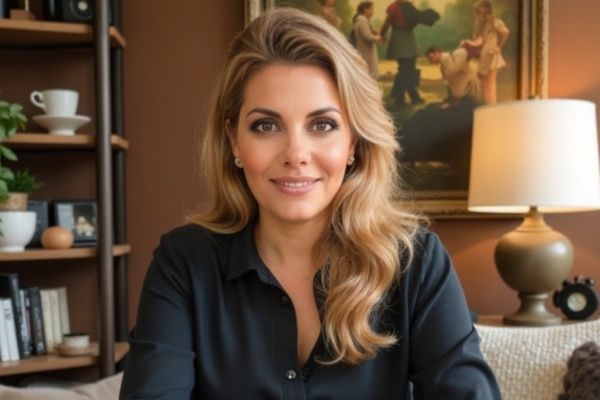
Very often, the greatest breakthrough lies behind fear. A career is not a straight line. It is a series of opportunities that you either seize or miss – depending on whether you are ready to build yourself, not just to take advantage!
Introduce yourself in
a few sentences..
My name is Madlen Zhekova – a visionary, data expert, strategic consultant
and creator of solutions in the fields of corporate wellbeing, sustainable
architecture, and agro-food systems. I work at the crossroadsof data, human psychology, and
systemic thinking to create an environment where organizations and people can
thrive. I believe in moral ambition – that inner driving force that
makes us do things right, even when it’s not the easiest path.
What did you dream of
becoming in your childhood?
As a child, I wanted to become a fashion designer. I was interested in aesthetics,
the psychology of non-verbal communication, the stories behind cultures, and the ability of people to find a common language even
in the most difficult situations. Over time, I realized that besides creativity and exceptional skill,
I possess another ability that has always helped me build friendships, find effective and profitable solutions for all parties, and that is to be a
wonderful mediator and diplomat between worlds – not only in business, but also between people and ideas.
At what age
did you earn your first money? Tell us an interesting story?
As a teenager, I started working – first with organizing
exhibitions and participating in negotiations with various foreign exhibitors, then with small projects. But
the most interesting thing was that even then I was assigned tasks that required trust
– to communicate with foreign partners, to prepare offers and reports. I remember how a client from Switzerland, whom I helped with translation during the conduct of several successful deals at
the exhibition he participated in, told me after the exhibition that he couldn’t believe I was only 16 and how much I had
helped him with practical guidance to reach the Bulgarian
business and client in the right way. This was the beginning
of my relationship with trust and responsibility.
What are the main factors and examples
that shape us as individuals at an early age? What is Your recipe for curiosity,
sources, and inspiration at this stage?
It is often said that difficulties break us. For me – they built me. Even at
very early age, life confronted me with challenges that required not
just adaptation, but inner evolution. These experiences taught me to feel
more deeply, to read the context behind actions, to develop empathy beyond words
and situations. They awakened in me not just ambition, but moral ambition – to
use my personal power not for dominance, but to create structures in which
others can also build and restore themselves. The belief that we can do something better – not just
for ourselves, but for the system as a whole – became my direction. Early examples of
human resilience, self-sacrifice, care, and moral dignity showed me that
true strength is quiet, clear, and resilient.
My curiosity in those years was like a mechanism for survival. I wanted to understand why
things are the way they are – why some people suffer, while others create meaning
in spite of everything. I sought answers in books. Inspiration came not from loud
success models, but from quiet, deep manifestations of human dignity. This type of growth creates a
particular quality: strategic sensitivity. The ability to see
the system, to sense people, and to choose not the easiest, but the most valuable path.
Did any significant difference occur
in perceptions Y and in more mature age?
I wouldn’t say there was a sharp change – rather, there came an increasing
clarity. Over time, I began to see more clearly the conditions – of
the systems, of society, of our own internal models. And I realized something
simple, yet fundamental: a person can create and build anything, as long as they
understand well the rules of the game, the obvious and hidden mechanisms through
which the world functions. This clarity also gave me peace. Instead of fighting against the systems,
I began to read them, to analyze them, and to build my own, better
structured, more human and meaningful ones. It was this that unlocked in me a strategic
ambition – not just to succeed, but to create new architectures of the possible. In more mature age, motivation no longer
comes from the need to prove something, but from the desire to leave meaning. And to do it
intelligently – with an understanding of people, of conditions, of the invisible
layers of reality.
Whose decision was it where to pursue
higher education and what to study?
The truth is that not always what we think we want, or what we
believe is our strongest skill, turns out to be the right path. In my case,
life took a complete 360-degree turn. After my parents did not
support my passion for fashion design, and architecture was seen as
an impractical compromise, fate literally took my direction into its own hands. I won
a full scholarship for studying abroad – something that at that time was a big
breakthrough. But upon arrival at the place of study, it turned out that an administrative error sent me to
a program where I had to simultaneously learn two unfamiliar languages and adapt to an extremely demanding academic environment, with uncompromising
discipline of the mind. Thus, I found myself accepted and subsequently graduated from one of the most prestigious
diplomatic academies in the world – not by a pre-planned script, but by an unexpected
route. Looking back, this was one of the most fateful “accidental” decisions
in my life – because there I learned not just how to negotiate or how to manage
international relations, but how to read context, how to build systems,
and how human behavior is shaped by the visible and the invisible. Today I understand that sometimes fate leads you through paradox – to discover yourself more deeply and more truly. And if
you have an open mind and a strong inner axis, even one mistake can become a
portal to fateful knowledge and personal transcendence.
Share more
about your interests, knowledge, skills, and hobbies?
I have a passion for building architecture – not only physical but also mental.
I engage in strategies, data, psychology, writing, innovations in food, agroand economics and wellbeing. In my free
time, I love to climb mountains, write books with psychological depth, and
participate in the creation or support young communities with a future.
Would you change
your profession today and which fields of activity capture Your interest?
I wouldn't say that I have a specific profession, because the areas I engage in are
extremely diverse and inspiring. My curiosity today moves towards the science of longevity,
architecture of human experiences, and building platforms for future
leaders. The areas that excite me include behavioral economics, ecosystems
for sustainable development, and artificial intelligence as a partner in
internal growth.
What would you like
to hear today as part of your personal brand?
That I am a person you can rely on – not only because of my knowledge and experience, but
because of the inner stability, strategic clarity, and moral resilience with
which I approach every situation. That regardless of whether it is about data,
human systems, experience architecture, or business process management – I can
go deep, see the invisible, and translate it into a real,
effective solution. That within me coexist both the creative and the rational mind – and this is a
superpower that allows me to see things holistically, systematically, in perspective. I would like people to say, that I am a rare combination of vision and
execution – between a dreamer and a finisher. And most importantly – that I am a person who does not compromise on the value
I provide. Because I believe that in Bulgaria we can build a new culture of
trust, morality, and professionalism – as long as there are enough people willing not only
to dream of change but also to create it from the inside out and act.
How do you deal with
the daily challenges of life to stay in good shape and
mood?
I have a strong personal hygiene of the mind – every morning is a time for silence, for
structuring thought. I breathe deeply, I plan, I do an emotional check-in every month and
change what is necessary. I am learning to say "no", to prioritize, and to find time for
myself despite the numerous responsibilities. The environment also matters – I create an aesthetic, organized world
around me, allowing and choosing only clean and genuine people
in my close circle and helping/supporting people in my wider circle to
change and improve their lives.
The most important conclusions about communication with
different characters?
I learned that in communication with people the most important thing is to not take anything personally.
To listen not only to the words but to what is hidden between the lines – because often
the truth is not stated directly. I learned to sense when a person is not looking for
an answer, but simply space – to be heard, to be understood, to be…
accepted. Every character carries a different perspective on reality – and the key is not
to react, but to understand. This is a skill that not only improves
communication – it changes your entire relationship with the world. But there is another,
deeper layer. In Bulgaria, I feel how many people talk about their lives using
the language of the victim – as if everything is "happening" to them. The truth is that everything we
experience is connected to our choices. And if we are not happy – that is a signal
that we need to start something new within ourselves. To change the mindset, to
take responsibility, to learn a new skill, to part with something old that
hinders us. Communication is not
just a conversation – it is a tool for personal and collective transformation. And when
we start to speak as responsible creators, not as victims, then we truly
begin to change the results in our lives.
What do you think about money? What is
your advice?
Money is energy. It is not a goal, but a means – a reflection of our choices,
our value to the world, and our ability to create. But this energy
requires awareness, discipline, and inner organization to be managed
properly. In Bulgaria, financial literacy is still at an extremely low
level. Most people do not know what to do with money when they receive it – they either
lose it quickly or hold it in fear, without making it work for them. Many
people do not think strategically about their future at all, do not plan, do not understand
the power of long-term financial decisions. But there is something even deeper – financial
well-being from a psychological and subconscious perspective. Many people
live in constant inner anxiety related to money – whether they have it or not. They sabotage themselves, fear to ask, to receive, or
believe that they do not deserve abundance. This is a quiet but powerful barrier to their personal
freedom. That is why we conduct trainings and courses on the topic – both for entrepreneurs
and for people in the process of personal transformation. The goal is not just to teach
people how to manage their money, but first to understand themselves – what
they need, what blocks them, and how to create an inner environment in which
money is a natural result of the value they provide. My advice? Focus on what you
create. Be responsible, think strategically, and work in parallel
with the inner and outer world. Money will come as a consequence. And how much is
enough? Enough to be free – not dependent, not obsessed. Just –
free.
What is the most valuable career advice
you would give?
Choose projects that build you – even if they are not the most profitable at
the moment. At the beginning of your career, it is especially important not how much money you will receive, but
what you will learn – what skills you will develop, what environments you will get to know,
what people will shape you. Sometimes the reward that is not paid in
money is paid back many times later as capital of knowledge, skills, network, and
confidence. Work with people
who inspire you – people from whom there is something to see, not just
something to hear. A good mentor can teach you things that would otherwise take you
years of trial and error. And here comes something important: a higher salary is not always
the better offer. Sometimes the opportunity to be next to a strong leader who sees your potential and challenges you is priceless. And never, really never, compromise on the value you put into your work. Do not settle for
mediocrity. True progress comes from effort, repetition, and persistence.
Nothing falls from the sky – mastery is built. Do not be afraid of
opportunities that seem "too big". Very often
people around us see potential that we ourselves have not yet realized. So
– take risks. Trust the boss, the partner, that friend
who tells you: "This is for you, you can do it." Even if you are
afraid – start. Very often behind fear lies your greatest breakthrough. A career is not a straight line. It is a series
of opportunities that you catch or miss – depending on whether you are
ready to build yourself, not just to take advantage.
#Madlen_Zhekova #Korporativno_blagosustoyanie #Liderstvo_i_vatreshen_balans