Only the one who knows nothing is convinced that he knows everything
· Ognyan Bekyarov
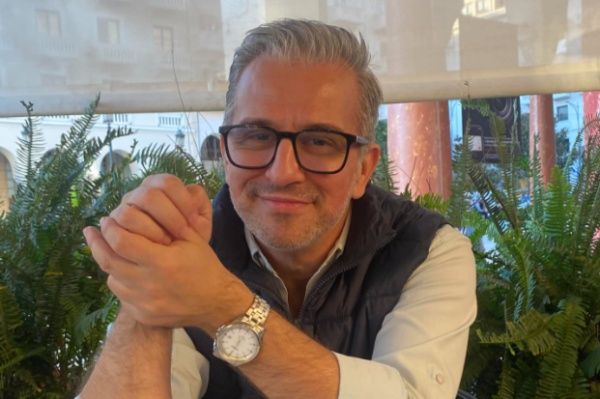
Always listen to the other side - your opinion is neither more important nor more authoritative, let alone the only one!
Introduce yourself in a few sentences..
My name is Ognyan Bekyarov and for more than 20 years my professional realization has been in the field of communications.
What did you dream of becoming in your childhood?
For a long time, even as a child, I didn't know exactly what I wanted to become, unlike many other boys who have a very clear idea of this even at such an age. Boys usually want to become policemen, football players, astronauts - I don't have a very clear memory of the other professions, but I have more than a categorical memory that I didn't want to become a policeman. The others were simply “no,” while policeman was a “categorical no.”
Probably around the age of 18, I already had a much clearer idea of what I wanted to do - I am still engaged in that today.
At
16 years old, with my friends, for about 10 days we sold German and English magazines and
newspapers to tourists at one of the big Black Sea resorts, and due to the huge
difference in those years in the exchange rate of the lev to the British pound/German mark, the profit was
more than mind-blowing for boys who were almost children. I remember that my parents
had to fill out a consent form for me to work as a
minor. I also remember that a British person responded to my invitation to buy with
“The Sun is a rubbish newspaper” - I had no idea why. Now I know why.
Later,
my first paid serious job was part-time as a student in the “Marketing” Department at the Athens office of one of the big global courier companies.
It was paid as for a student, and for a student, this is always a lot.
What are the main factors and examples that shape us as
individuals at an earlier age and form our interests? What
is Yourrecipe for curiosity, sources and wells of information and inspiration at
this stage of our human development?
The example
- not the prompt, not the imperative imposition, but the example is the lasting and effective
factor in nurturing curiosity and forming interests.
The example of reading, the example of showing a child that everything is connected to
everything and everything speaks about everything in a magical sequence that connects
science, art, and everything that defines a person as cultured,
giving him knowledge that allows him the right explanations.
I myself, from the position of a parent, now show my daughter how music is
connected to mathematics, mathematics to visual arts,
visual arts to biology, biology to chemistry, chemistry to physics
and physics to mathematics, to get back to music, harmony, and
closing the meaningful cycle. The meaningful cycle leads us to language and so on,
and so on - discovering connections is an endless process that can explain
the Universe around us, and the explanation always generates the next curiosity.
And
this formula is valid just as much for a child as it is for an adult -
the only one who knows nothing is convinced that he knows everything.
Has there been any significant difference in perceptions Inand in more mature age regarding what motivates you to do or not do something?
Oh,
for sure. The maturation of each of us is also related to the inevitable feeling
that fewer and fewer things excite us, but this is not entirely true and here we need to
make a significant distinction - fewer and fewer things can surprise
the mature person, but that does not mean that fewer and fewer things should
excite him. The enthusiasm from achieving something new is the driving force behind
each one of us, regardless of whether it is about professional realization,
personal activities, or hobbies. Every new step taken excites, but also
shows that after it follows at least one more and isn't that one of the most beautiful
feelings in the thing called life, in which over time surprises become fewer
and fewer!
Whose decision was it where to pursue higher education and
what to study? Was this decision correct,
looking at it from today's perspective?
The decision
about what to follow and what to engage in was entirely mine - my parents
showed not only a sufficiently liberal attitude in this regard but also full
understanding of my choice.
I
don't know if it was right - this always leads to the spiral of doubts “What
would it have been if…?”, and I doubt that this logic is the most correct and
effective. Of course, it would probably have been something different if my choice had
been different, but good or bad, no one could know that.
Therefore, I think my choice was correct - if it had been different, I probably wouldn't even
have had the opportunity to answer these questions.
Share with us more about your interests, knowledge, skills and hobbies?
In
my free time, I enjoy engaging in things quite far from
my professional sphere - that’s why it’s called free time. I love swimming and out of
all physical exercises, this is the one I like the most - I don’t like, for example, to
run, I find it an extremely boring activity.
I am interested in history, music, I collect records. I love literature, but lately, I don’t even buy new books - I inherited a huge library with wonderful editions from my parents, and after so many years, I finally
started reaching for it and I have readings for several years ahead.
Sometimes I just love to do nothing, to sit and drink coffee for 2 hours in the sun
- Aristotle didn’t toil all day with a hoe.
Would you change your profession today and which areas of activity
capture your interest?
Without
hiding behind my finger, I think that no area captures my interest
to such a degree that I regret why I am not engaged in it.
I like what I do.
They say that the personal brand is everything that people say
about You, when you are not in the same room with them.
What would you like to hear today?
I
would like it to be said about me that I am a worthy, honest person and a good parent or at least
I have tried with all my might to be such, but it is more likely that before that in
the room it would be mentioned that I have always been well-dressed, which does not exclude
categorically the first.
Emotional intelligence, adaptability, and flexibility,
as well as our soft skills are key conditions for success in the last
few years. How do you cope with the daily challenges of life to
stay in good shape and mood?
Adaptability,
and emotional intelligence, in fact, have always been the most important factors
- only in the last few years have we all rediscovered how significant
they are. Adaptability allows us to survive in a constantly changing
environment and emotionality, in the form of emotional intelligence, has always been the creative force. All great things in this world are
created from great emotion, not from great reason. No creator creates,
saying to himself “And now, let me create something meaningful!” - no, no! These are hurricanes of
emotions tearing apart the entire being of a creator. Michelangelo cries next to
the marble he shapes, redraws the Creation scene in the Sistine
Chapel 14 times. Beethoven (look at his scores!) writes, scribbles, crosses out, does not
touch food for 3 days, agonizes, pressing his ear to the piano, because he has almost
completely lost his hearing, says “What I write is only the tip of everything
my soul feels.”, crosses out and writes again - these are the works of a person
in very, very great spiritual torment and pain. And it is precisely this
emotionality that has helped the Earth to spin at least a little longer.
Why did we mention emotionality and what is its connection to emotional
intelligence?
Emotionality
has not only aesthetic dimensions, but above all ethical ones, and precisely
ethics is the connection between the two. Education, but education not in the sense of “He
is a good boy and always greets,” but in the context of ethics - clearly defined
ethical criteria that allow our emotional intelligence to
become the necessary mechanism for evaluating events and states. That is,
emotional intelligence is nothing more than our cultivated ability to
correctly distinguish right from wrong, good from bad, significant from insignificant.
Emotional
intelligence is accumulated, built ethical intelligence.
How do I cope with daily challenges in this
sense?
I try
to change the things that could be changed - I try not to pay attention to others.
What are the most important conclusions you have drawn so far for
maintaining proper communication considering the different characters of the people
you meet daily – colleagues,
friends, relatives?
Always listen to
the other side - your opinion is neither more important nor more authoritative,
furthermore, it is not the only one!
The truth
about a person is always his subjective projection of how he decodes
his surrounding environment - the truth between two sides is usually somewhere between
them and is a matter of properly constructed dialogue to reach it, not
stomping with a foot.
What do you think about money? What
is their influence on your life You? What
is your advice to people who often ask themselves questions related to money and
how sufficient they are?
Money
is something wonderful that often costs a lot, and sometimes even everything.
What is the most valuable career advice you would give to
people?
Do
what makes you feel satisfied and allows you to look at yourself
calmly in the mirror while brushing your teeth!