Recognize and accept the world, and do not reshape it to our frames
· Nadia Atanasova
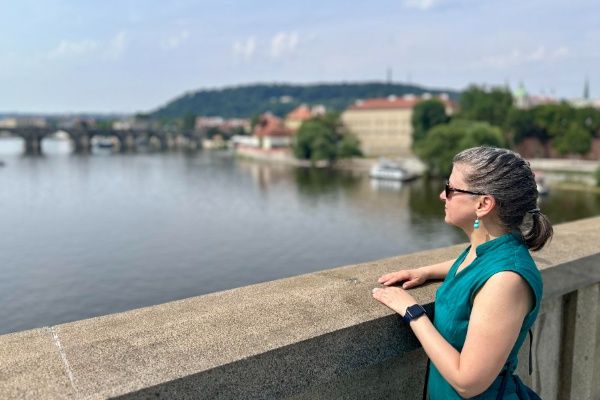
My journey presents a mirror for my own world!
Introduce yourself
in a few words..
My name is Nadia
Atanasova. I have dedicated my life to finding the balance between contributing to
others – family, society, clients, organization, and contributing to my own
development, growth, and satisfaction.
What does
traveling the world mean to you?
My home. Every
time I have what you might call a plane ticket in my hand, I feel like I am
receiving a gift from life. My travels allow me to check my watch on how much I
appreciate everything that happens to me. Traveling, I see and experience so many
people who live in completely different ways regarding activities, routine,
material security, values, choices, preferences, and the environment they have
created and maintain. This presents a mirror for my own world.
How many different
countries have you seen so far? Share an interesting story or highlights from your
travels?
Interestingly, I
know the exact answer and it is 36.
For me,
the visit to Peru 11 years ago was one of the significant travels that unlocked
personal changes in my thinking and choices. It was not the first distant
country I visited, but perhaps it was the moment for it to be the one that would
provoke me to change.
I spent 3
weeks there with my friends and we visited many places. Everywhere, local guides
shared different stories, but they all had one common thread – it is typical for
the local history of Peru to integrate the old with the new. I was very impressed,
because my observation of our world in Europe was about the destruction of the old
by the new with this typical idea of the birth of the new from the ashes. In that
distant world, we saw traces of several civilizations next to each other, not one
on top of the other – the old inscriptions of the Huacas exist alongside those of
the Incas, who built their empire after them.
Perhaps the moment
in my life was such, but for the first time, I clearly heard this approach to life.
Until then, I might have been deaf to it.
Do you like to
repeat destinations? Give examples and motivation “for” or “against”?
There are
destinations I have visited multiple times. I set aside business trips, and if
we focus on tourism, these are countries and cities that I first visited alone
during my youth travels, and later my husband and I chose to include in our
journeys together. These are places that either stand out for me with very nice
memories – Prague, Munich, Bali, or have been on his list of desired
destinations, but I have already visited them before – in this group, we have
upcoming places like Paris, the Scandinavian countries, and Egypt.
What was
your first trip that truly changed you as a professional and can be said to have
changed your thinking?
I don’t think that
exactly travels change my professional side, rather experiences and people do.
Traveling develops my personality.
Geneva, for
example, is my favorite destination, where I have been several times on business
trips and we happily planned a family trip there, which we are about to realize
soon. I look forward to seeing if the city, 10 years after my last visit, is still
as colorful, diverse, and welcoming. It will be interesting for me to look at
myself from the outside and see what path I have walked since those first
visits there until now. Probably then I will understand much better what
Switzerland gave me 10 years ago.
What do
you learn about yourself and your professional skills when you are in a new cultural
environment?
My
professional path for more than 25 years has been entirely in an international
environment and daily communication with colleagues from various countries around
the world is an integral part of it. The most valuable for me was to learn that
making the same request to colleagues from 13 countries simultaneously must be
accompanied by at least 4 or 5 different additional guidelines, country by
country, to receive a complete and timely response from everyone.
Intercultural
differences exist, and respecting and reflecting them in our approach to our
colleagues brings us closer to them. Building a successful network of contacts in a
large international organization, for example, requires us to speak to different
people in their language, and here I do not mean German, French, or Chinese, but
those aspects of communication that constitute the language of human contact.
Have you met
people or ideas during your travels that have influenced your career path?
To a very large
extent, it influenced me and helped me a lot for the future development of my
communication style, for example, an unspoken conflict between one of the
directors of our company in another country and our team. This conflict strongly
marked our first business trip with the colleagues from the host country. It took
me time to realize what led to the tension in that director, because at that
moment there was no visible reason for me.
After each
subsequent conversation, already back in Bulgaria, I analyzed for myself what was
different and how communication was changing. And step by step, I realized that
the problem had arisen from the lack of change management when the project we
were working on had started. The absence of a structured plan on how to prepare
both the colleagues in the host country and us, who were going to work with them,
left many uncertainties regarding expectations. The unmanaged unknown had awakened
fears in both sides that we were not aware of.
After this case,
I set myself the goal of always ensuring transparency to prevent, as far as it is
within my capabilities, the emergence of a conflict that can be avoided.
Do you think
that traveling helps you expand your professional network? How?
During a
specific business trip, for example, I certainly seek to strengthen my contact with
specific colleagues on site beyond the narrow team with which the meeting itself is
planned, but this needs to be worked on every day, not just within the framework of a
short visit.
What skills
do you develop the most when you travel, and how do they reflect on your work?
The ability to
adapt, readiness to accept the unexpected more lightly, interest in the new. My
work currently combines two spheres – in the corporate world, I literally work
every day with people from all corners of the world, which requires flexibility,
and in my coaching practice, the most important skill is to be humanly open to
the client. Both are nourished by contact with the new and culturally diverse,
and this is exactly what I encounter during my travels.
Is there a city
or country that has inspired you to start a new business or project?
During travels,
interesting new languages can become appealing to me, and this is how I started
learning Italian, but I do not consider it a business endeavor.
When you are in
a foreign country, do you feel more motivated or more distracted? Why?
In a foreign
country, I feel more attentive until I orient myself or learn what is inherent to
the environment and adapt my behavior as much as possible to it. I believe that
from this approach, we all benefit – I, because I can absorb more from the local if I
understand it better, and the environment, because my behavior would not be like an
elephant in a china shop in it.
Are there
destinations that act as a “restart” for your creativity and ambition?
Yes, Iceland and
Norway have affected me this way. For this reason, the other Scandinavian
countries are on our list for family travels in the coming years.
The nature in
these countries with vast spaces, high cliffs in the fjords, huge waterfalls,
the deep blue of the sky on sunny days struck me and provoked me to feel as if I
am unfolding. This motivates me to engage with new goals or realize those that have
long been on my dream list.
How do
you manage the balance between work and pleasure when you travel?
During personal
trips, I do not work. During business trips, I always take long walks in the cities
I visit in the evening or on weekends.
How have
travels changed the way you perceive the value of money?
Money allows me
to realize my travels, and in this sense, if I want to travel more, I need to take
care of the financial provision of this opportunity.
Do you travel
with the aim of finding new ways to earn money?
If any trip
has inspired me for some direction in my professional development, it has not been
conscious.
What lessons on
financial independence have you learned from different economies and cultures?
I learned the
lessons of financial independence from my parents. They guided me from an early age
towards learning languages, so I could access the world and choose my path in life
with open eyes and heart.
Do you think
it is better to spend on experiences rather than material possessions?
Regarding
things, I consider myself a minimalist. It is important for me to possess in a
material sense what corresponds to my understanding of “quality,” so that it serves
me for a long time and brings me pleasure. I do not value a large number of things,
but their aesthetics and functionality.
However,
when it comes to experiences, I have no limit on the number of travels, new
countries, visits to the cinema or concerts, for example, that I consider “sufficient.”
I am not saying that I prefer experiences; I am saying that I do not feel saturated
with them.
How do you see
the future of digital nomadic life?
As long as there
are people who feel satisfied with this option, it will continue to exist.
Are there
specific countries that are more favorable for work and investments?
Every comparison
needs a measure, and in this sense, how favorable a place is depends on the
personal measure of the one answering the question. Before one country is compared
to another, it matters whether the person answering the question is inclined to
change the country in which they live and work. If not, as I am not, that person is
interested in how to have the most suitable job in their current country.
If you could
choose one place in the world to develop your next big idea, what would it be and why?
The modern world
in some processes and activities is free from the limitations of borders. My
coaching clients, for example, are from different countries. I work remotely, so
there is no need to look for a new place because the place is everywhere.
What are the
destinations you would definitely recommend to be visited and why?
From what has
been said, it is already clear that Peru and the Scandinavian countries are for me
examples of highly recommended destinations. In addition, there are several places
that I would like to visit when the political climate allows me to do so, and the
reason is related to their nature and history. These are the Antelope Canyon in the
USA, Lake Baikal in winter in Russia, and the valley of the Nile River along its
entire length in Egypt.
What is the
career advice you would give based on what you have seen around the world?
My still
emerging professional path, for example, I would advise to accept an offer that was
made to me years ago to lead the financial department of the organization in
Bahrain for a certain period of time. This would have given me a perspective that I
later acquired, and it would certainly have stimulated me to appreciate the world and
the opportunities for development much earlier in my life. My advice is to communicate
with the world a lot and often, and to do so with the desire for the world to be
recognized and accepted, not reshaped to our frames.