The ability to communicate with people is a "superpower"
· Gergana Stoichkova
Understand what kind of life you want to lead and choose the right career accordingly!
Introduce yourself in a few sentences..
I am Gergana and I help startups understand what investors expect from them and how to successfully prepare for funding from venture capital funds (VC).
I spent 5 years at one of the leading funds in the region – Eleven, where I met some of the most inspiring entrepreneurs in Southeast Europe. Before that, I was part of the team at Paynetics, where one of my roles was related to seeking funding for the companies in the group. Other roles I have held over the years include Director of the Bulgarian Fintech Association, Program Manager of Visa
Innovation Program, co-founder of 180
Degrees Consulting Sofia, as well as numerous mentoring positions in various programs (Teenovator, Founders Institute, Dea etc.)
What did you dream of becoming in your childhood?
When I was very little, I don't remember, I think I wanted to be a ballerina. And for a very short time, I was (completely unprofessionally). In my school years, I wanted to engage in PR and event planning. In the end, I graduated in finance, but at times I still return to PR and events.
At what age did you earn your first money? Tell us an interesting story?
At 16 or 17. I was punished and my parents didn't let me go to the sea. So I had to find a way to earn money for the trip on my own. And I became a promoter of lyutenitsa.
What are the main factors and examples that shape us as individuals at an early age and form our interests? What is your recipe for curiosity, sources of information, and inspiration at this stage of our human development?
First of all – the examples around us, the people we admire and emulate. These can be our parents, but they can also be teachers, coaches, mentors. And nowadays – online personalities we respect. In early age, the environment plays a big role: who do my friends like? What music do they listen to? What books do they read, etc. That's why I believe that the environment in early years (not just the home environment) is extremely defining. For example, in 7th grade, out of 4 best friends, 3 of us entered the same school. As for advice, we should focus our attention on good examples. On people we can relate to, but who are ahead of us and can serve as a direction. This applies to every age, not just childhood.
Has there been any significant change in your perceptions in more mature age regarding what motivates you to do or not do something?
I have always been motivated by personal goals that I set for myself. These goals, of course, differ quite a lot today compared to what they were, when I was 16. Back then, the last thing I thought about was career development. But I was fighting for status in our small high school community. Today, I am motivated by the opportunity to build my future and success on my own.
Whose decision was it where to pursue higher education and what to study? Was this decision correct, looking at it from today's perspective?
The decision was entirely mine, but of course, it was influenced by the environment and my parents (even subconsciously). I graduated from 91st NEG in Sofia. Almost all of my classmates went abroad to study, most of them to Germany. For me, it wasn't a question of whether, but where exactly. I chose Munich, again somewhat influenced by my friends' choices. My time there is not among my favorites, whether it was the right decision – I can't say. Would I repeat it today? – No, I would have different criteria. I have much more positive impressions from my master's in Italy, which I chose based on completely different and more objective criteria.
Share more about your interests, knowledge, skills, and hobbies?
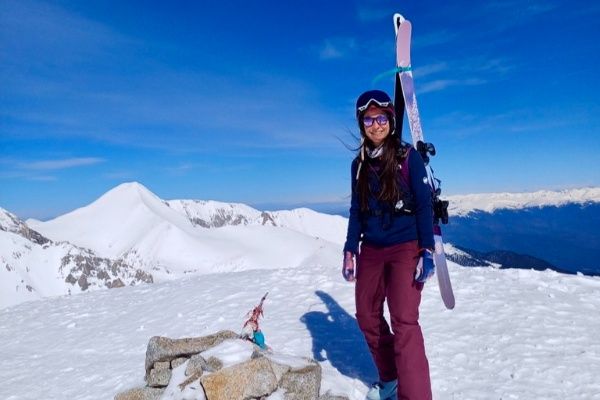
I could spend way too much time on this question if I let myself. :D I have always been very sporty. I am an avid freeride skier (one of those who climb peaks with skis on their backs) and I have been skiing since I was 2 years old, literally. I love playing tennis, but I have never played professionally. In recent years, I practice a lot of yoga and pilates. And my family and I regularly go hiking in the mountains (my child was 32 days old when we took her to Vitosha for the first time. It was February). Oh, and we travel a lot – most recently we were in Sri Lanka with our daughter before she turned 2. Beyond sports and travel, I love to read, averaging 30-40 books a year on various topics, both professional and not. Overall, I consider myself a very curious person. I find a topic and I want to dive deep into it. One such topic, for example, is longevity – I have read dozens of books and listened to hundreds of podcast episodes related to it. My greatest skill is to communicate with people and to “connect” with them. I think that is my secret “superpower”.
Would you change your profession today and which fields of activity capture your interest?
I just did it recently. But my career has always been so diverse that it's hard to feel it as a change. The big difference is that for the first time I started working entirely for myself. The field in which I have the most experience and interest is related to investing in startups. My role is to be the link between companies and funds, helping the former understand the process.
They say that personal branding is everything that people say about you when you are not in the same room with them. What would you like to hear today?
I would like to be said that I can be relied upon, that I keep my word and that I can be trusted. Also, that I deliver more value than I promise, that I am positive and easy to work with. I am happy when people connect with me because they have heard from someone that I helped them.
Emotional intelligence, adaptability, and flexibility, as well as our soft skills, are key conditions for success in recent years. How do you cope with the daily challenges of life to stay in good shape and mood?
With hobbies, quality time with my family and friends, with more focus on the things that make me happy. Professionally, this is communicating with inspiring people, as well as working on projects I believe in.
What are the most important conclusions you have drawn so far about maintaining the right communication considering the different characters of the people you meet daily – colleagues, friends, close ones?
I always try to put myself in the shoes of the person I am communicating with. Over the years, I become more skilled at this, but it is harder when I am exhausted myself. Still, I try to be empathetic and read emotions, but I don't always succeed.
What do you think about money? What is their influence on your life? What is your advice to people who often ask themselves questions related to money and how sufficient they are?
You can't do without money. But for me, they are a means, not a goal. I have never been fixated on having a lot of money, that's how I was raised. When my brother and I were very little, my parents were left with literally 200 BGN in total at one point. And they went skiing with it. So that's roughly how I was raised. We live in different times, but money for me remains just a means that allows me to lead a happy, comfortable, and diverse life (according to my definition). I hope at some point, when I can afford it, money will also be a means to support various initiatives and projects I believe in. I am happy that I already do this, but for now mainly with time, not with money.
What is the most valuable career advice you would give to people?
Understand what kind of life you want to lead and choose the right career accordingly.