The journey has no curriculum and exam, but every day is a lesson
· Reni Mitkova
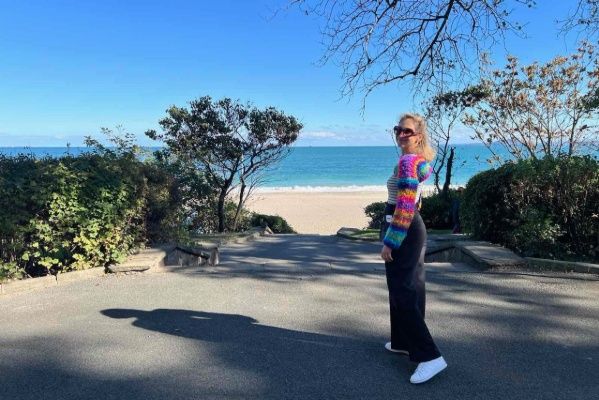
Our most valuable resource is not money, but the freedom to choose how and where to live!
Introduce yourself in a few words..
My name is Reni Mitkova and I have been in the world of finance for over 20 years. I manage “EOS Matrix” – a leading company for debt collection and management, part of the German EOS Group. But if I have to introduce myself in a few words, I would say this: I am a woman who believes in the power of choice. The choice to be a conscious leader, but also a caring mother. To run a company, but not miss the first day of school. To build a future, but also to stop and enjoy the sunset from a new city.
I have a 24-year marriage, three children, and one eternally restless heart that loves to travel. I believe that experiences change us much more than things – that’s why traveling is my priority, my “escape to myself” and the best education I can give my children.
I created the column “With Reni on the Road” on Instagram to share not only beautiful views but also the practical side of things – how much it costs, how to plan wisely, what is worth it. I love to combine emotion with reality – because in life and in travel, the meaning is in the balance.
What does traveling the world mean to you?
Discovery. Recharging.
Time with loved ones and returning to oneself.
If I have to choose where to invest my money – traveling is always first. For me, it’s not an expense, but an investment in experiences that build values, memories, and identity – especially when we travel with the children.
How many different countries have you seen so far? Share an interesting story or highlights from your travels?
I don’t count them. The truth is that when we applied with the children for American visas last year,
we listed over 10 destinations just for the last 5 years – and we ran out of space on the form.
We travel a lot – with my husband, but also as a family. Because I believe that traveling is the best education for children. The most memorable trip? During the winter of 2022, when our eldest daughter was choosing a university and we toured England and Italy. In Rome, on Sunday morning, we stumbled upon the service of Pope Francis. We didn’t understand his words, but we understood that we arrived just as the service was ending with blessings. It was as if
life hinted to her: “This is your place.” And so it happened – she chose Italy.
And our first morning in Costa Rica... We woke up to something that sounded like the roar of an angry lion, right in front of the door of
our bungalow. My heart was about to leap out of my chest.
It turned out to be a troop of monkeys that were following their plan to greet the sun and wake up the jungle.
Do you like to
repeat destinations? Give examples and motivation “for” or “against”?
Yes, there are definitely destinations
that I return to again and again – like a favorite song that never gets old. London, Thessaloniki, Costa Rica… all places that give me something new every time I visit. Sometimes – peace, sometimes – inspiration, and sometimes
just a nice coffee with a view.
We plan our family trips with care and attention – we look for something for everyone: culture, delicious food,
entertainment. To laugh, to learn, and to create memories together.
When we travel only with my husband,
we are more spontaneous. Sometimes we are driven by the need for something new, other times –
the desire just to escape for a weekend and recharge. There are destinations
that you feel you have “fully experienced,” but there are also those that call you back again
– and you still want more.
What was
your first trip that truly changed you as a professional and can be said to have changed your thinking?
The first trip that truly
“shook” me professionally was to Germany – back in those years when we needed a visa, an invitation, and a bit of luck for every trip. I was invited on a business visit and thought I would see a few offices and come back with photos
and business cards. Instead, I returned with a new understanding of order.
It was a shock for someone who grew up in
Bulgaria. The streets – impeccably organized, the people – punctual to the second, and that
feeling that everything moves by an invisible mechanism that works smoothly because
everyone does their job responsibly. After 8 PM – the cities seem to fall asleep.
So orderly that you almost miss the liveliness.
Then I said to myself: if we can take the German structure but keep the Bulgarian soul – we will have
a great model. And to this day, in our company, I believe we manage to achieve
exactly that: to be organized but humane. To work efficiently without losing
the energy and joy of what we do.
What do you
learn about yourself and your professional skills when you are in a new cultural
environment?
Every trip is a slight test
– not for the suitcase, but for your own flexibility. You realize how valuable
communication and adaptation skills are, especially when “yes” doesn’t exactly mean “yes,” and “we’ll see” can mean anything – from “never” to “text me on Monday.”
Over time, I learned not just to
listen, but to feel the nuances – in language, in behavior, even in silence. In a new
cultural environment, you realize that your way is not the only one, nor necessarily
the best. This made me more tolerant – both towards people and situations.
Sometimes I wonder how it is possible
for us to be so different and yet – to understand each other. Travels teach me to
appreciate this very diversity – in life and in work. And they remind me that
true professional maturity is not in convincing others that you are right,
but in hearing them, even when they think in a completely different way.
Have you met people or ideas during your travels that
have influenced your career path?
Sometimes you travel for a few days,
and return with a decision for your entire life.
That’s exactly what happened to me. On
a business trip to Cyprus, I met a person with whom we subsequently created
the company I manage to this day. A few years later, he came to
Bulgaria to start a new call center, and invited me to help. I said to myself: “I’ll
try, what the heck…“
I was in this business “for a little while.”
That little turned into 23 years. And the joke – one of the most meaningful things I’ve ever
engaged in.
This journey taught me that you don’t
always have to have a plan. Sometimes life has a plan for you – as long as you are
ready to say “yes” to the unexpected.
Are there destinations that act as a “restart” for
your creativity and ambition?
Hemingway said: “Everything
that is far from the sea is province.” I fully support this philosophy.
The sea is my personal restart. It
calms me, recharges me, and inspires me in a way that nothing else can.
I love being by the sea or ocean, especially off-season – when the shore is
empty, the wind is honest, and my thoughts finally align.
If there is a place that recharges me the most, it is Burgas. The city that as a teenager I couldn’t wait to leave, and today I can’t wait to return to. It is calm,
unpretentious, and close to my roots. There, I don’t just rest – I remind myself
who I am.
How do you manage the balance between work and pleasure
when you travel?
At the beginning of my career,
business trips were of the type "airport–office–airport". I saw the cities through
the taxi window, without feeling their spirit. I remember once passing by a small
Parisian café, nestled between two streets – tables outside, people with
baguettes under their arms, the aroma of coffee... And I said to myself: "This
cannot be all of Paris."
There was adrenaline, yes. But it lacked
experience. Over time, I realized that without emotion and memory, a trip is just
logistics.
Now, even with busy
schedules, I always leave myself a "window" – time to immerse myself at least for a
little while in the place where I am. To feel its pulse. The balance between work and
pleasure is not extravagance – it is a necessity. And I believe that a good
professional is fueled not only by results but also by the experiences in between.
How have travels changed the way you perceive the
value of money?
Travel has changed my
perception of money more than any financial course.
I grew up at a time when
traveling was a privilege – something for the "chosen ones". I remember how we waited
days in front of the German or French embassy for visas. Airplane? An unattainable
luxury. We traveled by buses, by cars, with many dreams and little luggage. That’s
why today, when I can book a flight at the last minute and in the morning drink coffee
in London
or in some small town in Italy, I do not take it for granted – this is
wealth.
For me, money is a tool for
living with more choices. It does not buy happiness, but it can buy time with the
people you love. And experiences that change you. That’s why, in our family budget,
travel is always first, after basic needs.
Yes, it’s nice to drive a nice
car or to have quality clothes. But things break, get lost, age.
Experiences – they remain. And it is precisely these that motivate me to earn more –
so we can travel more, live more
Do you travel to find new ways to earn money?
Definitely yes – although not
always intentionally.
There have been trips whose goal
was literally "to start a business". That’s how the partnership was born, with which
we created the company I manage to this day. From one meeting, one coffee, and
a shared vision – something started that has been part of my life for over two
decades.
But even when I travel just for
pleasure, I almost always come back with ideas. It could be something I saw
in a small bookstore, a new service model, a way of thinking that makes me say: "Aha! We can bring this here too."
Opportunities are literally
everywhere. As long as you set out not just to "sightsee", but to observe.
What lessons about financial independence have you learned
from different economies and cultures?
One of my strongest
realizations about the value of money came not from a table of numbers, but from a dusty
road in Zanzibar.
We traveled with the children from the airport
to the hotel. Outside – houses without roofs, children walking kilometers to school.
My little daughter, then 7, asked me in confusion, "Mom, how do these children live in an
unfinished house?" It was a question that hit me harder than any
statistic. At that moment, I realized that sometimes the best lesson in financial
literacy comes not from a book, but from real life.
Traveling, I see economies where
people live on minimal means but have amazing creativity. Or those where wealth is
normal, but the connection with effort is lost. This has taught me to appreciate
moderation, flexibility, and the ability to adapt.
Financial independence is not a sum; it is a state of mind – to have the freedom
to make choices that reflect your values, not the need to survive.
My husband and I dream that when our
third child embarks on their path, we will live as "global citizens" – to
travel and work from different points in the world. Financial independence for us
does not mean never working again. On the contrary – it means being able to
work what we love, when and how we choose. To spend more time
learning, reading, and having quality conversations with people who inspire us. To
have choices – not bills to pay.
How do you see the future of digital nomadic life?
Digital nomadic life sounds
like a dream come true – laptop, Wi-Fi, and a view of the sea. And yes, we have friends
who practice it and make it look irresistibly easy. But there is one peculiarity: none of
them have children.
The truth is that this way of
life is wonderful for people with flexible professions and a more free life structure. I
have chosen a different path – to be a parent of three children and a manager of a
company with a large team. And for now, I cannot imagine myself as a full-fledged
digital nomad – simply because I have another kind of responsibilities and commitments.
But that doesn’t mean I don’t dream.
Financial independence, as my husband and I understand it, is not to stop working,
but to work when and how you want. Recently, we spoke with our mentor and
friend – Richard Harrington, a serial investor, philanthropist, and visionary, recognized by
Forbes. Originally from South Africa, Richard comes from a humble family and achieved
financial freedom at just 24 years old. But instead of stopping, he decided to share
his experience and help over 1 billion people around the world achieve the same. Today,
he travels the world, gives lectures, organizes training, and builds a community of people
who want to take control of their money and live with purpose.
When we talked with him and
his wife here in Bulgaria, the topic of freedom and digital nomadic life
was very natural. Both Bobby and I laughed when we realized that whatever we
plan – for now, we have another 9 years of "home presence" until our youngestchild, son becomes independent.
Until then – we will imagine, plan, and work for that future. And when the time comes – we will gladly try what it’s like to drink coffee on a Monday morning from a different
point in the world, without having to take a vacation.
Are there specific countries that are more favorable for
work and investments?
At different stages of life, I have
heard how each subsequent country was "the best for business" – for some, it is America,
the land of unlimited opportunities. For others – some tax haven with favorable
regulations. And for others – Bulgaria, with relatively low tax rates and a well-developed
startup ecosystem.
The truth is, there is no universal
rule. Israel, for example, is an excellent example of a country that actively supports
innovation and the development of new businesses. But what is an opportunity for one
entrepreneur may be an obstacle for another – if they do not feel "in their element".
For me, the most important factor is not
where the lowest taxes are, but where you can unfold yourself. A country where
you have access to a community, growth opportunities, and a culture that resonates with
your values. So it’s more a matter of personal choice than some universal recipe.
If you could choose one place in the world to
develop your next big idea, where would it be and why?
The place must have only two
things: a view of the sea and stable internet. Everything else is a bonus.
For me, the sea is not just a backdrop, but a
creative catalyst – it expands thinking, calms the noise in the head, and leaves
room for ideas. And good internet – it is the bridge that connects inspiration with
action. From there on – the world is open. Great ideas do not come from concrete and
neon, but from space – both internal and external.
What are the destinations you would definitely
recommend to visit and why?
It depends on what you are looking for. If you want
history – Rome. If you need inspiration – London. If you seek peace – southern
Portugal. If you crave nature – Costa Rica. And if you want to remind yourself
how much you have – Zanzibar.
But the most important destination is
the one that makes you come back different. Not the same as you were on
the way there. Such places are worth it – whether they are far away or three hours by
car.
What is the
career advice you would give based on what you have seen around the world?
Traveling is the best
education – there is no curriculum, no exam, but every day is a lesson. It teaches you to
be flexible, to observe, to listen. To see opportunities where
others see only boundaries. A career is not built only in the office – it happens
at an airport in a foreign city, and in a conversation with someone who thinks
radically differently from you. The broader your horizon, the bolder your
dreams become.
For me, traveling is not a luxury – it
is a choice. It is a way to expand your consciousness, to create connections and to
return to yourself. And if I can give one piece of advice, it is: step out of your bubble.
Not because it is more beautiful there, but because there you will discover the more authentic version
of yourself.
Whether I am on the shore with
a laptop in hand or walking around Burgas, traveling always reminds me of something
simple, yet profound:
our most valuable resource is not money, but the freedom to choose how and where to
live.