We connect with the strengths and weaknesses of the people around us
· Vanya Kăndova
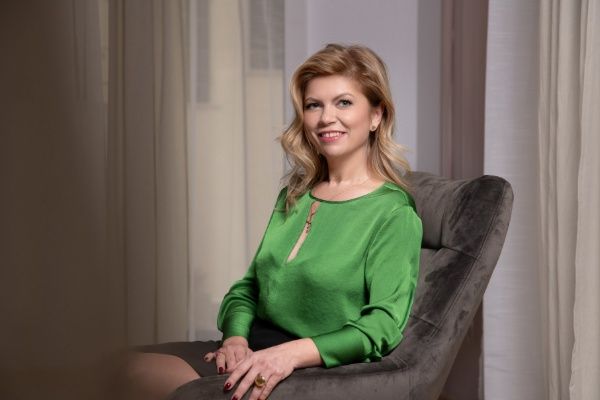
Whatever they tell you – trust your heart. Willpower and discipline will take you as far as the response of your heart is strong, and it doesn't matter how old you are!
Introduce yourself
in a few sentences..
I am Vanya Kăndova and I am a happy person. All the roles I take on have their manifestations and descriptions and are connected to my personal need – to help and give of myself with the ultimate goal: to be part of the change in the society we live in.
The roles I take on are quite different – coach; mentor; HR; owner of Dynamic Talent Management, a company for outsourcing services related to the management and development of human resources; conductor of a church choir; wife, mother...
What did you dream of becoming in your childhood?
Oh, in my childhood I dreamed of becoming a concert pianist, it was a long time ago... the last time I played was while I was pregnant with my sons (almost thirty years ago). For a long time, I searched for myself, not so much because I didn't know what I wanted to do, but rather because as an extremely curious and inquisitive person, I wanted to be able to do many different things.
At what age did you earn your first money? Can you share an interesting story?
You surprised me with this question 😊. It was around my nineteenth birthday. I wasn't accepted into university the first year after I graduated high school and I decided that university wasn't for me. However, I didn't have a profession, so I enrolled in amateur and later professional cosmetic courses. Naturally, I couldn't find a job because all the ads in this field required experience, which I didn't have. In the end, I started working in a small bakery producing bread... and that was when I earned my first salary. I worked there for more than half a year and very quickly decided to stop being “angry” at Sofia University, where I later studied Theology, Philosophy, and Educational Management.
What are the main factors and examples that shape us as individuals at an early age and form our interests?
Looking back from my almost fifty-two years today, I realize (which is confirmed by science, of course) that the factors and examples that shape us as individuals are those that were either in contradiction to our upbringing or those that provoked us to seriously step out of our comfort zone and reach the appropriate level of awareness for our age. Since childhood, justice and honesty have been extremely important to me, and for this reason, to this day, I carry a strong protective syndrome within me. Years later, I parted ways with the illusion of an equal start, for example, but as a sixth-grade student in the distant 1986, an interesting story left a very vivid imprint on my later development. During a Bulgarian language class, our “comrade” was sick and was replaced by another teacher. I am sure readers remember the concept of “best friend,” well, mine was the daughter of two doctors, her mother worked at the local polyclinic, and her father in a Sofia hospital, while my parents were “ordinary.” So the two of us not only sat at the same desk, but we also drew the same sentence for syntactic analysis. You can guess that we did the analysis together. Our grades, however, were different. She had a 6=, and I had a 4+. At that time, I promised myself that whatever it cost me, I would become “something” to make it easier for my children. Years later, when I became the deputy director at the same school where the story I told happened, and where their sons were studying at the time, it was far from easier for them, but that is another story. So, in my opinion, such incidents inspire and motivate us for development.
What is your recipe for curiosity, sources, and wells of information and inspiration at this stage of our human development?
I read a lot – both then and now. I have always wanted to know more. My hunger for knowledge has provoked me and continues to keep me “awake” to this day. Although seven or eight years ago, I paid the price for that knowledge by experiencing the sadness mentioned in Ecclesiastes 1:18 – “for in much wisdom is much grief, and he who increases knowledge increases sorrow. But it seems that in my childhood, we didn't have much to do except read, or at least those of us who wanted a different life from the one defined by the status quo. With the transition into a more conscious age between my twenties and thirties, driven by my curiosity, I began to experiment a lot. What do I mean? I learn something new and immediately start applying it to see if and how it will work for me. And to this day, it is so.
Has there been any significant difference in your perceptions in a more mature age regarding what motivates you to do or not do something?
This hunger for knowledge continues to motivate me to this day, additionally stimulated by the practically achieved results. The significant difference is that I now have a very serious foundation, thanks to which I developed very strong combinatorial thinking. This, in turn, is the reason the services I offer are innovative, which in itself is a double-edged sword because people are not quite ready/mature for the things I do. But as you know, there is no former teacher, and as a person who has dedicated fifteen years to secondary education, I continue to teach, only now to my audience. Overall, I am a person who is oriented both towards people and towards results, and actually achieving the balance between the two is the key to a meaningful life for me.
Whose decision was it where to pursue higher education and what to study? Was that decision correct, looking at it from today’s perspective?
I wanted to study theology, shortly after I gave up the conservatory, but then my father managed to influence me... After studying chemistry for five years, with two interruptions and already married, I decided to return to my original plan and enroll in theology. My other specialties always followed practice, so it happened with Human Resource Management and Development – a wonderful master's program at New Bulgarian University. Basically, my path has always been – real education, provoked by interest and practice, followed by schooling in the respective academic institution. In “Weapons of Mass Distraction” by John Gatto, you can understand the difference between education and “schooling.” My faith and my service as a conductor during festive liturgies are my greatest “charger.” Sometimes, when the theologian and philosopher in me come into conflict, I face other challenges that require the appropriate reactions, but that is another topic for another conversation 😊.
Share more about your interests, knowledge, skills, and hobbies?
My interests are in many areas – psychology, philosophy, business, lately marketing, provoked by the desire to create the most effective strategy for promoting my brand... I love good movies and transformative authors, even though everything new is well-forgotten old – like Marcus Aurelius, Seneca, Sun Tzu, to date Maslow, Carl Rogers, Viktor Frankl, Nassim Taleb, Jonah Berger. When I have the opportunity to “catch” my muse, I write poetry and prose. Years ago, I used to embroider tapestries, then for a certain period of time, I painted, provoked by “Killing Commendatore” by Haruki Murakami, our favorite family author. I love to sing and dance, especially folk songs and dances. I enjoy the moments when I cook, although lately they have become rarer, I love being in the kitchen. I want to have more time for walks in nature outside Sofia.
Would you change your profession today and which areas of activity capture your interest?
I would not change a single episode of my colorful life. In fact, it is precisely the obstacles and challenges that helped me become the person I am today. As a coach, mentor, HR, conductor, and donor – everything I do is related to the well-being of people, including myself.
They say that personal branding is everything that people say about you when you are not in the same room with them. What would you like to hear today?
I hear it often – that I have changed their lives, which is not entirely true, because they have actually changed themselves, to the extent that they could... I have only been a catalyst or provocateur for those changes.
Emotional intelligence, adaptability, and flexibility, as well as our soft skills, are key conditions for success in recent years. How do you cope with the daily challenges of life to stay in good shape and mood?
Awareness. One little word that stands behind more than thirty years of constant work – in exploring myself. Flexibility and adaptability are two of the three TOP qualities I seek in all the people I work with. My third is speed. The very definition of “challenges” implies coping and also directs us towards taking action and making decisions. A working practice for me is focusing on the resource instead of the deficit/what I don’t have or what doesn’t work for me – not at all, but as quickly as I want. For more than twenty years, every morning I smile when I look in the mirror, sometimes when I have some issues, auto-suggestive phrases like: “You are a machine, you can do it!” help me. I try to deliberately slow down the pace and enjoy every single moment and live it consciously and mindfully. I don’t always succeed, but I continue to work on it. As for my mood, it’s easy – I am naturally joyful and happy. Still, since I am a human being, what works best for me is to enjoy listening to a special playlist curated by my husband in the morning while driving to the office or to clients and smile at the new day.
What are the most important conclusions you have made so far about maintaining proper communication considering the different characters of the people you meet daily – colleagues, friends, close ones?
Here I will recount a quote from Nassim Taleb, part of the prologue to his book “Skin in the Game.” He says the following: when your hair (and beard) is black, pay more attention to analysis than to conclusions; when your hair (and beard) is gray, pay equal attention to both analysis and conclusions; when your hair (and beard) is white – don’t waste time on analysis, go directly to the conclusion.
In fact, we often make conclusions for which we have no grounds. This is usually due to prejudices, upbringing, different levels of awareness and intellect, and other reasons... In fact, this is the real “killer” not only of effective communication but also of our relationships with people.
Leading for me is the knowledge of ourselves, the acceptance of our “strengths and weaknesses” as they are, and our own desire for development and improvement. Accordingly, the path by which we can connect with others, according to their “strengths and weaknesses,” and most importantly finding that touchpoint from which we can start/continue our interaction.
What do you think about money? What is their influence on your life? What is your advice to people who often ask themselves questions related to money and how sufficient they are?
For me and my family, money has never been a goal, just a means. They will never be enough because “the eye is never satisfied,” so simply put, it is good to know how to manage them so that they do not manage/control us. Everything else is a matter of goals and priorities, simply because “a person knows both two and two hundred.”
What is the most valuable career advice you would give to people?
Whatever they tell you – trust your heart. Willpower and discipline will take you as far as the response of your heart is strong, and it doesn't matter how old you are.
Thank you for the wonderful questions!
#Vanya_Kăndova #Your_Voice_Has_Power #Personal_Style_In_The_Environment