You need to understand "who holds your money" and attract them
· Katerina Vŭrbanchovska
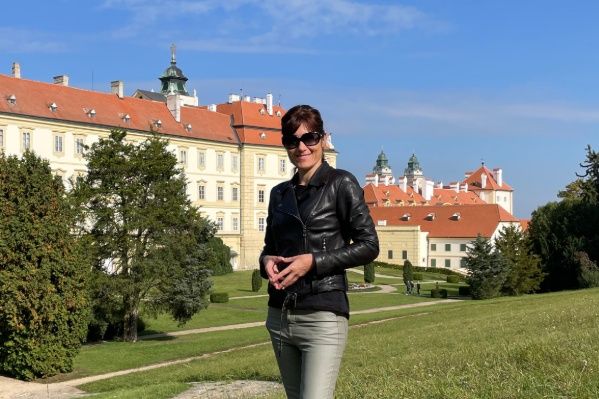
To adapt to a new place, a person must first be open to new norms, cultural differences, and a desire to make acquaintances!
Introduce yourself
with a few sentences. What does your work as daily
commitments consist of?
Hello to
the readers of the column "Bulgarians Abroad"! My name is Katerina Varbanchovska and
I am the founder and manager of Grant Cardone CEE in Bulgaria, as well as LearnOcto in the Czech Republic. The two companies are the main
representatives of Grant Cardone for countries in Central and Eastern Europe and are
focused on commercial training based on the Cardone University. The second
line of business is publishing books, including the Grant
Cardone series and many titles that help readers develop their
sales and business, for self-improvement, motivation, as well as partially and
other genres.
In which country
and city do you currently live and how did you end up there?
I currently live
with my husband in Pune, India, from where I continue to work on the projects I am
engaged in in Europe. Fortunately, this is something that the development of the
online environment and the adaptation of business to the new realities of communication
allows. We were brought to India by Skoda – the company where my husband works,
in connection with the development of new projects in the Indian market. For me, this is my second
relocation as an expat abroad. The first was while I was working at Nestlé,
when I took the position of business manager for the Czech Republic and Slovakia for the
child nutrition department. This 3-year project actually turned into a 13-year phase of
my life in this Central European country.
What were the
biggest challenges you faced at the beginning of your stay in
Czech Republic?
Personally, for me,
the challenges were mainly from the team I was working with. Coming
from Bulgaria to a somewhat more developed country, I definitely did not expect the problems I faced at the workplace. Being part of various great
cohesive teams in Bulgaria, working with proactive people who can take
responsibility and strive for the best results, ready to develop and
improve, seeing a completely different environment in the Czech Republic was a bit of a shock for me. The culture
in the team was marred by interpersonal problems, the attitude "you are the boss,
you decide, this is not my job" prevailed, and there was a division between the Slovak and Czech
teams. I believe that these things are quite regressive for a "supposedly more developed business".
On a more personal
note, I had to accept that here I would not find the emotionality in
relationships that you can build in Bulgaria with colleagues. And this comes
from two directions: for most people, making friendships at work is not
important here; and for those who do, it is difficult for a foreigner to be let in close or
it takes much more time. We are far more open to foreigners, new people,
and new colleagues.
How did you
overcome the language barrier (if there was one)?
In international
companies like Nestlé, the language barrier is rarely discussed, at least not at the work
level, since English is often the main language of communication, adopted due to
the presence of expats in almost every country, as well as the common regional or
international clusters in which businesses and markets are united. And although not for
every position English is necessary, Czech and Slovak are quite
close to Bulgarian and with a little initial training, one can easily
start to understand at a basic level. With this mindset, I often let meetings in our team
be conducted in Czech/Slovak, so that my colleagues could express themselves and
understand more easily for themselves. If I needed clarification, I preferred
someone to translate for me.
Outside of work,
I can say that in the few cases at the beginning when we had to
communicate in a hospital or police, English was always sufficient.
At a later stage,
when I founded my own company and the circle of contacts and institutions I
had to communicate with expanded, Czech was already needed in many more places. But
by that time, I had already progressed with the language.
What resources or networks (local communities, colleagues,
organizations) helped you adapt?
To adapt
in a new place, one must first be open to new orders, cultural
differences, and a desire to meet new people. In my case, my colleagues were those I
initially relied on for my adaptation in the Czech Republic. But since I moved
from Bulgaria with my two children, it turned out that their school played
a key role in my family's social integration. I can only
commend the approach of this institution, which was extremely different from
other educational establishments my children have attended. The school had a very
well-developed process for integrating new students into public
life, for their socialization in the new environment, as well as for their parents. From
a whole range of extracurricular activities for students, to international cuisine days (this
automatically brought together people from the same countries); from football tournaments for
teachers and fathers, to regular breakfast meetings for mothers. And it was here that we found
people who became part of our closest network of friends and are still so today, and interestingly – all of them are Bulgarians.
What are the
main differences between the work culture in the Czech Republic and that in Bulgaria?
Let me start with
the working hours 😊 If in Bulgaria someone starts work at 8:00
in the morning, we often think that this is quite early. In the center of Sofia, the streets at
8:30 are still empty. In the Czech Republic, it is quite normal to be in the office from 7:00-7:30
in the morning. At 6:30, sometimes there is no place to sit in the metro. In return, at
16:30 you can already be with your family – on bikes, in the yard, in the park.
And in this regard,
the Czechs are much stricter about the balance between work and personal life. This is
reflected in productivity during working hours, during which they strive
to focus as much as possible on tasks and projects, rather than on
"developing social connections".
Another thing that may
impress you in professional life here is the expression and way of communication,
which are much more direct than what we are used to in Bulgaria. At first, I often attributed it to the fact that English was used in communication with me and from there I explained the
more dry, bordering on rudeness tone in emails, for example. But later I realized that
although the foreign language plays some role, at the core it is simply the direct
expression here. And this includes the way feedback is shared.
What workplace values and practices impressed you the most?
In the Czech business
environment (at least from a more eastern and southern perspective), there is definitely a higher
level of trust in business. And here I am talking about relationships between business partners and
adherence to contractual relationships. Anywhere you can be deceived, delayed, and
so on. But here overall, I believe that entrepreneurs are more responsible in this
regard. I have often experienced contracts with various companies being read to
the last letter and if any clause cannot be fulfilled, they require it to be
changed. In contrast, the attitude in Southeast European countries is
quite "more flexible". Although they are aware that they will be in violation of a clause, they say – "well, who will understand anyway", or "well, who will watch this", or
"if we get to that, we will figure it out."
In general, regarding the quality of work and details in technical terms, the Czechs are
similar to the Germans, for example. When it comes to services, once you get used to
it, your move to India (as in our case) opens new horizons for
initial shock regarding the quality of execution. 😊
But the service in restaurants, taxis, hotels looks exactly the opposite.
On the other hand,
what has personally impressed me in most cases is the much
more welcoming and human attitude when you encounter the police or hospital
compared to Bulgaria. No one treats you as "dependent" or "inferior"
from their official position, empowering them to make decisions regarding you.
There are always exceptions, but for me, the positive examples are far more than
the negative ones here.
Have there been situations where cultural differences have caused difficulties?
I cannot speak
about anything particularly difficult from the perspective of cultural differences. But two things
come to mind when we talk about differences that I noticed in my work in the Czech Republic.
People who have been to the Czech Republic and Slovakia have probably noticed differences even
between these two countries, which are often considered as one whole. But here you will
also feel the warmer and friendlier attitude of the Slovaks compared to that of the Czechs. It manifested itself at the team level I was working with. In social
terms, we are closer to Slovaks than to Czechs.
The second thing that
we can sometimes appreciate positively, other times – not so much, is flexibility.
Something I touched on in the previous question. In Bulgaria, we have a greater tendency
to seek solutions, flexible approaches when needed. For the Czechs, things are
more straightforward. And when I say that this is not always a positive – I will give you an
example with India. If we are flexible, then the Indians are one level above us. But
what does this mean – if something needs to happen, but there is no clear procedure and
therefore there are obstacles, the Indian will look for ways to fulfill it at least
partially, as far as he believes that this is satisfactory, even at the expense of
the chaos it may cause. In the Czech Republic, if something goes outside the
process, you will rather hear that it won't happen. It will happen when it can and
when the conditions allow for the expected result. But at least you will know what to
expect. In India – you just remain in ignorance until you see the result,
good or not so good, or just none.
And when we talk
about culture, I would like to point out something. Every individual is different. And
when you work with people from other cultures, you should not make assumptions about
the individual characteristics based on where a person comes from.
But this does not mean that it is not important to learn the cultural context. To everyone who is about to take such a
step – whether it is living abroad or working with foreign colleagues, I highly recommend
the book "The Culture Map" by Erin Meyer.
How does finding a job differ in your current
country compared to your homeland?
Regarding the differences
in finding a job, I think there are two main factors that can influence.
It is more likely that in your homeland you have a better-developed network of acquaintances
and professional circles, which would always be an advantage. And the second factor is the mastery
of the local language at a native level. This is almost always a requirement and expectation,
when you are looking for a job in a given country. It is rarely a factor when you are sent
through your company, but when you are looking for a job on your own, in
most cases it is a cornerstone that you may stumble upon.
Did you have to
go through any additional qualification courses?
No, I did not have to.
When I chose to improve in some area, it was mainly my personal decision, but not specifically because of my work in a foreign
country.
Have you encountered prejudices or obstacles because of your
foreign origin?
Personally, for me,
this is one of the things I consider more of a psychological issue. If
you live with the idea that someone will treat you unfavorably because of your origin, then
most likely you will see in every action directed towards you exactly that. If
you do not think and do not believe that people have a reason to see something
different in you based on the fact that you come from another country (eastern or western),
such prejudices simply do not exist in your space. Yes, certainly, when you mention that you are from Bulgaria, there are people for whom
subconsciously this may evoke a certain negative perception, but you should not
nourish this perception with your own thoughts. You are you, you
are your personal brand, you are what you contribute as individual
values and as a person, not what someone somewhere has contributed with the lack
of such.
And if someone to
the west of us, like the Czechs for example, lives with the notion that somehow
they stand higher generally than the more eastern peoples, due to the more developed
economy, they are mistaken. As I mentioned, in the Czech Republic we met many
Bulgarian expats who were sent here to leadership positions in various
companies, which is proof that the capacity of Bulgarians is sufficiently
high, so that we do not allow and do not accept anyone's prejudices to overshadow
our self-confidence. Never justify someone's unfavorable attitude towards
you with prejudice. This can only "shrink" you unnecessarily. It can even blind you, as you do not look objectively at possible areas for development for yourself, shifting everything onto the "prejudice".
What would you advise people who want to take such a
step?
If a person wants to
develop, they must step out of their familiar environment, confront differences, to
understand that they are part of the world and our existence, and that every culture has
its pros and cons. And we cannot have a limited mindset about what
is happening in our country or in the world. Also, we will be much more tolerant of the differences,
which if we learn to respect, our worldview can only expand. We will be
more tolerant of the way we look at different solutions. We often have a
tendency to see things in black and white – if mine is right, then the other's is wrong. But
the world is much more complex and life is an eternal learning process. And sometimes it may surprise you how similar customs and traditions you will encounter to the Bulgarian ones, even in
a country as distant as India, for example.
In a similar way,
the school of my children, full of expat children from various countries, taught
them to accept differences tolerantly, rather than pointing fingers. Which I believe
will help them in the future not to fall into the circle of prejudices towards
anyone whom life encounters them.
If you could go back, would you choose the same
path?
The path – yes, whether
I would do some things differently along the way – for sure, but I would not
change the path. Although, who knows – probably another decision at some point would
have taken me in a completely different direction from today's. For better or for worse.
What do you miss most from your homeland in a professional and personal sense?
Since I still
work, albeit virtually, with Bulgaria, the feeling of professional connection is not
completely lost. But definitely, the direct and closer contact with people is something
that the online environment cannot replace. In the same way, nothing can replace
the feeling in the air, within yourself, when you step on native soil. Fortunately, today we have all possible applications for constant and regular
connection with friends and family, which gives us the feeling that we are very close, within
reach. And it is particularly interesting how subjective the notion of
home and distance is. While I was in Bulgaria and lived in Sofia, every return to
Vratsa, from where I am originally, brought the feeling "I am home". Later, when we
returned from Prague, for that feeling it was enough just to step in Bulgaria. Today,
from the perspective of India, the feeling "I am home" comes with our return to
Europe.
Have you considered returning and under what conditions
would you do it?
I will leave this to
life and fate to decide 😊 Everything will develop according to the opportunities that
life provides me. Bulgaria will always be the home where I find support and strength.
It is nice for a person to have a place where they know they can always return –
whether just to recharge, or forever. But at the moment I am not looking for
specific conditions for returning. My work there, as well as my family, keep me
connected, which is the most important thing for me at this stage.
What do you think
about money? What is their influence on your life? What is your advice to
people who often ask themselves questions related to money and how sufficient they are?
I think that to a large extent, when we think and talk about money, we subconsciously oppose the concept of money against concepts like happiness, family, children. And from here often comes the misconception that money is something bad and if we have a lot of money, it is very likely that we do not have a fulfilling social or family life. And this should not be the case.
Personally, I prefer to have them, and better more than less. If someone collects money just to keep statistics or to use it as a sign of satisfaction from being successful in their career, without having an idea of how to return it back to the economy for the benefit of society, then it makes no sense. Money should not be an end in itself. But I also see no sense in not being sure whether you will be able to pay your bill for the car repair that has unexpectedly broken down, or whether you will be able to provide your family with a nice vacation at the sea or skiing.
I do not see who gains anything from this. Why not strive to provide the best school, healthcare, and outlook for ourselves and our children? Or why not strive to be successful and have the opportunity to invest, from which society can only benefit by providing jobs, innovative products, and an easier life? Money largely determines the range of choices in our lives. Money is an expression of our labor, of our productivity. And they must be meaningful. And striving for a higher goal that we can achieve with them, I think there will be few people who will not go through the stage of satisfaction from the possibility of material acquisitions. The question is whether we will overcome this level (of greed for the material) or it will be the final result.
Money should facilitate our lives. If we do not have them to buy services or products – we have to do or produce everything ourselves, which is often an ineffective investment of our time (and sometimes impossible). Or we have to deprive ourselves of things that would make us feel better, more knowledgeable, more fulfilled, and focused not on petty household problems, but on creation.
In India, for example, people fundamentally believe that money should go into circulation. They are much more likely to share it with someone from whom to buy something or to do them a service than to hold onto it, whether it is more or less.
And for those who do not live with an internal problem regarding money and for whom "enough" is not an excuse to stop creating and adding value to life, as well as to seek even more opportunities to make the lives of their loved ones and those around them better, clear your mind of the idea of the limitation of money. When in circulation, money is not limited. You just need to understand "who holds your money," as Grant Cardone says, and find a way to attract them.