A random meeting in Chicago turned out to be one of the greatest professional lessons of my life
· Desislava Kutsarova
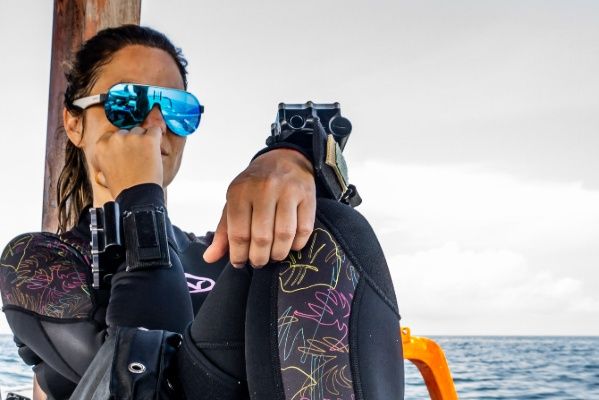
My favorite story is a trip to Gili Trawangan in Indonesia, when I missed the transfer boat and had to reach the island with a small boat, the captain of which, however, did not assess the tide…!
Introduce yourself in a few words..
My name is Desislava Kutsarova - an adventurer at heart, by profession the Development Director at Happy, and by education... a mathematician and a master's graduate from the Medical University. It sounds strange, but in my world, there is time for all kinds of journeys - between numbers, fins, sushi, and laboratories.
The balance in my daily life comes from two extreme activities - parenting a soon-to-be graduate and technical diving at depths of under 40 meters. One teaches me patience, the other - concentration and planning, and both involve a lot of travel, emotions, and constant adaptation.
For you, traveling the world is…
My greatest passion. The world for me is not just above water - beneath the surface lies another world, which occupies 79% of the globe. The wonders of nature, different cultures, what happens beneath the earth's surface - all things that amaze and energize me.
How many countries have you visited? A curious incident?
46 so far. Every time I leave the country, I do so with so much excitement, anticipation, emotions, and curiosity. My favorite incident is a trip to Gili Trawangan in Indonesia when I missed the transfer boat and had to reach the island with a small boat, the captain of which did not account for the tide... And I had to walk over a kilometer on the seabed, with my feet sinking in the wet sand and a 32 kg suitcase. Not for a moment did it weigh me down, nor did I get angry, I just wanted to reach the island. That was when I truly realized how much I love to travel.
Do you like to repeat destinations?
Yes. Mexico is my absolute favorite - I adore the nature, the food, the history, the music, the atmosphere, the cenotes, and the Caribbean depths. Dubai and the southern part of Egypt are also places that always give me something new, even though I have been there multiple times.
Which trip changed you the most as a professional?
The trip to Chicago for the NRA Show - this is the largest exhibition for the restaurant business. There I met the founder of the International Franchise Association - by chance, after I literally got lost in the exhibition, ending up with a non-working bank card and no battery on my phone, in a completely unfamiliar place. This meeting was perhaps the most significant (unplanned) contact that significantly changed my approach to my work, focused my attention, and developed my skills to previously unimaginable levels..
What do you learn about yourself in a new cultural environment?
To listen. To observe. Not to judge immediately. To give a chance. And most importantly - to never stop changing. My job is such that we interact and create daily with people from all over the world, and this teaches me that professionalism has different faces. Over time, I realize that skills are applicable everywhere - as long as there is flexibility and respect.
Have you met people or ideas during your travels that have influenced your career path?
That same chance meeting in Chicago with the founder of the International Franchise Association. He found me lost, without GPS, without a working mobile phone, and in high heels that I had already taken off. But from there, conversations began that gave me invaluable guidance. He didn't just talk about franchising - he shared a philosophy for creating systems: structures that are both organized and open, which free the mind from routine but do not deprive it of thinking. And this turned out to be one of the greatest professional lessons of my life. And my contact with this person to this day includes exchanging packages for Christmas and cards for Easter.
Do you expand your professional network through your travels?
Definitely. In our industry, contacts happen literally everywhere. You like a restaurant - you meet the chef. A product impresses you - you discover the manufacturer. You see a concept - you find its creator. Places that inspire often turn out to be invaluable opportunities for collaboration.
What skills do you develop the most when you travel?
My patience. Especially in Southeast Asia, where there are places where time has stopped. I learned to control my initial reactions - cultural shocks no longer scare me, but challenge me. And of course - curiosity and adaptability. To truly feel a country means to immerse yourself in the lives of the locals, and this is categorically impossible without flexibility and an open mind.
Is there a city or country that has inspired you to start a new project?
Dubai. I received a task from my boss to create an oriental sushi menu - the entire strategy of the Company at that time was to align the menus with a theme. And it was ORIENT. I couldn't even react, I just hung up the phone and stared at one point for at least 2 hours. I was sure this would be my biggest failure - what sushi in the middle of imam-bayaldy and adana kebab... I remember that instinctively I headed to Istanbul (it seemed the most oriental to me at that time). And on the way to Istanbul, I found myself at the airport, so I decided to go to Dubai, alone, with carry-on luggage of 2 t-shirts and sneakers. (Dubai is another favorite destination of mine that surprises me every time with new technologies, new flavors, and unexpected curiosities and innovations). The inspiration came unexpectedly, from the feeling that you don't know where to start, from the impulse to create something that doesn't exist. And so, wandering aimlessly along Kite Beach, the idea for sushi towers came... Tall, with golden dust, sprinkled with pomegranate for abundance, and named after Burj Al Arab and Burj Khalifa. To this day, these are the absolute bestsellers, and the famous oriental sushi menu holds a sales record that is still hard to surpass.
When you are in an unfamiliar country, do you feel more motivated or more distracted?
Extremely focused. All my travels seem short, and I use my time for observation, learning, and inspiration. Distraction comes later - upon returning, when I have to return to a work environment and meet everyday life again.
Are there destinations that act as a “restart” for your creativity and ambition?
All related to diving. Underwater, you live by different rules - you neither breathe, nor speak, nor move the way you do on land. You are a guest among all the strange creatures and predators, and you don’t “knock on their door,” they just come and check what you are doing in their home. You often spend time underwater under anesthesia (nitrogen). Every exit after the next 40-60-80 meters is like a rebirth for me - I remind myself who I am, where I am. Outside of diving - I adore Mexico.
How do you balance work and pleasure while traveling?
For me, this balance is achieved quite naturally - I work in the restaurant industry, so every new dish, every establishment, and every cultural peculiarity in food is part of my job. The pleasant and the useful constantly intertwine - tasting is not just a pleasure, but a tool for observation, analysis, and inspiration.
I strive to plan my travels so that I do not have to actively work during them, but thanks to the systems we work with, remote communication is entirely possible. I try to create an environment where I can be useful but also free, and this is the most sustainable form of balance I have found.
How have travels changed the way you perceive the value of money?
I have a new motto: the big expenses are not a problem, but the small incomes. Travels - especially when they involve diving, long flights, and serious distances, often come with higher budgets. This naturally raised my personal motivation for additional and more stable incomes.
In this sense, travels not only changed the way I look at money, they enhanced it. I realized that value is not just in the numbers, but in what you can do with them - what places to see, what people to meet, and what ideas to realize. So every trip is motivation - to earn more, but also to spend with more meaning.
Do you travel with the aim of finding new ways to earn money?
Even if it is not the initial goal, so far every trip of mine has led to at least one real opportunity for new income. Sometimes it is an idea that brings a bonus in my current job. Other times - a new skill that becomes a side source of income. And often - new contacts, with which later develop entire business ventures.
For me, travels are like an open world, full of potential, you just have to be observant enough (and a bit entrepreneurial) to see it. Opportunities do not always come with a label “invest here” - sometimes they hide in a conversation at the airport, in an unexpected dinner, or in a different way of thinking.
Look, listen, ask - and something always pops up.
What lessons about financial independence have you learned from the world?
The most valuable lessons about financial independence I have learned not from seminars, but underwater - during dives, in conversations with people from various backgrounds. From CEOs of leading Swiss chocolate companies to cybersecurity specialists from Silicon Valley - they all follow one and the same financial philosophy:
Invest in yourself.
Yes, everyone has savings and investment plans, side hustles, and financial strategies. But the most meaningful part of these conversations was always related to experiences and skills that no one can do for you - travels, sports, cultural clashes, new knowledge, new skills. They cannot be bought, delegated, or inherited; you have to experience them yourself.
The meaning is simple: health and personal development are the smartest investments, with the highest returns.
Is it better to spend on experiences rather than on things?
After so many travels, realistically about 30% of my time is spent living out of a suitcase, I know this: I value material possessions, but only to the extent that they provide me with necessity, comfort, and a standard of living. Everything beyond that weighs me down, literally and figuratively.
Experiences are what remains. They are the investment that does not lose value over time, does not age, and does not go out of style. A new memory, a new perspective, or a new skill - that is the real value I carry with me, no matter where in the world I am. And that feeling cannot be bought or packaged.
How do you see the future of digital nomadic life?
My work allows a certain degree of digital flexibility - and I am more than happy that this is possible. However, not everything can happen from a laptop under a palm tree - reality sometimes requires structures, meetings, teams, and physical presence. But when the situation allows, I believe that the freedom to change locations without losing focus is not just a luxury, but a powerful stimulus for better results.
For me, this model works flawlessly, but in certain periods of the year when I am in a mode of strategic work, planning, or developing new concepts. I believe that the future of digital nomadic life will be based not so much on travel, but on the ability to combine flexibility with discipline. And that is the combination that brings real value - both to the employer and to the individual.
Where is the best place for work and investments?
Surprisingly, but not for me - Malaysia. Recently, it has attracted huge investments from technology giants, becoming a serious center for cloud technologies and artificial intelligence, a cosmopolitan city, and phenomenal diving spots.
Where would you develop your next big idea?
My big dream is to have a children's school for surfing and diving on the beach. After retirement, in Sinai.
Top 3 destinations that must be visited?
- Dubai- the speed of human capabilities in real time.
- Mexico- a mix of culture, energy, and flavor that changes you.
- Southern Egypt- the most beautiful underwater world, eternal history, and
the feeling that land is not actually the most important part of the planet - it is only 29%, and I always wonder why we call this planet Earth.