From Tarnovo to Wall Street: The Story of a Bulgarian Woman Without Borders
· Tsveta Kaleinska
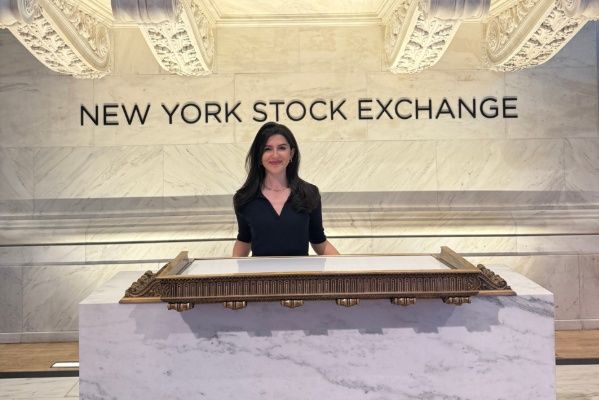
I live in Manhattan, New York. In 2008, I graduated from high school in Bulgaria and moved to the USA to study at a small college in Brooklyn!
Introduce yourself in a few sentences. What does your work involve as daily commitments?
My name is Tsveta Kaleinska and I am the founder of the boutique market research agency RILA GLOBAL CONSULTING, where we use the latest technologies to help our clients understand more about their consumers and improve their strategies. I am also an expert at the European Commission to the European Innovation Council, where I evaluate high-tech startups with a budget of over 80 billion euros. My extensive knowledge in the field of technology and artificial intelligence is also the reason I often appear as a commentator on current topics in the American television airwaves.
My days mostly start with my responsibilities as a mother of two daughters - from dressing them to preparing their lunch for school and talking to them about the upcoming day before sending them off. This is a very important daily ritual for me and helps me remind myself of the meaning of my day and what is important in life. After I drop them off at preschool, I start my day with colleagues. The working model of Rila is entirely remote; for a large part of the days, I am in meetings with clients and the team for about 8-10 hours a day. The team itself consists of 12 people, and it is very important for me as a leader to maintain contact with each one of them and to communicate often.
In which country and city do you currently live and how did you end up there?
I live in Manhattan, New York. In 2008, I graduated from high school in Bulgaria and moved to the USA to study at a small college in Brooklyn. After my higher education, I started working at a large marketing research agency and stayed in the city where I am to this day, 17 years later.
What were the biggest challenges you faced at the beginning of your stay?
I arrived in the USA completely alone and without any external support, which was definitely a very big challenge for me. Like most Bulgarians abroad, I also had an adaptation period at the beginning of my stay, during which I was looking for my community in the new place.
I encountered truly significant challenges years later when I started my business. I had grand dreams, I strongly believed in myself and my abilities to help my clients, but even in the first week, I received a letter from a lawyer of a former business partner threatening to interrupt the registration process of my business. This was a key moment for me that motivated me even more and also taught me new lessons about friendships and money.
How did you overcome the language barrier (if there was one)?
I was fortunate to graduate from a Language High School in Veliko Tarnovo, and for me, there has never been a language barrier, as our education was at a very high level. There, I studied French, Spanish, and English simultaneously, and thanks to my teachers, these are skills that continue to serve me every day in my work. My barriers in the USA were mainly cultural, coming from Bulgaria, where there are significant differences. In America, there are unwritten cultural elements that only someone who has lived here for a long time can understand, and deciphering them was the most difficult for me in the first years.
What resources or networks (local communities, colleagues, organizations) helped you adapt?
I don’t think I found any network or community that specifically helped me. My circle of friends and acquaintances, whether Bulgarian or foreign, were certainly very significant and important to me. They all helped me a lot with advice, ideas, and lessons.
What are the main differences between the work culture in your current country and that in Bulgaria?
The differences are huge. First of all - directness. Bulgarians always say things directly, while Americans would prefer to sugarcoat their words at times and often “hide” the truth between two compliments. Bulgarians are also much more open and relaxed than Americans, who are more often guided by the most efficient method to complete a task to optimize every resource. In America, words are required to be measured very carefully, while Bulgarians can be very free in our expression, whether in front of a colleague or a client. I miss this a lot from working with Bulgarians - the personal relationship we have with each other and how caring we are towards everyone.
What values and practices in the workplace impressed you the most?
In America, they greatly respect the hard work that goes into every task. This definitely brings results, and it is true that the USA is a land of opportunities for those who work hard. Of course, there are downsides, especially when it comes to the balance between work and rest, because in some places it is considered “normal” to work constantly.
Have there been situations where cultural differences have hindered you?
In the first years, when I moved, one of the things I learned is that while in Bulgaria we use commas when writing 1,2, in America it should be written 1.2 with a dot. Dozens of times, I have wanted to write one thousand two hundred, but it reads as one whole and two, which is a tragicomic incident when working with very large tables.
How does finding a job differ in your current country compared to your homeland?
I wouldn’t say it differs much, as Bulgaria is already a very advanced country and in both places everything happens with a lot of online applications, as well as recommendations from acquaintances. In both places, over time it becomes easier, as the industries are quite small. The more you grow in your career, the fewer people remain who do exactly the same as you.
Did you have to go through any additional qualification courses?
No, my education from Bulgaria was sufficient and more than enough :) In many cases, I stood out precisely because of my knowledge from our homeland.
Have you encountered prejudices or obstacles due to your foreign origin?
Of course, and I find it completely normal. I have faced obstacles, for example, with my name, which is strange to them and they can immediately tell from it that I am not local, but I always try to leave such things behind me and not pay attention to the obstacles. Life is a series of clashes - we cannot stop at every one. Only forward and upward, as they say.
What would you advise people who want to take a similar step?
Believe in yourself. With hard work and intelligence, you can achieve anything!
If you could go back, would you choose the same path?
Yes. I do not know another path, and the path I have chosen is always The Path. For my path, I would use the nice Bulgarian expression “slowly but surely.” In my opinion, these successes are the best - the slow and the sure.
What do you miss most about your homeland in a professional and personal sense?
On a personal level - my family and friends. I also miss our culture a lot and how free-spirited we Bulgarians are. I am fortunate to work with Bulgarians constantly.
Have you considered returning and under what conditions would you do so?
I certainly do not rule it out at all. Life changes every day, and although I am building a family here, Bulgaria will always be at the forefront if we consider moving.
What do you think about money? What is their influence on your life? What is your advice to people who often ask themselves questions related to money and how sufficient they are?
Unfortunately, money has a huge significance in all our lives. Regardless of whether we want it to be so or not. What I have learned from my childhood in Bulgaria is that money has an important place in life, but it is not an end in itself. We definitely need to learn how to work with it so that it works for us. By this, I mean frugality, always thinking with an eye towards the future, and being careful with it always helps. In America, my impression is that they view money in the same way - money must be handled with great care.