He knows how to connect people and ideas in a quiet but profound way
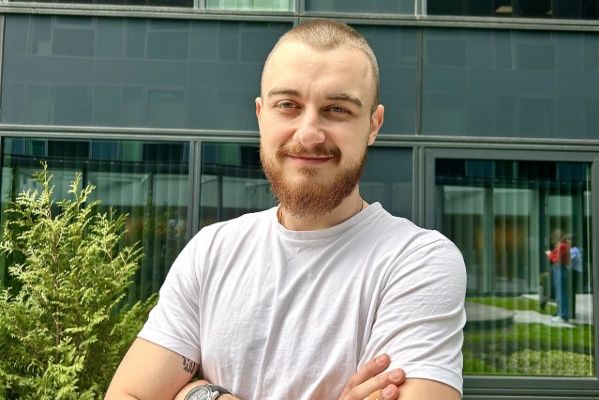
· Emmanuel Tonev
You are not just your job. You have the right to a life outside of it!
Introduce yourself in a few sentences..
Emmanuel Tonev is a LinkedIn expert at BookMark with over 6 years
of experience in digital marketing. He is a certified LinkedIn marketing specialist with
a focus on B2B and B2C communications. He is the author of the first book in Bulgaria on LinkedIn
marketing and the organizer of The Linked Academy - an initiative dedicated to
trainings and events related to professional development on LinkedIn. He is professionally
engaged in developing personal profiles and corporate pages on LinkedIn.
He successfully builds a career as a freelancer and consultant, helping
professionals and businesses.
What did you dream of becoming in your childhood?
As a child, I wanted to become a hairdresser or a teacher. The first one, who
knows, maybe because of my mother. She is a hairdresser and still is to this day. This profession was not
by choice, but by sympathy. After all, I saw and heard about the profession every single
day. As for the second one - I liked to help. I liked to give my
classmates and friends not just anything, but knowledge. To be able to pass on something that will
live on after me. Then I discovered words and realized that they can also build
knowledge, foundations, and be passed on - only in the minds of people. I suppose
I somewhat fulfilled my “dream”.
At what age did you earn your first money? Share with us
some interesting incident?
The honest answer - probably at 7-8, when I sold tomatoes and
cucumbers in front of the house where I lived in the small town I come from. The real
answer - I think I was 16 when I first started working as a bellboy.
I remember that back then they paid me 20-30 leva a day, which means about 3-4 leva per
hour. It wasn't much, but the feeling that someone appreciated your work was stronger than
the amount itself.
What are the main factors and examples that shape us
as individuals at an early age and form our interests? What is your
recipe for curiosity, sources, and wells of information and inspiration in
this stage of our human development?
Curiosity is not cultivated if there is no space for
it. My parents gave me the freedom to ask and to doubt, and that was
the greatest gift. When you are small, you only need one person to tell you
“ask again” and the whole world starts to open up.
Has there been any significant difference in your perceptions in a more mature age regarding what motivates you to do or not do something?
Over time, motivation shifts from “proving something”
to “leaving something meaningful behind”. I no longer seek noise, but direction.
I want to participate in things that create value, not just noise in the system.
Whose decision was it where to pursue higher education and
what to study? Was that decision correct, looking back today?
If I say it was mine, I would be lying. I was pressured by my
parents to stay close to my hometown, which automatically meant going to Varna for me.
However, I do not regret their decision for a moment.
That’s why I can calmly say - it was mine. And it was confusing, to be honest.
From today’s perspective, I wouldn’t change anything, every step has led me to something
clearer. I don’t believe in a “wrong path” if you have been awake on it.
Share with us more about your interests, knowledge, skills, and
hobbies?
My interests have always revolved around the human - their
nature, needs, fears, and hopes. I love to reflect on what drives us, how we
create meaning, and why we need to tell stories - whether through
text, image, music, or movement.
My knowledge is hybrid, accumulated at the intersection of
humanities and digital. Over time, I developed skills in writing, editing,
strategic communication, content creation, and project management. I believe
that hobbies are that space where a person talks to themselves - without
audience, without expectations. Mine is precisely that - to talk to myself through
words, images, and movement.
Would you change your profession today and which fields of
activity capture your interest?
I wouldn’t change my profession in the classical sense, but
I am constantly looking for ways to enrich and expand it. The fields that attract me
are related to the psychology of communication and higher education.
I envision work that is an intermediate zone - between storyteller, researcher, and
mentor.
Sometimes I think about what it would be like to teach, to work with
young people and encourage them to find their voice. What pulls me is always
at its core the same, namely the human connection.
They say that personal branding is everything that people say
about you when you are not in the same room with them. What would you like to hear
today?
I want to believe that people would say I am someone you can
count on. Not only professionally but also emotionally. That they felt
comfortable with me. That I knew when to speak and when to be silent. I hope to
leave a sense of authenticity, that I don’t wear masks, don’t play roles, but show up
as I am. If someone says “he knows how to connect people and ideas in a quiet but
profound way”, that would be the best “personal brand” I could wish for.
Emotional intelligence, adaptability, and flexibility,
as well as our soft skills are key conditions for success in the last
few years. How do you cope with the daily challenges of life to
stay in good shape and mood?
Consciously. I try to stay in touch with my body - with
sleep, food, movement. I try to give myself space - for mistakes, for
a breath, for ignorance. I strive not to succumb to the constant pressure “to be OK”,
because we are not always. Adaptability does not mean bending constantly, but learning
when to stand firm and when to yield.
What are the most important conclusions you have made so far about
maintaining proper communication considering the different characters of the people
you meet daily - colleagues, friends, close ones?
One of the big lessons is that people do not always hear what
you say. They hear what their experience allows them to hear. I learned not to rush to explain,
but first to try to understand where the person across is coming from. I try not to impose my view as universal. In
professional terms, this means being adaptable but also clear. Personally, to be honest,
but not harsh.
What do you think about money? What is their influence on
your life? What is your advice to people who often ask themselves questions
related to money and how sufficient they are?
Money is necessary, but it is not meaning. They give us freedom,
security, opportunities, but they cannot fill internal voids. For me, it is important
that money serves life, not life revolves around them. Financial
literacy is important, but even more important is the personal definition of “sufficiency”. This
is not a fixed amount, but a feeling.
My advice is not to constantly compare yourself, because others’
standards often detach us from our own needs. Ask yourself not only “how
much money do I need”, but also “what do I want to use it for”. Then the numbers start
to speak a more meaningful language.
What is the most valuable career advice you would give to
people?
Do not be afraid of pauses and changes. A career is not
a straight line. It is a puzzle of experiences, mistakes, inspirations, and disappointments. It is important
not only what you do but also how you experience it. Do not stay in an environment that
systematically drains you. And remember: you are not just your job. You have the right to a life
outside of it.