If you feel that your own business is "yours", you have no right to give up
· Eli Stoyneva
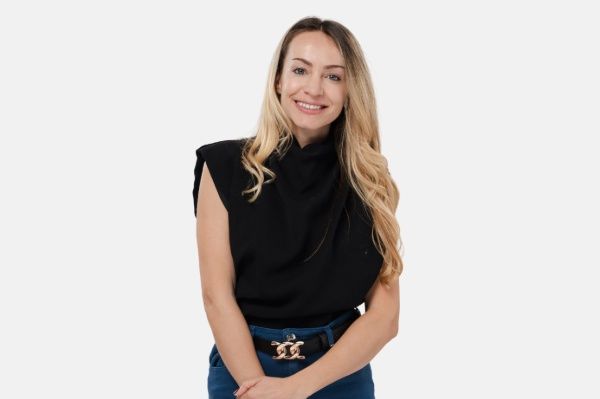
Don't wait for the 'perfect moment' – start with what you have, where you are, and be ready to learn on the go. Growth comes not from waiting, but from action!
Introduce yourself in a few words..
My name is Eli
Stoyneva and I am an entrepreneurch, investor, and soon
I will also be an author of a book.
I am the founder of an HR agency “Top
Skills Recruitment” and together with my husband Dimitar Kalev we have been developing our business
for 9 years now. I am taking serious steps towards investing in real estate and
managing them.
I grew up in
foreign countries, and today I am a mother and lead a dynamic life, where I combine
responsibility to my family with the ambition to develop a sustainable business and to
create long-term value.
I have over 10
years of experience in the field of personnel selection and B2B sales, as I believe
in the power of good service, clear communication, and true
partnership. I dare say that I use a creative approach, dedication to clients, and
positive attitude with which I meet every challenge.
I manage a team
of 10 professionals, and leadership for me means being an example, creating an environment for growth, and learning every day - especially regarding
employer-employee relationships.
In recent
years, I have been taking targeted steps in the field of investments in
real estate and their management, with the clear goal of building a stable
source of passive income and creating value through quality, transparency, and
long-term vision.
Life has taught me that confidence does not come from knowing all the answers, but from the belief that
you will find them.
How would you describe your career in a few words?
I love what I do. Having my own business is completely "mine", I manage well and live with inner
peace. In business, I manage to use and combine all my strengths - creativity,
sales skills, team management, and marketing. This allows me not
only to build sustainable projects but also to feel inspired and
fulfilled every day.
What was the
most important choice that shaped your path Inand?
The most important choice that shaped my path was to start.
Fate itself pushed me in this direction, and I – then a 28-year-old girl -
just felt that this was my path and that it was the right one. From the moment I
made the first step, I knew that I had no right to give up. It was this thought
that gave me the strength to endure all the difficulties I encountered along my way - difficulties,
that are not just inevitable, but in my opinion mandatory, if you want to build
something real and meaningful.
The fact that I was not alone, but supported by my partner
was extremely important and decisive at that moment, and I am grateful that life
brought me together with the people who are still with me and support me.
What would you like to know at the beginning of your career,
but no one told you?
I have always wanted to know more about managing
finances, building effective processes, and leading people. It turned out,
that this is not just not easy - but is one of the biggest challenges you can face as an entrepreneur. Especially when we talk about
managing a team of professionals with different experiences, motivations, and needs.
No one had
told me what to do with the income from the business - how to allocate, reinvest,
plan. This is not taught in school, and often is not explained clearly. It took
me several years, countless trainings, many books, and conversations with mentors,
to understand what works for me.
Today I already have
a clear direction and confidence that I am making informed decisions. The path was not easy, but
thanks to it I am exactly where I want to be – with a business that
grows, and with inner peace that I am doing it my way.
How can a person
understand which profession is suitable for them?
The profession
is often chosen while we are still children, right? Or at least it seems that way - when we have to decide which
school to apply to. Then, even before we have fully built ourselves,
the direction begins to take shape. That is why it is good at this early
age to ask ourselves a few important questions:
- What tasks make me
feel fulfilled?
- In which activities do I forget about time?
- If I imagine doing a certain
job every day - do I feel
ease, meaning, and joy?
I believe that
we should listen to our intuition - it
is a quiet but clear advisor. Of course, at such a fragile age this is difficult.
That is why it is useful to try different roles through internships, volunteering,
freelancing, or short-term projects. Every practice is a lesson. Through action,
you discover not only what inspires you but also what is categorically not for you.
Talk
to people from different professions - not only about what they do,
but also how they feel, when they do it. Their perspective can
provide a new direction.
Sometimes people
do not find “their” profession - they
create it. Just like I did. A career is not a one-way street, but a complex map
with many possible paths. And every turn can be valuable, as long as it leads
closer to yourself.
How to
build a network of useful contacts without appearing interested?
And why should we
worry that we appear interested? In today’s connected environment,
building a network of contacts is not only a reasonable step but a necessary
investment in our personal and professional development.
My advice is:
actively use LinkedIn. Keep your profile updated, engage with
people in your field, and do not be afraid to send connection requests - even to people you do not know
personally. Your common professional environment is a sufficient reason.
However, it is important
not only to accumulate contacts but to build relationships. A small, meaningful comment
under a post or a personal message with a compliment about a project can open
doors.
Do not try
to hide your interest - it is better
to show it with authenticity, goodwill, and a desire to exchange value.
People sense when you approach with the intention of creating a relationship, not
just for benefit. This is what makes relationships sustainable and useful in the long-term.
What is the
biggest mistake you have made in your career, and what did you learn from
it?
I do not trust
easily - especially
if someone is trying too hard to convince me to do so. This is
one of the most valuable lessons I learned in recent years thanks to
my profession. My work brings me into contact with many people and has taught me to rely not only
on my intuition but also on the actions and persistence of the other party.
Another important lesson
is related to managing revenues. For a long time, I was not sure how exactly to reinvest
the profit from the business and often postponed important financial decisions. I would not call
this a "mistake", but rather a natural learning process. Today, however,
thanks to this experience, I manage my investments with confidence and clarity.
Mistakes (or
lessons) are an inevitable part of the journey - the important thing is what we choose to do with them.
What would you
do differently if you could start over?
I would not change anything
How to
maintain our motivation in times of stagnation?
For me,
times of stagnation are not a failure - they are a sign that it is time for a restart. In such periods, I
allow myself to slow down, to look inward, and to remind myself why I started in the first place. I do not seek inspiration outside of myself - I return to the dreams that
once pulled me forward, and I ask myself a simple question: “What would I
do today if I were starting from scratch again?”
I often change my
perspective - travel,
a new book, a conversation with an inspiring person, or just a walk without a phone.
Action, even if small, always returns my energy . Motivation does not come before action, but after it.
And
most importantly - I allow
myself not to be 100% all the time. I give myself space to be human and this helps me to return stronger,
more aware, and with a new direction.
How to
achieve a balance between professional and personal life?
For me, balance
is not a constant formula – it is a daily choice. It comes from the ability to set
boundaries, but also from a deep awareness of what really matters to you at
a given moment.
As
an entrepreneur and a mother, I often feel divided between tasks and time with
my loved ones. But I remind myself that presence is more important than perfection.
I plan my time so that there is room for work, play, and rest.
I have days for business meetings, but also evenings when the phone stays
aside.
I believe that
balance is not in the number of hours, but in the quality of time, which
you dedicate. I am not afraid to say “no” to things that are not a priority at
the moment - because
I know what I am saying “yes” to.
Sometimes
business needs more, other times - family. The key is in flexibility, in
trusting yourself, and in the ability to combine your roles with love, not with guilt.
When is it time
to change our career, not just the job?
When the feeling
of dissatisfaction is deep and prolonged - it is not due to the boss, the team, or
the company, but to the very essence of what we do.
If we often ask ourselves “Does all this make sense?” and
even after changing
several jobs, the feeling remains the same, then perhaps it is not just about
the need for a new employer, but the need for a new path.
If the job
does not awaken in us interest,
and only fatigue or eventhe feeling that we are using only a small part of our potential –
we need to change something.
A career is not
a lifelong contract, but is
a journey that we can reshape in a direction that better reflects our
values, interests, and desires. The best moment to start is when
you realize that you no longer want to wake up on Monday with a feeling of
emptiness.
If you had to
give only one piece of advice to people seeking success, what would it be?
Don’t wait for
the “ideal moment” – start with what you have, where you are, and be ready) to
learn on the go.
Perfectionism,
the fear of failure or of others’ opinions often stop us before we even
make the first step. The truth is that growth comes not from waiting, but from
action. Build habits, seek value, create connections, be
curious and consistent. And most importantly – build such value that,
no matter where you are, it always goes with you.
If you have an idea,
a goal, or a dream – try it. Even if it doesn’t turn out as you imagine, you will be
closer to yourself than if you never start
What is Your
definition of “successful career”?
My definition
of “successful career” is not measured only by titles, salary, or recognition - although they also have their significance. For
me, a successful career is one in which Iwake up with desire on Monday morning, Ifeel that I contribute something meaningful and
valuable, Iam developing
as a professional and as a person, Iwork with people I respect and from whom I can learn. Not least - Ifeel
inner peace and satisfaction, not just achievements on paper.
A successful
career is not static - it
transforms with us. And most importantly is that it does not have to look “successful” in
the eyes of everyone, but to feel meaningful in our own hearts.