In England, competition is serious, and work standards are high
· Magdalena Djurdjeva
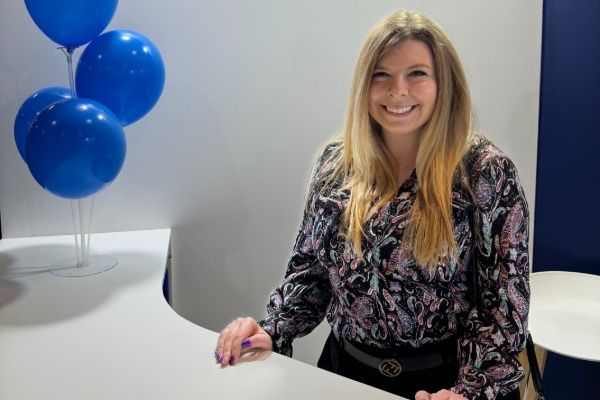
The care for the employee here is on a completely different level – from budgets for professional development in the form of courses and training, to team buildings and monthly social events for team bonding!
Introduce yourself in a few sentences. What does your work as daily commitments consist of?
My name is Magdalena and I am a Marketer specializing in
software solutions in tourism and hospitality. I consider myself a
true lucky person because I am professionally realized in the industry
that has always inspired me. Doing marketing in tourism is both
extremely creative and inspiring with all the beautiful destinations and hotels around
the world and that natural positivity that people feel towards traveling and
discovering new corners of happiness and adventures.
Since the beginning of my professional journey, I have always been part
of this industry – starting with my education in Tourism Management at
Bournemouth University in England, an internship in Germany, working for a leading tour operator in
Bulgaria and later for the world leader in tourism, Expedia, in London.
Currently, I am a Senior Marketing Manager for “Strategic
Partnerships” at SiteMinder – one of the leading hotel distribution
companies in the world. I work on joint marketing initiatives with international partners and
the development of our partnership programs, I organize global events, and one
of my favorite parts is that I support my amazing team of
professionals, scattered all over the world – from Sydney and Manila to Rome,
Barcelona, Dallas, and New Mexico. My job is extremely dynamic, diverse
in terms of projects and challenges, and it brings me together with inspiring people from all
corners of the world – something I value immensely.
In which country and city do you currently live and how did you end up
there?
I have been living in London for 7 years, which was definitely not
love at first sight. I ended up here after returning to Bulgaria for 5
years after I graduated from my higher education. In our country, I had
a great start to my career, but over time I realized that I missed
the cosmopolitanism and the scale of opportunities that life and
work abroad offer. So one sunny day in 2018, I made the decision to
return to the United Kingdom, where I started working at my dream company.
What were the biggest challenges you faced at the beginning of your stay?
I would say that the challenges for me in a work context
were mainly around the different style of work and communication. Everything here is much
more structured, dynamic, and planned, which is imposed by the volume of work
and the high results we strive for. The standards are high, and
the competition from excellent professionals is serious. This constantly pushes you to
learn, think quickly, develop, and adapt quickly to changes -
things that – at least from my personal experience – we are not subjected to to such an extent
in the corporate environment in Bulgaria.
On a personal level, when I entered university, it was
more difficult for me at first to get used to the teaching style at the university, where
you are evaluated based on analysis and critical thinking, rather than on 'memorizing'
the material, as often happens in the Bulgarian educational system.
How did you overcome the language barrier (if there was one)?
I wouldn’t say that I had a language barrier, rather I
had to adapt my communication style to the culture.
What resources or networks (local communities, colleagues,
organizations) helped you adapt?
The most help came from the circle of friends that gradually
grew. In London, people are extremely communicative and open to new
contacts because almost everyone is "from somewhere else". Thus, your social
circle expands naturally – from one friend to another, almost without you
noticing it. My colleagues have also been supportive and open, which contributed to me
feeling accepted and part of the team. Most of my colleagues have also been positive,
friendly, and open to working with me, which helped me feel
part of the team and community.
What are the main differences between the work culture in
your current country and that in Bulgaria?
To be honest, I wouldn’t compare the work culture of the two
places, as the scale and work mentality and culture are very different from
those in Bulgaria. Here, everything moves at a great speed, people are highly
focused on their sphere and responsibilities. This often means that if you want
support for a project, you need to be particularly creative and convincing in your arguments
– to clearly show what the benefit is for their work. On one hand, this is
an interesting professional challenge, but sometimes also exhausting. While in
Bulgaria, communication with colleagues in similar situations is much easier and more open.
What values and practices in the workplace impressed you the most?
The care for the employee here is on a completely different level – from
budgets for professional development in the form of courses and training, to
team buildings and monthly social events for team bonding.
The relationships between colleagues are also more attentive and considerate –
empathy and positive attitudes towards each other are encouraged, regardless of
the position.
Have there been situations where cultural differences have
challenged you?
Bulgarians are very direct as people and mentality in
communication, usually with a clear opinion on a given issue or topic. This
direct way of expressing oneself is not always perceived positively here, as
people are usually more delicate and careful in their speech - this is something I
had to adapt to quickly and I strive to apply it daily.
How does finding a job differ in your current
country compared to your homeland?
Job searching here is practically a ‘full time job’.
The process is much more comprehensive and has more requirements, as candidates with
similar qualifications are quite numerous compared to the available positions. To be
competitive, you need to put in a lot of effort and pay attention to detail - from
the very composition of your resume to preparing for interviews, which
are usually at least three in number. There is almost always a task or case that
you need to present. In Bulgaria, at least according to my observations, the process is
much more informal and less stressful.
Did you have to go through any additional
qualification courses?
In marketing, it is extremely important to keep up with
the trends and novelties, so I try to attend online trainings,
events, or courses for obtaining a specific certificate.
Have you encountered prejudices or obstacles due to your
foreign origin?
The fact that I am Bulgarian did not always work in my favor in
the initial perceptions of people about me at university, influenced by
stereotypes. Also, at that time finding part-time work as a student was
much more difficult for Bulgarians, as there were restrictions that applied only to
Bulgarians and Romanians from the entire European Union, as well as a lot of negative
propaganda in the media just before the lifting of those restrictions.
But things have changed quite a bit since then, and London -
as one of the most cosmopolitan cities in the world - offers a different environment than
the average English city. Here, people appreciate who you are as a person and
what you can do, not where you come from. Nowadays, my origin rather arouses
interest – people are often curious to learn more about Bulgaria as a culture and
tourist destination.
What would you advise people who want to take
such a step?
Living abroad is not for everyone, so before you
decide to take such a step, it is important to be clear with yourself – what are your goals
and what are you looking for. Is this a temporary stage for professional experience, or a desire
for a new way of life? This way you will be able to set the right expectations for
yourself and your plans.
Also, to feel part of the new environment and
community, you need to be active and socialize in the environment you have
chosen to live in. In my observations, many Bulgarians choose to stay in a closed
Bulgarian circle and miss opportunities to create a social circle outside
their comfort zone.
If you could go back, would you choose the same
path?
Absolutely. Every decision and experience has taught me
something important and has brought me to the place I am today.
What do you miss most from your homeland in a
professional and personal sense?
In a personal sense – family. In a professional sense – nothing
specific, but I am grateful for all the great colleagues in Bulgaria, with whom I
still keep in touch today.
Have you considered returning and under what
conditions would you do it?
At this stage, my partner and I are not planning to return, but
I never say "never" – life often brings surprises.
What do you think about money? What is its influence on
your life? What is your advice to people who often ask themselves questions
related to money and how sufficient they are?
For me, money is a means, but not an end goal and balance is
very important. Financial comfort is an important motivator, but I believe that
if a person is hardworking and goal-oriented, they will be valued and rewarded accordingly.
My advice to people who often ask the question “how much is enough” -
think about what you are willing to sacrifice to have more and how important that is
for you, because everything comes at a price.
#Magdalena_Dzhurdzhieva #Marketing #Tourism_and_hotel_management