The Bulgarian Carrie Bradshaw with an upcoming inspiring book
· Elina Ivanova-Atanasov
Exceptional personal experiences from the travels of a businesswoman-entrepreneur!
Introduce yourself in a few words..
Elina Ivanova-Atanasov, entrepreneur, owner and
CEO of 9 companies with different focuses. Marketer with 20
years of experience and over 11 000 projects behind her. Business mentor, author of
tens of articles on marketing, advertising, entrepreneurship, artificial intelligence, and
more. I am a person who prefers to create industries rather than try to fit into
existing ones, and I already have solid experience in this
direction.
My hobby is traveling, getting to know new cultures, and
being inspired by the world around me. I would also call it passion, pleasure, and meaning.
Currently, I am finishing writing a book that is an interesting symbiosis of life lessons, business advice, and stories of inspiring personal experiences from travels around the world.
What does traveling the world mean to you?
I would define it with two very specific words: Wanderlust & Ikigai.
Wanderlust: An extremely
strong inner urge to discover the world, an irresistible desire to explore new
places, cultures, and people
Ikigai: That,
which makes you get out of bed in the morning, that to which you would dedicate your life
from now on.
How many different countries have you seen so far? Share with us
a curious incident or highlights from your travels?
About 45 countries and over 200 cities. The incidents are countless,
I will only hint at highlights, and in part of the book dedicated to my travels,
you will be able to read what lies behind them:
· The romance soaked in the shores of Amalfi
· The blue fairy tale city of Chefchaouen in Morocco
· The fun in the monkey forest and the swing over the jungles of Bali
· The fiery dances of fire swallowers in Koh Phi Phi in Thailand
· The amazing architecture and discipline in Singapore
· The shiny boutiques of Milan, Paris, and Dubai
· The night dances of the Bedouins among the sandy dunes in the desert of Abu Dhabi
· The wild exoticism of the beaches of Seychelles and Tanzania
· The magic of the Bosphorus nights in Istanbul
· The timelessness in the streets of Amsterdam
· The charm of the French Riviera and Monaco
· The elegant intertwining of history and modernism in Moscow
· The grandeur of the hidden underwater cenotes of Mexico
· The charming yacht harbors of Porto Cervo in Sardinia and Portofino in Italy
· The exhilarating parties under the stars in Ibiza, Mykonos, and Miami
· The endless white and uninhabited beach strips of Cayo Coco in Cuba
· The liveliness and impeccable order in Shanghai
· The chic après-ski spots on the slopes in Courchevel and Meribel
· The aristocratic spirit and nightlife of London
· The adrenaline, lights, and shows of Las Vegas
· The captivating underwater world of Egypt and the Maldives
· The impressive culture of Japan
· The unreal colors of sunsets in Bora Bora
· The enchanting eyes of the children in the villages in Zanzibar
Do you love to repeat destinations? Give examples and
motivation "for" or "against"?
My answer is a bit contradictory – in theory, the world is
infinitely large and one lifetime will not be enough for me to touch everything I
would like to see, so I try every year to have many new, different
and challenging places that I travel to.
In practice, however, there are three destinations that I repeat and
will continue to repeat many times – Maldives, Italy, and Lampedusa – luxurious
places that I will never get tired of rediscovering and experiencing.
What was your first trip that truly changed you
as a professional and can be said to have changed your thinking?
I cannot point to a specific trip that has changed me – each one is a new meeting
– with the world, with people, but most importantly with myself. Traveling is
more than rest for
the mind – it is the realization
that the world is much bigger than the problems that keepus awake at night.
When we return from a trip, we do not just return home – we return
as changed people. Every place we have visited, every culture we have touched, and every view we have captured in our minds leaves
a lasting impression. But the true value of these experiences is not only in how they enrich us, but in how we carry them back into our daily lives. How we
return to routine, but already with a stronger focus, clearer goals, and more
creativity. What do we take from there to bring into our lives
and those of the people around us.
What do you learn about yourself and your professional skills,
when you are in a new cultural environment?
I am very curious and I am truly grateful that I
have the opportunity to meet incredibly different people all over the world – with some
for work, with others our paths just cross, but with each of them
I observe a different mentality, habits, worldview. There have been dozens of cases where I have liked some of them and have brought them with me to my office. I always
enthusiastically tell my colleagues everything that has impressed me. The way a person works in China, in Germany, in Tokyo, and in Nairobi is incomparably
different. I can talk about this for hours. I always take the opportunity to
learn about the personal lives of these people, how they perceive the world and us,
Bulgarians. What is important in their day, what they strive for, how far their
possibilities and dreams extend, how they look at their children, how they relate to
their work.
Have you
met people or ideas during your travels that have influenced your career Vand path?
Ideas. Definitely many ideas. I draw inspiration from
my travels constantly. I have, for example, a company where we create products
with designs dedicated to different places around the world, different cultures, different
art. If you haven't been there to touch, to feel a scent, to taste, to hear
a story, you can never create the product with the precision that you
achieve when you truly immerse yourself in a foreign environment. And so you carry it not only
home, but also around the world.
Do you think
that your travels help you expand your professional network? How?
I travel both for work and for pleasure. When it is for work,
it is inevitable because I communicate with a lot of people from the respective
professional field. But the most valuable thing is when some of them become
friends. I have friends all over the world, this is an irreplaceable wealth.
What skills
do you develop the most when you travel, and how do they reflect on your work Vand?
A person who does not travel is like a person who holds a book in
his hand but has only read one page of it. Every new destination is a source of
inspiration. What I learn from different cultures not only enriches
my personal world – it also changes the way I work and how I
live.
Communication skills, the ability to integrate into an environment where,
as people have said, you must act and think "When in Rome, do as the Romans do" –
you must be able to communicate with everyone, learn what the etiquette is in a foreign country, what
are the customs, understand and respect them. Sometimes you need to be very tolerant
and this should not stress you.
The differences in
the food culture between China and Japan, for example, are strongly expressed and arise not just
from different etiquette, but from deep cultural values, historical traditions, and
perceptions of social behavior.
I give a very simple example – I work a lot with Chinese,
I travel there, host partners from China here or around the world – do you know how they
eat? You look at them – a person in a high position, dressed in an expensive suit, in a refined
establishment, but slurping loudly, chewing with an open mouth, cleaning their teeth by clicking with
their tongue, slurping from a bowl of noodles, burping at the table. And this is perceived as
the most normal, even as a sign that they really like the food – this is how they express
their compliment to the chef. Historically,
in rural Chinese areas,
the noisy eating has been associated with authenticity
and spontaneity – people did not pretend, they just enjoyed.
In Japan, on the other hand – people are quiet, restrained, eat
with minimal movement, cleanly and silently, carefully put away their chopsticks,
arrange the table aesthetically, and bow after eating. By saying a short
word before taking the chopsticks in hand, they honor everyone in the chain who has
ensured that the dish is on the table. Etiquette
is rooted in the concept of “omotenashi” – refined
hospitality, in which every part of the experience must be aesthetic and
respectful. TheJapanese
culture values harmony and self-control – noisy behavior is
perceived as rude and disrespectful. Historical influences from Buddhism and Shintoism suggest
modesty, silence and gratitude towards food and nature, from
which it comes.
Another
elementary example – taxis:
Taxis in Japan are like
small moving temples – impressive clean,
with polite drivers and automatically opening doors – since
the cars have right-hand drive, you enter and exit only from the left. In every taxi
car, the seats and backs are covered with bright white lace – a historical
symbol of the cleanliness and meticulousness of the drivers. They, in turn, drive
with white gloves, which they change at the slightest contamination from contact with a suitcase of
the client.
Taxis in China have nothing in common with the impeccable ones in
Japan. In whichever Chinese city I have used this service, they are all very old
cars, scratched and dented on the outside and with unpleasantly dirty and worn leather or upholstery
inside. Often on the floor and around the seats, you can see all sorts of trash,
rags, bags, hair, dust, and other unpleasant sights. The drivers generally
smell repulsively of high-proof alcohol. In the trunk of the taxi, which
is supposed to serve as a place for the passengers' luggage, there are often buckets filled with
plastic bags with all sorts of contents, dirty clothes, and all kinds of strange
items.
Is there a city
or country that has inspiredyou to start a new business or project?
I have been creative for years - ads, strategies, designs,
products, concepts. Slowly over time, I unfolded this “calling” of mine until I
realized that my role is to work, to create, and then to pass on
everything I know and can to others. Because I believe that the work of truly
successful people is to create things that are useful to others, things that
last over time, and most importantly – to create other leaders after themselves by
passing on their knowledge and skills.
Many times I have been asked where I find this inexhaustible
energy to constantly move something new, to create, invent, develop,
apply, evolve from something non-existent to something great or impressive. Now
I know – this is my Ikigai – to travel and to create. Ikigai is not an idea that comes suddenly.
It is a process of discovering the inner meaning, of what brings joy,
inspiration, and a sense of purpose - it
is not a static concept. It is like a compass that constantly points to what has personal meaning
in lifefor everyone.
Many times I have been inspired for new projects and businesses,
even, if I have to be really honest – almost all my business ventures
were born “on the road”.
There are many places from which I have drawn inspiration –
Tokyo, New York, Moscow, London, Kenya, Seychelles, Dubai, Morocco, Capri…
When you are in
an unfamiliar country, do you feel more motivated or more distracted? Why?
When I am in an unfamiliar country, I am always in a slight trance –
it is extremely interesting for me to explore, to try, to taste. I love to get
lost in the small streets of ancient cities, to wander in the jungle, to dive
among thousands of fish, to admire foreign architecture, to be inches away from
animals in the savannah… all these things bring me a true rush of dopamine.
And the pleasure of floating in the clouds and looking like
spellbound through the airplane window, thousands of meters above the ground, is perhaps
the strongest meditation for my mind.
All these sensations always recharge me to the point where when I return, I am truly motivated to work.
Are there destinations that act as a “restart” for your creativity and ambition?
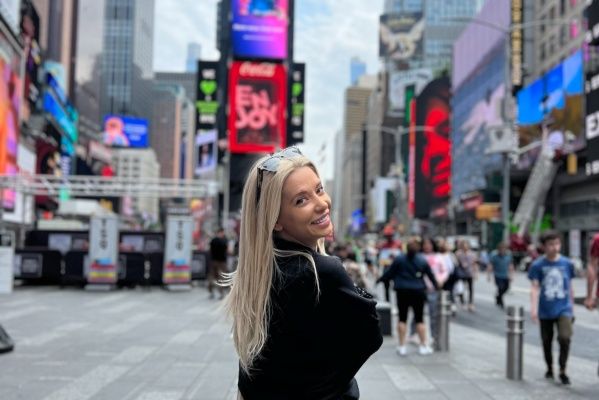
New York is my vibe. A city that vibrates at its own
unique frequency. Alive, rhythmic, colorful, impressive, and so inspiring. New
York is not for everyone, it is for those who love to live at a fast pace and are
in love with the dynamics of the day. I don’t know if it’s because I dreamed for a long time to go there or
because I have watched hundreds of movies filmed in this metropolis, but there I felt
unadulterated pure happiness - I couldn’t wait to open my eyes and break my legs
from wandering while I eagerly absorbed more and more sights. And I want to go back another
100 times there.
New York is not
just a city – it is a stage, where everything moves at such a speed that it looks like a choreographed dance of chaos. Every moment is
filled with energy, every street carries a story. New York truly
gives the feeling that dreams have no limits. There, in the chaos, all styles, all people, all destinies intertwine so skillfully. And you both get lost and feel small, yet you find yourself and feel inspired.
And Bora Bora, I would define as the other
extreme. This
island is not just natural beauty – it is a feeling. A feeling of tranquility,
harmony, and a true connection with yourself. In Bora Bora, you don’t just enjoy
the moment – you somehow becomepart of it. And
when evening falls and you sit with a glass of wine on the veranda, surrounded by the whispers
of the waves and fireflies in the distance, you realize that it matters only to be “here and now”.
49 hours. That’s exactly how long it took us to
get from Bulgaria to Bora Bora. 4 consecutive endless flights. “Is it worth it?” – everyone asks me after we returned. Absolutely! The most beautiful sunrises,
the most unreal sunsets – the sky burns orange, and often a rainbow spills across it,
which you can clearly see exactly where it starts and where it ends – meters away
from you, bright and fairy-tale like from a perfect children’s picture. Every
morning begins with a light breeze that brings the scent of saltywaves and coconut, as the sun gently rises
above the lagoon. There is always a hint of
vanilla – one of the most valued products of Tahiti. There is something magical about this land – everything looks in perfect harmony, as if even time flows
more slowly. That’s where you truly rest! There, the brain actively reorganizes everything
that has accumulated, calms down, and gives room for fresh ideas and
creativity.
How do you
manage the balance between work and pleasure when you travel?
I travel for work, I also travel to explore the world. In
the latter case, I am always available on my phone, but the people around me
have learned to value that time and if it’s not absolutely necessary, they don’t
bother me. The truth is, I always work a little or a lot even on my vacation trips.
Returning after
traveling for me is not an end, but a new beginning. Because balance
between personal life, work, and travel is not just a skill – it is a
conscious choice to arrange my life more correctly each
next time.
Because… look at it this way - every time you return from a new
place, you are not the same person who left. And that is your gift – not
only for you, but for everyone around you. And you must
seize that moment.
How have
travels changed the way you perceive the value of money?
It is interesting in a journey to be in the company of people,
who live on 1 dollar a day and are happy with life and grateful. And in
the next trip, to be with those who leave $50,000 for a “party lunch”
in the restaurant and that doesn’t even make them happy.
There are places in the world where I have slept in a tent and have
ridden in a cart and those where I have flown by private jet to the yacht. And I
would not trade any experience! That is wealth.
When I was in Zanzibar, I stepped out of the shiny 5-star
resort and asked to be taken to a nearby village. But the condition was that it had to be
natural, not from the “touristy”. At first, they looked at my request strangely and
with undisguised concern, then they agreed. A sobering experience. The children,
dirty, with torn clothes, runny noses, and beautiful big doe eyes, study
in a building resembling a semi-ruined transformer station – there are no windows or doors.
They sit in several rows on the dusty ground, while the teacher stands straight – writing on the wall with
a chalk. I brought treats for everyone. They instructed them to extend their hands forward and
not to move, because they explained that otherwise, they pounce like little beasts, something
like that doesn’t happen to them often. I had taken a local guide to translate. He explained that they
make a living by the men from the village going into the ocean early in the morning to catch fish. If
they catch something – there is food, if they don’t catch anything, they take on credit from the “store” and
when there is a catch later – they pay off their debt. And is it a store to describe it… again a building, unplastered, with windows made of hanging rags, with 10
products inside. But you should know how smiling these people are!
30-40 children play with a soccer ball, the goals are made of poorly
joined wooden beams, it’s so hot and the air doesn’t move, but that doesn’t bother them. And everything there is “pole
pole” – “slowly, slowly”, they are not in a hurry anywhere.
Do you travel
with the aim of finding new ways to make money?
I wouldn’t define it that way. Rather, I travel to meet my business partners,
to visit their offices, factories, to go to an exhibition, not exactly to look for new cash flows.
What lessons
for financial independence have you learned from different economies and cultures?
From my travels, I educated myself and became passionate about investing in the American financial market, as this is a great option for a side steady income if you know how to handle the tools correctly.
Many foreigners arrange their lives in such a way that they have at least
2-3 different incomes, some active, others passive, to secure themselves and
their loved ones.
Their philosophy is often different from ours, because for Bulgarians one of the most important things is to buy a home, to own it, for the land to be theirs, to secure one for their children, while for a large part of people in the West, this is not important, they are completely okay living in rent, but using the money for a business that generates them income.
Here we “stash” money – we accumulate savings for “rainy days” or for the education of our children from the moment they are born, while there they are completely okay with taking loans for everything and practically living on credit their whole lives.
According to itis better to spend on
experiences rather than material possessions?
“There is no price for pleasure.” I would spend all my money on
traveling and exploring the world, I would never save from that. And yes,
I categorically prefer experiences over possessions, this is how we raise our
children, who for years have been receiving and prefer to receive such gifts for
their occasions – we go to concerts, festivals, sports matches, cruises, safaris.
How do you see
the future of digital nomadic life?
Like the present. Millions of people work from millions of places around
the world. And it doesn’t matter where they are, as long as they can do their work through
a device they travel with. Artificial intelligence is advancing at an incredible pace
and the more processes it can take on, the less we will have to
work. Many countries are already transitioning to a 4-day work week and reduced
working hours. Predictions are that in about ten years it will be possible to
work 2 days, because the rest will be done by AGI agents.
Are there
specific countries that are more favorable for work and investments?
It depends on what criteria we are examining - whether taxes, stability, quality of
life, access to markets, technology, workforce, etc.
In the USA, there is huge access to financing, especially in
Silicon Valley, and there is a long-standing culture regarding innovation. In
Singapore, there are very low taxes, a stable legal system, and it is an open door to
Asian markets. Of course, the United Arab Emirates - a free
trade zone, no personal income taxes, endless opportunities for
business development. Canada has a very good and liberal immigration
policy, high quality of life, and very good pay.
Austria is one of the most organized countries to live in
Europe (more precisely Vienna), Norway and Finland lead by several lengths in
education, Estonia is superb in terms of digitalization of everything.
For investments – it greatly depends on what – in real estate, in
companies? Portugal, for example, has a “golden visa” program with a growing
interest from foreigners regarding investments in real estate. Even in our
neighbors like Greece and Turkey, there is high potential due to low prices and high
tourism.
If you could
choose one place in the world to develop your next big idea,
what would it be and why?
USA. An immense market, endless opportunities.
Extremely open to innovations, which I have been fundamentally engaged in for
years. Currently, the situation is quite shaky due to Trump’s policies, but
I hope that this will pass soon.
What are the destinations that you would definitely recommend
to be visited and why?
If I had to choose a top 5, I would probably go for New York,
Singapore, Kenya, Bora Bora, and Tokyo.
Each of these destinations is a different world. Incredibly
different from each other, incredibly different from us in terms of worldview and mentality
of people, I can’t even describe how interesting the experience is at each of
these places.
What is the career advice you would give based on
what you have seen around the world?
Build your work in such a way that you have the opportunity to
travel as much as possible, as often as possible. Traveling helps a person to find and balance. To look beyond tasks, schedules, and
commitments. It helpsyou to
remind yourself every timethat above all, you must bein harmony with yourself, to be useful to others.