The journeys that build a leader
· Atanas Radev
Sometimes 28 dollars can give you a story to tell for a lifetime!
Introduce yourself in a few words..
My name is Atanas Radev, I am 54 years old, an entrepreneur and
founder of the companies “Green Master Group” and “Vitagold”. For years, I have been working in
the fields of healthy living, innovations in dietary supplements, and
network marketing. I believe in sustainable growth based on innovation, personal
development, and international partnership.
What does traveling the world mean to you?
Exploring landmarks, natural beauties, culture
and lifestyle of different nations. It is also a source of inspiration for business development and
a chance for a fulfilling rest. Every trip helps me expand
my worldview, get acquainted with new ways of thinking, and rediscover myself
and my professional role in the global economy.
How many different countries have you seen so far? Share an
interesting story or highlights from your travels?
So far, I have visited over 40 countries on four
continents – Europe, Asia, Africa, and North America. Every trip brings something
unique, but one incident from China will stay with me for a lifetime.
After successfully participating in an exhibition in Guangzhou, I decided to
stay a few more days to explore the region – including Shenzhen and
Hong Kong. Financially, I was calm – I had three credit cards. But fate decided
to ground me – literally and figuratively.
Due to an earthquake in the Pacific Ocean, an important underwater internet cable was cut,
which blocked ATMs across China.
The result? My colleague and I were left with only 28 dollars in our pockets… and three megacities ahead
of us. The cards were full of funds, but completely unusable – a modern
irony of fate.
At that moment, I pulled out my student mode from memory – cheap transport,
improvised meals, and well-measured steps. It turned out to be not just survival,
but an unexpectedly romantic and fulfilling experience.
We traveled like locals, met incredible people, and saw more than what is usually “bought” with comfort.
Three days later, at the airport in Hong Kong, when the system
was restored and “I was rich again,” I realized how valuable this
experience was.
The conclusion? The saying that one should know both 2 and 200
holds true. And one more thing – always carry a little cash, especially in Asia.
Sometimes 28 dollars can gift you a story to tell for a lifetime.
Do you like to repeat destinations? Give examples and
motivation “for” or “against”?
Yes, I love to revisit some destinations, especially when
they have made a strong impression on me. This is especially true for cities with rich
cultural and historical heritage like Rome, Paris, Istanbul, Vienna, Saint
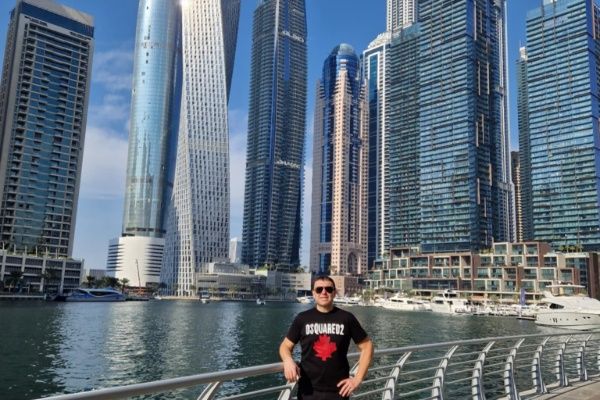
Petersburg, and others. I have also been to Dubai multiple times – this city always impresses me
with its dynamics, innovations, architecture, and business environment. Dubai is
a prime example of transformation and visionary thinking – from a desert landscape to a global
hub for technology, finance, and tourism. Repeating such destinations allows me
to build upon my experiences and discover new perspectives. Of course,
I also love to visit new places – this is part of my quest to seek
inspiration and learn from different cultures.
What was your first trip that truly changed you
as a professional and can be said to have changed your thinking?
My first trip to China in 2004 was indeed
such a turning point. I was extremely impressed – even shocked – by
the scale, the different culture, and the value system. Confucian philosophy,
which emphasizes order, respect, and sustainable development, was in
contrast to the aggressive, yet effective business management, oriented towards expansion
and innovation. This trip helped me realize that success is achieved not only
through dynamism but also through respect for the traditions and cultural peculiarities of
partners.
What do you learn about yourself and your professional skills
when you are in a new cultural environment?
In every new cultural environment, when I communicate with
business representatives or the local community, we inevitably discuss my
activity. It is in these conversations that I understand to what extent my expertise is
relevant and impressive to people from different backgrounds. I always listen to
feedback – it helps me highlight my strengths and
identify areas where I need to improve. Thus, every
trip becomes a lesson and an opportunity for professional and personal growth.
Have you met people or ideas during your travels that
have influenced your career path?
Many times. Part of my travels has always been
related to business meetings, international exhibitions, and forums. In these contexts, I have
met innovations and professionals whose ideas I have integrated into my
companies. This is how I maintain the high quality and relevance of
the products and services offered. I believe that innovative ideas are born at
the crossroads of cultures and economies.
Do you think that your travels help you expand
your professional network? How?
Yes, definitely. My travels have provided me access to
entrepreneurs, traders, and experts from the fields in which I develop. This has
significantly contributed to my past and present successes. I believe that personal
contact and live communication are irreplaceable – they build trust, which is hard to
achieve through online communication alone. I recommend every entrepreneur, especially
young ones, to travel, attend international events, and create
real contacts – this is how valuable partnerships are formed.
What skills do you develop the most when you travel, and how
do they affect your work?
My communication skills and adaptability develop the most – the ability to orient myself and function effectively in
different cultural and business contexts. Moreover, every trip enriches me with
new knowledge and business practices that I apply in my companies. This directly
influences the quality of the decisions I make and the
competitiveness of my business.
Is there a city or country that inspired you to
start a new business or project?
Yes – definitely Saint Petersburg. This is the city where
I actively developed my business and which deeply impressed me with its
scale, cultural value, and economic dynamics. Unlike Bulgaria,
where the market is more limited, in Russia I saw real potential for large-scale
development, precisely because of the vast territory and the millions of inhabitants.
My work there inspired me to think bolder, to expand my business strategies,
and to seek solutions that meet the needs of large and diverse markets.
This experience has definitely motivated me to start new projects and to view
opportunities on a more global scale.
When you are in an unfamiliar country, do you feel
more motivated or more distracted? Why?
In an unfamiliar country, the feeling of novelty and unpredictability
acts as a catalyst – at the very least, it awakens curiosity. This
curiosity is sufficient motivation to stay focused, even in a completely
different environment. For me, it is precisely the new that unlocks concentration and inner
mobilization – I observe, analyze, and learn. Instead of getting distracted, I feel that
I think sharper, see clearer, and appreciate deeper. In such moments,
consciousness expands, and imagination begins to outline new possibilities.
Are there destinations that act as a “restart” for
your creativity and ambition?
Yes, definitely. Dubai and Shanghai are two cities that always
make me hit “restart”. There, development is tangible – not just over years,
but literally over months. You see buildings, technologies, and ideas that were just
concepts not long ago. These places remind me that nothing is impossible when there is
a vision, boldness, and persistence. They recharge me not only with inspiration but also with
the desire to dream bolder and apply innovations in my field. In such environments,
creativity is not a choice – it is a natural response to the surroundings.
How do you manage the balance between work and pleasure
when you travel?
For me, pleasure is an integral part of every business
trip – not a luxury, but a necessity. When you are in a foreign country, far from
routine, you have the opportunity to “reset” – to adopt new perspectives,
refresh yourself mentally and emotionally. Even a short evening walk or lunch in
a local restaurant can recharge you with new energy and inspiration. I believe that
good mood and inner balance are an irreplaceable foundation for productivity –
they unlock creativity, build resilience, and make even the toughest
decisions clearer. That is why my travels are not just a series of
commitments, but experiences that better prepare me for professional
challenges.
How have travels changed the way you perceive
the value of money?
Traveling has taught me that the true value of money
is not in the quantity, but in what it creates for you – as an experience,
knowledge, and connections. I have met people who live richly in terms of
emotions with little means, and others – with much, but with an empty gaze. That is why I believe that one of
the best investments you can make is in travel. They not only
broaden your horizons but often lead to ideas with real economic value.
I have learned to view travel expenses not as costs, but as capital – capital that brings dividends in new knowledge, inspiration, and contacts.
Do you travel to find new ways to make
money?
Yes, when I travel for work – especially to international
exhibitions, conferences, and business forums – I always look for new ideas, opportunities, and
partnerships. This is one of the main goals – to discover potential solutions,
products, or concepts that can be adapted to our market and bring
value. But when I travel with family or for leisure, the focus is completely
different – there I seek connection, tranquility, and experience. In truth,
sometimes it is precisely then – in an informal setting, outside the business context – that the most original ideas are born. That is why for me making money is never an end in itself, but a result of inspiration, observation, and the ability to see
opportunities where others see just landscape.
What lessons about financial independence have you learned from
different economies and cultures?
Traveling has taught me that financial independence is not
just a matter of income – it is a culture of thinking. In Germany, I have mastered
the value of precise planning and sustainability – there, everything is built with a vision
for the long term. In the USA – the entrepreneurial spirit and the freedom to take risks. In Europe –
stability, attention to detail, and the pursuit of sustainability. From each culture, I have
taken something – for example, the Asian tendency to save and the American
boldness to invest. The lesson is clear: financial independence is not a one-time
act, but a way of life. It is built with persistence, adaptability skills, and
the ability to recognize value beyond price.
Do you think it is better to spend on experiences
rather than material possessions?
I believe the key is in balance. Material possessions
satisfy basic needs – the home you live in, the car that provides
you security and comfort, or the technology that makes your daily life easier.
But experiences – especially those related to travel and cultural exchange –
affect you on a deep emotional and mental level. They change you from within, leaving
memories that do not depreciate and do not lose value over time. For me,
the most sustainable formula is to invest in both – to live comfortably, but also to
live meaningfully.
How do you see the future of digital nomad life?
I believe that the digital nomadic lifestyle will become
increasingly widespread, especially among young people. The world is now more connected than
ever – the boundaries between countries, companies, and cultures are becoming more
conditional. The ability to work from a place that inspires you – whether by the sea,
in the mountains, or in a dynamic metropolis – is turning from a dream into
a reality. This is a new form of freedom: to choose not only what you work on, but
also where and at what pace you do it. And it will change not only the labor market but also
the way we perceive work as part of life.
Are there specific countries that are more favorable for
work and investments?
For me, the focus has always been Bulgaria – the country where
I was born and built my business. Here I know the people, the mentality, and the market.
Over the years, I have also worked and invested in neighboring countries – such as Romania,
Greece, Turkey, and North Macedonia – precisely because of the cultural proximity,
geographical accessibility, and the opportunity to build long-term
partnerships based on trust and shared values. I am convinced that sometimes
“the best place” to work is not the most exotic, but the one you
can understand and develop in depth.
If you could choose one place in the world to
develop your next big idea, what would it be and why?
I choose Bulgaria. Not only because it is my homeland, but
because I believe in its potential – in the people, in nature, in the spirit. Here I have a foundation
from which I can create value, inspire, and build. I believe that
when you create meaningful things where you grew up, your contribution is double – both
professional and moral. Of course, I am open to global
challenges – if an idea touches me deeply, it does not matter where I will
realize it, as long as I believe in it.
What destinations would you definitely recommend
visiting and why?
China – for its vast scales, contrasts, and
the feeling that you are in the future, even when you are in the midst of millennia of history.
Dubai – because it is a living demonstration of how vision, ambition, and
modern technologies can transform the desert into a global metropolis.
Europe – every country here is a treasure trove of history,
culture, and lifestyle that carries identity and inspiration.
Russia – because it combines grandeur and depth. I love it
for its rich culture, strong national spirit, and cities like Sankt
Petersburg, which exude class, intellect, and history. Russia reminds us that every
nation has its unique path, and it is in the respect for this diversity that the
most valuable lessons for global thinking are hidden.
What is the career advice you would give based on
what you have seen around the world?
If I had to summarize what I have learned from my travels and meetings
around the world into one career advice, it would be the following: be global in
your thinking, but local in your actions. Be inspired by great ideas, by
foreign experiences, by the innovations you have seen on five continents – but apply
them wisely, with respect for the people and the context in which you work.
Another key principle is not to be afraid of change –
it is an inevitable part of success. The world belongs to those who adapt
quickly, learn continuously, and act with passion, whether they are in a small office
in their hometown or in a skyscraper in a metropolis.
And one more thing – professionalism has no nationality, but it has
a signature. Work in such a way that wherever you go, people recognize your style –
of integrity, resilience, and inspiration.