There is no better advertisement for a company than the satisfied people who are part of it
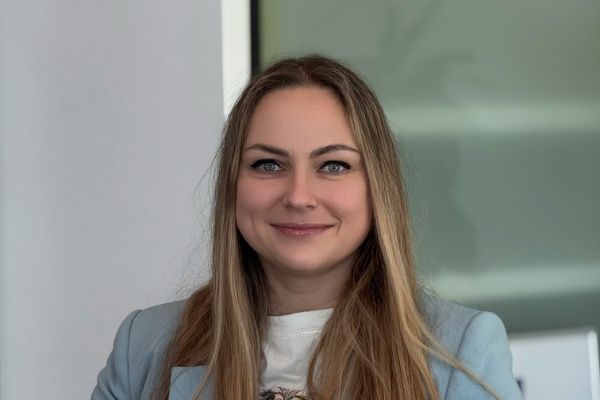
· Ivona Gavrilova
Career development is not a coincidence – it is the result of conscious choices, persistence, and the ability to derive meaning even from challenges!
Introduce yourself in a few sentences..
My name is Ivona
Gavrilova and I am Director, Talent Acquisition at Paysafe, responsible for building the
employer brand of the company in Bulgaria and globally. My role allows me to combine two
areas that are extremely interesting to me and related to my education –
Advertising Psychology and Labor and Organizational Psychology. I have been part of
this company for over 8 years, during which time I had the opportunity to go
through various roles and contribute to the growth of different departments in
our company. Personally, I am happily married and a mother of two wonderful little
girls who teach me something new every day.
What did you dream of becoming in your childhood years?
As a child, I dreamed
of becoming an artist – for over 12 years I actively engaged in drawing, but as
the years went by, I decided to change direction without giving up on creativity. In
my current position, this previous experience is extremely useful.
At what age did you earn your first money? Tell us an interesting story?
I started my first
job at 16, with the idea that it would only be for one summer, but I found myself in
a great environment and with a first manager with whom we built long-term relationships.
At this place, I also went through my first “career development” – from making
cappuccino (which was associated with unexpectedly many burns for me) to being an
employee of the travel agency that was connected to the establishment where I worked.
What are the main factors and examples that shape us as individuals at an early age
and form our interests? What is your recipe for curiosity, sources
and wells of information and inspiration at this stage of our human development?
In my opinion,
the main factor and example at an early age is family, and especially parents.
Their example, hard work, and loyalty can lay very stable foundations
for long-term development. And curiosity is something a person carries within, and it
is up to them to decide whether to nurture and develop it.
Has there been any significant change in your perceptions in a more mature age about what
motivates you to do or not do something?
I have always believed
that motivation should come from within. Yes, the environment, the team, and in
the work aspect, the manager are key factors, but in my opinion, a true
professional cannot rely on external motivators but must discover for themselves
why they do something and what the next steps for development are.
Whose decision was it where to pursue higher education and what to study? Was this
decision correct, looking at it from today’s perspective?
The decision of where and
what to study was mine, but it was definitely influenced by my background and
upbringing, and the examples in my environment that I saw. Today, I am
extremely satisfied with my choice, but not for the reason that was leading for me
when I was 19, namely – to escape further from mathematics, as at
this moment calculations and working with data are part of my daily life.
Share more about your interests, knowledge, skills, and hobbies?
Currently, I have a strong interest in the area of enhancing the employer brand and
how external communication is linked to internal. I strive to
understand my colleagues' needs better and help them feel
comfortable in the company and their role. In my understanding, there is no better advertisement for
a company than the satisfied people who are part of it.
Would you change your profession today and which fields of activity capture your interest?
I would not change my profession,
but I would definitely like to upgrade some technical skills in the area of
data visualization and work with specific tools for that purpose, such as Power
BI.
They say that personal branding is everything that people say about you when you are not in the same room with them. What would you like to hear today?
I would like to hear that I am an example for younger colleagues who have a genuine desire for
work and identify with the values of the company they are part of.
Emotional intelligence, adaptability, and flexibility, as well as our soft skills are
key conditions for success in recent years. How do you cope with
the daily challenges of life to stay in good shape and
mood?
Every day after
work, I try to spend as much time as possible with my family and
use every opportunity to travel together and create memories and
discover new places.
What are the most important conclusions you have drawn so far about maintaining the right
communication considering the different characters of the people you meet
daily – colleagues, friends, close ones?
The most fundamental thing for
me is that I listen to people, not to respond, but to understand them. All my
close ones – both at work and in personal life know that they can always count on
me – for help, advice, or just support.
What do you think about money? What is their influence on your life? What is your advice to
people who often ask themselves questions related to money and how sufficient they are?
I believe that money is undoubtedly important – not only as a means
of survival but also because they provide a sense of stability and peace. When
one is not constantly under pressure due to financial difficulties, they have more
freedom to focus on things that are pleasant, interesting, and constructive –
whether it is personal development, hobbies, travel, or time with loved ones.
At the same time, I believe it is important that money does not become
an end in itself. My advice to people who often worry about their financial
security or ask questions related to money is to not forget the other
aspects of life that have value – health, relationships,
satisfaction from daily life. The balance between the material and the immaterial is
what actually brings a long-term sense of fulfillment.
What is the most valuable career advice you would give to people?
The most valuable career advice I would give is to have a clear
direction and to be consistent in your efforts – but also to be open to
the lessons that each stage of the journey brings.
I believe that career development is not a coincidence – it is
the result of conscious choices, persistence, and the ability to derive meaning even
from challenges. Every experience, every role, even if it seems peripheral at
first glance, leaves a mark and contributes to what we do in the long term.
It is important to maintain focus on the direction we have
chosen, but also to realize that every step along the way builds us – and
often it is the accumulated knowledge from different contexts that makes us more adaptive,
confident, and prepared for the next level.