Career planning is our personal business plan
· Mihail Dokov
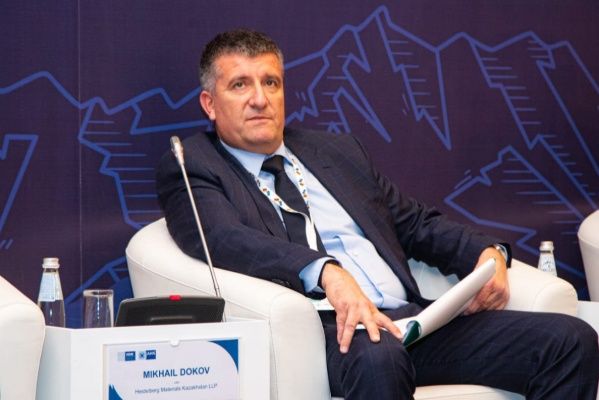
Today everyone talks about AI, but let's remember that it is just a tool, the effectiveness of which depends on the operator!
Introduce yourself in a few words…
My name is Mihail Dokov, I am 50 years old and I am currently the
General Manager of Heidelberg Materials (Heidelberg Materials) in
Kazakhstan.
How would you describe your career in a few words?
A Rollercoaster. Officially,
my career started in the late 90s, but I have been working since my
school years. I have been involved in various things and in different fields over
the years. I have gone through many industries that have little in common with each other-
heavy manufacturing, industrial chemistry, wholesale, retail,
telecommunications, as well as short-term projects in various directions such as construction,
pharmacy, finance. I first became a functional director in an international
company 22 years ago
What was the most important choice that shaped your path Inyou?
Perhaps the decision in the late 90s to seek and start working
in the corporate world. This period was full of many opportunities, but also many
temptations for a young person, which from today's perspective can be interpreted in various ways.
Therefore, the decision to seek such development was largely conscious.
What would you like to know at the beginning of your career,
but no one told you?
I believe I was and am lucky to have good teachers from
the very beginning and with few exceptions, I have always received the appropriate and
necessary advice. Over time, however, I realized that there is such a thing as career
planning. It is good for a person to get acquainted with this concept as early as possible, in
the ideal case, when the current situation is favorable, to avoid
the stress coming from the risk of failure. Moreover, career planning will
provide a roadmap and compass for the young person, which will facilitate adequate setting
of long-term and short-term goals. This is valid for both employment and
entrepreneurship. This is the personal “business plan” - what I want to live
from and what I am willing to give in return, so that I enjoy the process.
If I had received such advice at the beginning of my career, I would have saved a lot of mistakes from ignorance and most importantly time. And as we know, time is a
non-renewable resource.
How can a person understand which profession is suitable for
him?
By experimenting as much as possible. Allowing oneself
to make mistakes and learn from them. Trying and learning new things. This does not mean
changing jobs frequently, but expanding one's horizons. This can happen
through hobbies, new social relationships, changing locations, sports, etc. Constantly
expanding competencies and seeking opportunities to change roles
even within one company. This goes hand in hand with education and
subsequent qualification. We live in a time when it is not uncommon for people even at
my age, and even older, to need to retrain. The speed of
change will not slow down, and this requires quick adaptability. Otherwise,
a person can quickly find themselves on the periphery.
Which skills according to Inus will be
key in the next 10 years?
Even 20 years ago, there were specialties in universities that “trained” for professions that would already be non-existent by the time of graduation. Today, this is even more frightening as a concept. I believe we will have to discover and master new skills, but also rediscover old ones. We must not forget about personal qualities. For example, today’s managers are the last ones who are managers only of people. In the near future, teams will have full-fledged robot members. This comes with new requirements for planning, organization of work, and professional ethics. Today everyone talks about AI, but let’s remember that it is just a tool, the effectiveness of which depends on the operator. It is like the different result from the use of a scalpel in the hands of an experienced surgeon or a criminal with unhealthy intentions. I remember the time when I worked even without email or any management systems. So, the tools will evolve and we must learn to apply them. From soft skills- adaptability, ability to learn quickly, ability to filter quality and meaningful information. I believe that patience and loyalty are a scarce “commodity” and will be well valued in the future.
How to build a network of useful contacts without appearing interested?
There is hardly a straightforward answer to this question, it is very
individual. The act of building is a long process, so we must be
patient, and also know what we can offer to the other party.
Over the years, the “usefulness” of contacts and the existence of a network has been a contentious
issue if they are based only on temporary interest, so I personally no longer
consider it justified to focus on building a network just for the sake of
having it. In my opinion, it is better to concentrate on quality, sincere,
partnership, and friendly relationships that withstand the test of time and are always
useful.
What is the biggest mistake you have made in
your career, and what did you learn from it?
I wish I could point out just one specific one, there are many.
Rather, I have focused on my personal qualities and shortcomings that have
led me to mistakes. I continue to learn to view mistakes as
lessons, because then positive effects emerge that help in the future or
help to fix things faster.
How to recognize a toxic work environment and when is it time
to leave?
The problem with a toxic environment is that it does not always
manifest immediately or is visible on the surface. It often manifests the syndrome of
“boiled frog”. There are, of course, ambiguous criteria. For me, respect for
human dignity and the fact that “everyone has a place under the sun” has always been
paramount. If I notice that someone’s dignity is not respected by a boss, a colleague, or even a subordinate, that
is a sure sign for me that the environment is or will become toxic. It is very important who
you work with, not what and where. I can happily say that there are people with whom I could
work regardless of what and regardless of where, and we would succeed. I
don't know how it will be with robots and their “dignity”
What would you do differently if you could start
over?
Perhaps the same again, I do not regret my choices. But I
would certainly improve the timing and planning (career planning). This would save me
energy and give me time for more experiments.
How to maintain our motivation in times of stagnation?
First, we need to be aware of the reasons for the stagnation.
A critical view is needed. It is harder to admit that the stagnation is due to us
ourselves, but this makes it easier to seek solutions. If we find within ourselves
the reasons, motivation will come as we start working on removing
them. If the stagnation is due to reasons beyond our control, it is good to share with colleagues,
with bosses, with friends, with consultants. Let’s not forget that stagnation is also
a flexible concept and can have both time parameters and functional ones.
Experiment..
How to achieve a balance between professional and personal
life?
Achieving this balance is not a one-time act, but a
proactive and dynamic process. I have found myself thinking that I have achieved it,
but in the next moment I see that it can be better. And vice versa - to disrupt
your balance or to be taken out of it. Metaphorically speaking, for there to be
balance, work must serve as an energy accumulator for personal life and
vice versa. When work is satisfying, we do not bring problems home.
Harmonious relationships in our family give us the motivation and energy to be good at
our work. I would also add different interests, hobbies, friendships, and,
of course, sports.
If you had to give only one piece of advice to people who
are seeking success, what would it be?
Define exactly what “success” means to you and how you will
know that you have achieved it. Be as specific as possible in your definition. And
work.
What is Inyour definition of
“successful career”?
One that constantly improves one or several of
the parameters - work environment, work-life balance, compensation, new
projects, new locations, new competencies. Any career that leads to some
form of improvement or enhancement for me is “successful”. And this does not
necessarily correlate with the position held.