Communicating with interesting people gives meaning to our daily lives
· Gergana Boneva
It is very important not to view our professional path as something fixed, but as a process – a path that we can (and should) rethink, especially when we feel that something is missing!
Introduce yourself with a few sentences!
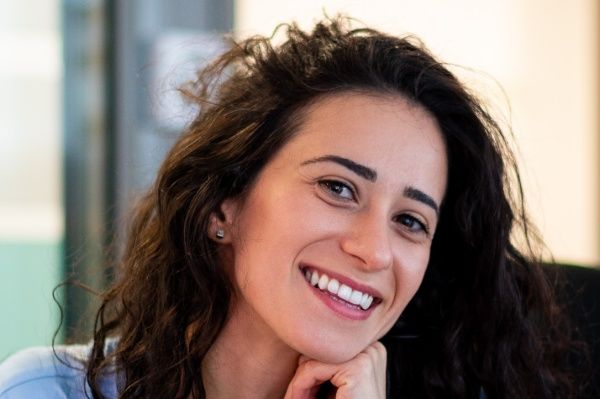
My name is Gergana Boneva and I am part of the team “Corporate Affairs and Communication” at JTI Bulgaria. I have extensive experience in the field of public communications and over the years I have worked in various industries, which helped me develop skills in managing internal and external communication, as well as in building strategic partnerships.
I am also strongly committed to JTI Bulgaria's initiatives in the field of corporate social responsibility. It is important for me to contribute to creating a better environment for the development of people and communities that traditionally receive less support and opportunities.
What did you dream of becoming in your childhood?
When I think back to my earliest childhood memories, I realize that I always dreamed of being an artist. I held concerts at home, danced, took on different roles – probably something completely ordinary for many children. As I entered my teenage years, I found an outlet in music and cinema even more often, but I also began to get interested in psychology.
Today I believe that the profession I practice is the best choice for the combination of interests and emotionality that I possess as a person.
At what age did you earn your first money? Tell us an interesting story?
I earned my first money at the age of 15 when I started my first job – as a waitress. I was very excited to go to work, not so much because I would earn money. For me, it has always been important to be useful – to myself, and often even more to others (I’m not saying that this is always the most reasonable choice). Since I was little, I had a need to be engaged in activities that I believed would make me more responsible.
What are the main factors and examples that shape us as individuals at an early age and form our interests? What is your recipe for curiosity, sources and wells of information and inspiration at this stage of our human development?
I believe that every child is born with natural kindness and curiosity. They come into this world with open senses and a huge desire to explore it. In the early years, the most important role is played by the people around us – family, close ones, even teachers in early childhood. The relationships we observe at home, the way adults communicate with each other and with us, leave an imprint on how we perceive ourselves and the world.
The emotions we share, the environment we grow up in, the sense of security – these are, in my opinion, the main elements that build personality. If a child is encouraged to ask questions, to try new things and to seek answers, they develop a sense that knowledge is an adventure, not an obligation.
My “recipe” for curiosity at this early stage would start with communication, games, and support. To this, I add books, time in nature, art in all its forms – and everything that can spark a spark in a child's imagination and suggest to them that the world is much bigger, colorful, and exciting than what we see here and now.
Has there been any significant change in your perceptions in adulthood about what motivates you to do or not do something?
Over time and with accumulated experience, I began to clearly distinguish between the things that develop and enrich me from those that simply “need to be done.” If in my younger years my motivation was often related to the ambition to prove myself or simply not to refuse opportunities, today, with a more mature perspective, I realize that my strongest drivers are two: results and the people I work with.
Results motivate me because they bring satisfaction and meaning. But they have much greater value when achieved in an environment of respect, cooperation, and shared efforts. A good atmosphere in the team – trust, care, and mutual support – is no longer a “bonus” for me, but an absolutely essential factor. These are the two things I do not compromise on – to see a real effect from my work and to feel that I am part of a team.
Whose decision was it where to pursue higher education and what to study? Was this decision correct, viewed from today’s perspective?
The decision to study “Public Relations” at the Faculty of Journalism and Mass Communication at Sofia University was entirely mine, as I received strong support from my parents. I have heard various opinions about the education there, but from personal experience, I can say that the faculty has exceptional teachers – people who can ignite the spark for the profession in every student, as long as they approach with an open mind and a desire to learn.
I am very satisfied with my choice because when I applied, I arranged my specialties according to what I wanted to work in the future – and “Public Relations” was at the top. Of course, fate loves to present us with small lessons, and right at the beginning, I learned that not everything happens the first time – I was not accepted in the first ranking. But in the second ranking, only one place became available… and it was for me. I don’t know if it was luck or just fate, but I’m glad it happened that way.
I am proud to share that since February this year, I have been accepted into one of the doctoral programs at the Faculty of Journalism and Mass Communication.
Share with us more about your interests, knowledge, skills, and hobbies?
Over time, I increasingly realize that my greatest interest is the people I communicate with. I truly enjoy those conversations where there is a sense of connection, shared laughter, a common experience, or a dream. For me, these are the moments that give meaning to my everyday life.
Outside of human relationships, I find pleasure in various other things – I love going to the theater and cinema, reading, exercising, and lately I have been enjoying cooking more and more – as a small form of creativity.
Would you change your profession today and which areas of activity capture your interest?
Firmly no – at least not at this stage. I really like my job, the team I have the fortune to work with, and the company that stands behind us – with its values, culture, and attitude towards people.
For almost seven years, I have been part of a team that deals with public communication and regulations. I like the dynamics, the wide range of topics, and the fact that this role combines strategic thinking, quick reactions, attention to detail, and relationship-building skills. Satisfaction comes not only from the results achieved but also from the feeling that your work matters.
They say that personal branding is everything that people say about you when you are not in the same room with them. What would you like to hear today?
I would be happy if in such a situation people simply think: “I hope she stays with us a little longer.” For me, that would be the greatest recognition – not so much what is said, but the feeling I have created with my presence.
What is most valuable to me is when someone sincerely asks me why I am leaving or if I can stay a little longer. In such moments, I feel that I have been a meaningful interlocutor, a person with whom the conversation is pleasant and meaningful. I wouldn’t want superlatives to be said behind my back – it’s enough for me to know that I have left a pleasant feeling in my interlocutors.
Ultimately, if people remember that you were not just there, but that you were present with attention, attitude, and authenticity – that is the best you can leave behind.
Emotional intelligence, adaptability, and flexibility, as well as our soft skills, are key conditions for success in recent years. How do you cope with the daily challenges of life to stay in good shape and mood?
Emotional intelligence, adaptability, flexibility, and so-called “soft” skills, in my opinion, are among the most important factors for success. But besides being key for professional development, I believe they are also at the core of being in harmony with oneself.
I have walked a long path to learn to manage my energy better – both physical and emotional. One of the most important lessons I learned along this path was not to live with the thought that someone else's negative energy is provoked by me or directed only at me. Very often, other people's reactions have more to do with them than with us. Learning to make this distinction is a huge step that helps us feel better in our daily lives.
I think adaptability and flexibility are qualities that can be trained – and we must consciously challenge ourselves when something scares us or seems unfamiliar. New challenges at work – those that make us hesitate slightly – actually keep our shape, confidence, and ability to develop. It’s like physical training – if you stop moving, you start to lose the strength you possess.
For me, taking care of my inner state is very key to feeling good – with small steps, care for yourself, so that you can be useful to others as well.
What are the most important conclusions you have made so far about maintaining proper communication considering the different characters of the people you meet daily – colleagues, friends, close ones?
As a professional engaged in communications, I realize that I have often been too demanding of my interlocutors – whether colleagues, friends, or close ones. Sometimes unconsciously, I have expected their thoughts and expressions to follow my logic, to be clearly structured, and even to sound the way I want them to. This naturally leads to dissatisfaction in communication because the truth is that very rarely will someone tell us exactly what we expect – unless there is a specific reason or purpose to do so.
Over time, I came to an important conclusion – and I would even say a skill – that the true value in our communication with others comes from the ability to listen. Active listening gives us not only more understanding of the other person but also unexpected insights about ourselves. When we listen attentively, without immediately thinking about what we will say next, communication becomes easier and more meaningful.
And one more thing – although not so fundamental, but still useful: sometimes we happen to talk to people who just love to hear their own voice. For them, dialogue is not so important – they rather use communication as a stage. In such cases, there is no need to fight to be heard at all costs. Sometimes it’s better to save our energy for conversations where there is real communication, namely – dialogue.
What do you think about money? What is their influence on your life? What is your advice to people who often ask themselves questions related to money and how sufficient they are?
I believe that money is an important part of life – not as an end in itself, but as a means. Every person needs security: a roof over their head, food, the ability to take care of themselves and the people they love. For me, money is exactly that – a tool with which we can “buy” the peace of mind that our basic needs are not a problem in our daily lives. Only then can we calmly engage in dreams, development, creativity, ideals.
At the same time, I am convinced that money should never be the only driving force. I have worked in a position with very good remuneration, but in an environment where goodwill was lacking. There was no trust, the necessary energy, and inspiration to achieve our goals. This experience showed me that money cannot compensate for the feeling of teamwork
My advice to people who ask themselves “How much is enough?” is to try to answer another question: “What brings me satisfaction?” If money is the only answer – maybe it’s time to look deeper. Money is important, but not when it costs your inner peace, health, or the joy of what you do.
What is the most valuable career advice you would give to people?
The most valuable career advice I would give is for a person to regularly ask themselves the question: “What makes me happy at work?” and “Do I see meaning in what I do?” It is very important not to view our professional path as something fixed, but as a process – a path that we can (and should) rethink, especially when we feel that something is missing.
It is good and often to ask ourselves the question: “What is the next step that will make me feel useful?” When our work has a clear meaning – for us and for others – motivation comes naturally.
And of course, if we have this opportunity, let’s choose a work environment that gives us the freedom to develop our skills and potential.