Every journey is a source of fresh ideas
· Boris Mechkuyev
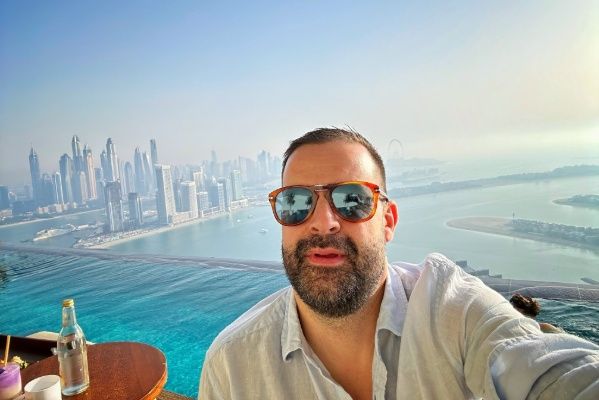
Breaking traditional stereotypes about business based on atypical business models for the area where you live is a serious joker!
Introduce yourself in a few words..
My name is Boris
Mechkuyev, a representative of a fourth generation of artists. I graduated from
the National Academy of Arts in Sofia. For the last 30 years, I have been
involved in creating corporate exhibition stands all over the world. I grew up
professionally in the company “Mechkuyev Design” – a family business that is a leader in
this industry in Bulgaria, and for the last two years, I have been heading the “Exhibitions” department at Euro
Games Technology – one of the fastest-growing Bulgarian companies on a
global scale. I am responsible for the realization of all corporate pavilions of
the company at the events it participates in worldwide. Apart from that, I am the main
shareholder and co-founder of the Home for the Elderly “Petrich”.
What does traveling the world mean to you?
Traveling the
world for me is a choice, sometimes it is an obligation, but often it is a necessity. It happens
that I am far from my family, changing cities and time zones, sometimes I
wake up and for a moment I don’t know where I am. The absence weighs heavily, but every new place gives me
something valuable – color, sound, taste, lesson. I don’t learn from textbooks, I learn from the streets, from
people, from local food, from the events I attend.
I seek inspiration –
sometimes in a noisy market, other times in a lonely mountain. And I find it. Always. Because
this restlessness, this thirst to discover, leads me to the next project,
the next idea, the next “me”.
How many different countries have you seen so far? Share with us
an interesting story or highlights from your travels?
I have been to about
75 countries. Some I have seen almost fleetingly, in others I have stayed longer and
had the opportunity to explore in more detail. The highlights from so many
travels are hard to be uniform, but when I travel for pleasure, I try
to combine historical landmarks with a good place to relax at the end of
the trip and a highlight with some interesting and colorful metropolis or pristine
natural treasures. Most travels are based on the main rule
“Maximum result with minimum effort,” which means short time, a tight
schedule, and a pragmatic approach to selecting sights – and all of this
packed into an economical budget.
Do you like to repeat destinations? Give examples and
motivation “for” or “against”?
Every self-respecting traveler asks themselves this question.
The world is big, colorful, and full of wonders – it’s logical to want to see as much
as possible. As a pragmatist, I tend to favor travels to the new, but
sometimes there are places that remain in the heart. And then you return, because you seek
something deeper. The first trip is often superficial – you roam
sights, try typical food, take pictures of the most famous views. But
one place reveals itself truly upon a return visit. You start to feel it,
not just see it. You talk to the locals, find nooks that are not in
any guidebook. And most importantly – you yourself are already different. Returning,
you see the same place with new eyes. Of course, there is always the temptation to discover new
horizons. But sometimes inspiration, relaxation, and true stories are hidden not
in the unknown, but in the familiar, experienced again. For me, repeating
destinations is not a loss, but a deepening. It is a journey not only in
space but also in time. A rule for me is to repeat only places
that have truly impressed me.
What was your first trip that truly changed you
as a professional and can be said to have changed your thinking?
The year 2007
was the moment when I started traveling. At that time, I visited an exhibition in
Shanghai. This trip and the opening of the door behind which lay the freedom
to see how people on the other side of the world do work like yours, and how
colorful and contrasting it is, related to culture, religion, even climate –
it was unforgettable and very useful for learning to adapt to
global approaches and trends.
What do you learn about yourself and your professional skills,
when you are in a new cultural environment?
Sometimes I
pride myself on what I demonstrate in my work, and the accumulated experience speaks
for itself. There are also cases when you tell yourself that you could do better – and you seek
a way to enrich your own possibilities. Precisely because you have the chance to be in
this incredibly different place and absorb as much knowledge as
possible from the source.
Have you
met people or ideas during your travels that have influenced your career Vand path?
My work is
related to the constant need to create a fresh flow of ideas and travels
are crucial for my development. All artists suffer from
the fear of losing inspiration.
We live in a consumer society where fresh ideas are the greatest wealth
– and I can boldly say that every journey is a source of that wealth.
Do you think
that your travels help you expand your professional network? How?
Of course, my
travels help me expand my professional network. My work is directly
related to organizing and participating in forums with hundreds of thousands of people –
everyone with one goal: to expand their professional network.
What skills
do you develop the most when you travel, and how do they reflect on your work Vand?
I develop skills
for orientation, for adaptation, for dealing with all kinds of stressful situations in
the field. There is almost no exhibition without some situations of the most diverse nature. In
dealing with them, you gain confidence and assurance – which makes you feel
at home, wherever you are in the world, even if it’s your first time.
Is there a city
or country that has Vand inspired you to start a new business or project?
Creating a
home for the elderly in the city of Petrich with friends was inspired by Germany –
a country known in my field as the “soft” of trade exhibitions. My frequent
business trips there gave me the opportunity to touch upon social
policy and the attitude of Germans towards the elderly. The German model impressed me
with respect for the individual, a homely atmosphere, and high quality of
services. There, old age is not loneliness, but a period of dignified and active life. I saw
the opportunity for this concept to be applied here – by creating a home
that combines professional care, attention, and an individual approach.
I believe that
good European practices can be the basis for a stable business with a mission.
When you are in
an unfamiliar country, do you feel more motivated or more distracted? Why?
To avoid being
distracted, I allocate a large resource to planning. I prepare a program for each trip,
with each day planned almost down to the hour. It contains information – from
a budget for specific activities to a weather forecast. This approach makes me
more prepared and often creates the feeling that I have already been there.
Are there
destinations that act as a “restart” for your creativity and ambition?
Only true
rest can qualitatively restart you. These are the destinations that connect you with nature – without a strict program, with cocktails by the pool,
contemplation of the jungle or ocean, lounging on the beach at sunset.
How do you
manage the balance between work and pleasure when you travel?
My passion for
travel balances with work and makes me feel useful while
practicing my hobby.
How
have travels changed the way you perceive the value of money?
I had a period when
everything I earned was calculated in plane tickets. But over time and
family life changed this way of thinking.
Do you travel
with the goal of finding new ways to make money?
I do not travel with
a specific profit goal, but I always look for ideas for business ventures that are unpopular
here.
According to Vis it better to spend on
experiences rather than material possessions?
I think these are different periods in everyone’s life and it is
impossible not to have swayed in both directions. The truth is that there must be
a balance. We cannot do without either one.
How do you see
the future of digital nomadic life?
Digital nomadism is something I do not understand. I don’t
think it is a permanent phenomenon; in my opinion, it is for people of a certain age.
I am structured, no matter how much I travel for work or pleasure, always
in the end to return to my own home.
I am attached to my family and home and do not exchange it for endless
travel, even if it is the most exciting.
What are the destinations you would definitely recommend
to be visited and why?
Costa Rica – Nature is preserved and is in an incredible
symbiosis with tourism, without interfering with each other.
Myanmar (Burma) – The people and history together with nature.
A country that has been in civil war for many years and closed to the outside world has
preserved the ideals and values of the local people, and one feels very
well there, despite the heavy misery and poverty of the population.
Japan – It definitely has to be the cherry on top for
every traveler. Traveling to Japan is in most cases not like traveling
to another country or continent, but rather like traveling to another planet.
The main factor is the people and their energy for that feeling. A place where
you walk smiling down the street, but have no clear idea why.
What is the career advice you would give based on
what you have seen around the world?
Breaking traditional stereotypes about business based on
atypical business models for the area where you live is a serious joker, so
I would advise - Travel, seek, find and do not hesitate to
experiment. Measured risk is at worst a good lesson.