I have the ability to awaken search in others
· Martin Petrov
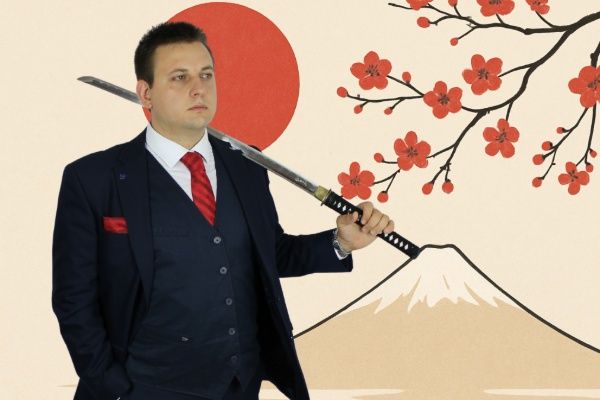
Many people rush into seeking titles, successes, money — without stopping to ask themselves: "Is this my path? Is this my place? Is this my pace?"
Introduce yourself in a few sentences..
My name is
Martin Petrov. I was born in 1990 in Sofia. I grew up in a panel block in one
of those neighborhoods we all know – with small entrances, dusty
inter-block spaces, and friendships that start with "are we playing
today?". I was a child who observed more than spoke. I listened to how
adults argued about politics, about money, about "what it was like
once", and I wondered why no one asked the question "but what is
important now?". Perhaps that was when my need to understand things more deeply began.
In school, I wasn't a top student, but I thought a lot. I didn't like
ready answers. "Because that's how it is in the textbook" wasn't enough for me. I asked.
Often annoyingly, often stubbornly. Then I discovered philosophy, Japanese culture, and
something in me fell into place. Like finding a word for a feeling you’ve carried your whole
life but didn’t know how to name. That was Bushido. Not as an exotic concept, but as a
principle – honor, integrity, responsibility.
Over time, I began to create trainings, to work with
companies, to speak in front of people. But I never wanted to be a “motivational
speaker”. That sounds to me like someone who comes, makes noise, hands out phrases, and leaves.
I want to be a person who stays. Who helps you ask the right questions – even if you don’t
get the answers right away. I have worked with
tech giants and small family businesses. With both types of people, I have sought
one thing – to create value and meaning together.
I don’t believe in “quick results”. I believe in
the process. In everyday life. In the small choices that are not visible, but shape you.
And I believe that leadership does not start
with a title, but with what you do when no one is watching. I
am not looking for a stage. I am looking for essence.
What did you dream of becoming in your childhood?
As a child, I had
one recurring dream. I stood in front of people, speaking, but not as an orator or artist —
but with some strange ease and sincerity. I didn’t know exactly what I was saying, but I felt
that I was touching them. They looked at me attentively, listened to me, not because they had to,
but because they wanted to. I woke up with that feeling that you can’t frame – something
between inner security and strange responsibility. Today, I explain this dream as
my first encounter with the feeling of calling – not as a profession, but as a
reason.
I went through all the typical childhood dreams – first I wanted to
become a lawyer, then a doctor, then a volleyball player. One would appear, the other
would disappear, then a new one would come. But the dream remained. The feeling remained. It was as if
all those dreams were attempts to name it.
This feeling pushed me to search. I started asking
many questions – about the world, about people, about myself. I began to read, to dig,
to understand how we think, why we do what we do, what blocks us,
what drives us. I wasn’t looking for “answers” in an absolute sense. I was looking for
movement, a change of perspective. And in this process, I gradually realized that
I have a gift — not to give wisdom, but to ask in a way that people reach their own. To make them stop for a moment, to doubt their habitual way of thinking, to break the routine and feel something different in themselves.
I don’t think I have fully discovered myself. I think I am
a person in motion. But I know that today I can say: I have discovered something important along the way
— that I have the ability to awaken a search in others. To inspire not with
slogans, but with questions. To make change possible – slowly, in small doses, but
lasting.
At what age did you earn your first money? Tell us
about an interesting incident?
I earned my first money
when I was 12. My father had an acquaintance who had a villa with a large,
uneven yard. He decided to level it and needed help. The work was
simple but hard — we had to carry over 50 cubic meters of soil with wheelbarrows. All
day we walked back and forth, filling, pushing, dumping. The sun was strong,
and my hands were still childlike, but persistent.
In the end, I was
covered in mud, exhausted to the bone, but strangely happy. I remember how we sat down at the end,
had a lemonade, and I held my first money in my hand. They were not just
banknotes — they were proof that I could. That hard work, even if heavy, brings a sense
of value. Not because of the money itself, but because of the journey to it. The feeling that something is
done well, and that you did it. Alone.
That feeling
stayed with me – and to this day I believe that nothing replaces that quiet satisfaction,
when you finish hard, real work and know that you didn’t slack off. I’m not
sure if from then on my life has always been so simple in
its equations, but that first lesson was clear: value comes from what you put in, not
from what you get.
What are the main factors and examples that shape us
as individuals at an early age and form our interests? What is your
recipe for curiosity, sources and wells of information and inspiration in
this stage of our human development?
Has there been any significant change in your perceptions
in a more mature age about what motivates you to do or not do something?
As a teenager, I wasn’t one of the “exemplary”. I was on a
path that at times seemed like a slide downwards – fast, convenient, but
empty. I lacked direction, and perhaps people to show me one. There was
rebellion, there was apathy, there was also fear — of myself, of not being enough, of
not knowing where I belong.
But then a few people appeared. Not as saviors from
a novel, but simply as people who spoke the truth to my face. Mentors, teachers,
random but key figures who didn’t try to make me a “good
student”, but encouraged me to think, to ask, to doubt. To
earn. They taught me that nothing real in life comes easily. That it’s not shameful
to fight, to work hard, to fall, to get up.
Only after high school, in college, did I start to feel what
education means in a deeper sense. Not as grades and diplomas, but as
the opportunity to awaken to something new. There I discovered another beauty – that of
knowledge, which no one had shown me before. Not as an obligation, but as
a fire. And that fire burns in me to this day. It drives me. It makes me hungry to learn,
to read, to understand, to develop — not to prove myself, but to become
more than what I was yesterday.
I think curiosity is not an innate talent. It is a
choice you make when someone shows you that the world can be deeper,
more meaningful, and more beautiful than you believed. I was fortunate to meet such
people. And since then I want to be one of them – for others.
At first, I did many things to prove myself. To
others. To myself. To some imaginary judge sitting in the corner and keeping
the score. I worked hard, often to exhaustion, because I wanted to show that I could.
That I am valuable. That I deserve respect. It was like an internal struggle, in
which you never fully win, but only postpone the next round.
Over time, however, something changed. Or maybe I
changed. I realized that living through the eyes of others is a trap — quiet, but
insidious. There is no victory in someone liking you if you can’t stand yourself in
the mirror. I started asking myself different questions: not “will this be liked?”, but
“does it make sense?”, “does it bring me joy?”, “does it help?”.
Today, I am driven by different things. Not applause, but
the feeling that what I do brings change. That it creates space for people
to think differently, to doubt, to awaken. I am glad when someone tells me that after our conversation they made a turnaround or that they stopped for a moment and
asked themselves "wait, is this how I want to live?". That has value.
My motivation is no longer in the external effect, but in
the internal resonance. The question is not “did I prove myself?”, but “did it make sense for both
of us from what we did?”.
Whose decision was it where to pursue higher education and
what to study? Was that decision correct, viewed from today’s perspective?
My education is a peculiar combination — both a series
of coincidences and perhaps the best choice I have made. I have two
bachelor's degrees and two master's degrees, but the beginning was far more uncertain.
Initially, I wanted to study economics at Sofia
University. It didn’t work out. At that time, I took it as a failure. Today I see it as
the first tile in a beautiful domino. That’s how I ended up at MT&M college — a place
I didn’t know, but which introduced me to an education I hadn’t expected.
Theory and practice went hand in hand. We learned, but also applied. And most importantly —
we had teachers who didn’t teach from the bottom up, but talked with us. This
place awakened me. It showed me that learning can be an experience, not just an obligation.
The college we called “the Danish” inspired me to go
to Denmark and continue my studies there. And so I did. There I completed my second
bachelor's degree. Not because it was planned. But simply because a door opened, and I
decided to walk through it.
When I look back today, I see not a strict plan, but
a series of random coincidences. Each one has led me to the next — without
guarantees, without big ambitions, just with the trust that if you take steps
consciously, the path aligns. And indeed — it aligned beautifully. Now I am facing
the next step in my academic career, namely the doctorate. The next
domino is almost fallen.
Share more about your interests, knowledge, skills, and
hobbies?
My interests have always been diverse. I am excited about
topics like education, civil society, politics, volunteering. Everything
that touches the public, that “greater than me”, has always found a place
in my thoughts and attention. Perhaps because I believe that change does not start from
systems, but from people. From conversations. From position.
Japan also holds a special place in me — not as
exotic, but as philosophy. Bushido, Ikigai, Kaizen – I don’t perceive them as
“concepts”, but as a way of existence. Origami, as much as it seems like
a hobby, is for me a practice of attention, focus, patience. Calmness. I think that
a person needs things that are not “useful” in the classical sense, but simply
help them to be whole.
As for the skills I have developed in working with
people – I would say the following. I have learned to listen. Truly. Not to wait for my turn
to speak, but to enter the world of the other, to understand where it hurts, what is missing,
what is not being said. Over time, I developed sensitivity to nuances — not only in
words, but in the pauses between them.
I can also see structures where others
see chaos. I can organize not only information but also thoughts. To ask the question
that unlocks. Not because I am smarter. But because I care. This is perhaps
the most valuable thing – that people feel that I am not leading them by methodology, but by human
connection.
Would you change your profession today and which fields of
activity capture your interest?
At the moment, I am practically juggling between several professions —
marketing and PR, training and leadership, artificial intelligence, startups, and
funding. To someone on the outside, this may seem chaotic or even greedy —
as if you can’t choose one. But for me, all of this is one and the same thread —
a search for impact. In different environments, with different tools, but with one and
the same intention: to contribute.
I wouldn’t change these professions. Each one gives me something
different — perspective, depth, flexibility. They do not compete with
one another, but complement each other. Marketing teaches me to formulate messages. Leadership —
to create meaning. Artificial intelligence — to look to the future without losing
humanity. Startups — to take risks, to believe, to lose and start again.
Funding — to see reality and think strategically.
And if one day I add something else — it will only be if it
truly inspires me. Not out of the need to do more, but out of the desire to
become more.
They say that personal branding is everything that people say
about you when you are not in the same room with them. What would you like to hear
today?
People most often seek me out when they need
perspective. Sometimes on topics like leadership, marketing, or personal choices. Other
times just because they know that they can talk openly with me — to vulnerability. Without
being judged. Without being offered a ready solution. Sometimes even just,
to ask them “what do you actually want?”. It’s not much, but often it’s
enough.
Most often, I am associated with Bushido and leadership. With the
philosophy of an inner compass that does not seek titles but seeks value. Over
time, more and more people seek me out, especially when it comes to communication – for
text, for messages, for the feeling of "I don't know how to say it, but I know it's important".
After I managed a media outlet in 2024, the spark for journalism ignited even more strongly
within me. I started writing more often, more directly, more uncompromisingly. And
people recognized it. Now, more and more, I am associated with this — with the voice that does not embellish,
but also does not destroy. It simply states things as it sees them.
In my personal circle, I have always been a bit of the "crazy one". Like
Alice in Wonderland — the child with wide-open eyes, asking "what's behind this door?". Or like that mad scientist who believes that the world can
be better, and therefore crashes into walls, sometimes with his whole body. I have always
been a dreamer, sometimes to the point of naivety. And yet — this stubbornness, this persistent
chasing of windmills has brought me the most meaningful encounters and the deepest
lessons.
If there were no limitations — neither in time, nor in
money, nor in circumstances — I would conduct training every day, but not just
trainings with slides and exercises. But those that change people from within.
Those in which neither I nor the participants leave the same as they entered. I would create spaces
where thinking is turned upside down,
understandings are shaken, and life begins to be lived with new clarity, new
responsibility. Spaces where we lead not with force, but with meaning. We inspire
not with words, but with presence.
I would read twice as many books as I have time for now.
Not because I want to "know more", but because reading brings me back to myself.
It organizes my thoughts, opens horizons that would otherwise remain invisible. Over
time, I feel that the more I read, the more I learn to listen. And
the less time I have, the clearer I understand what I am missing.
And I would spend at least ten times more time with
my family. Without extravagance. Just time. Presence. Real
conversations, walks, silences, laughter. If everything else disappears, this will be
the last thing I want to remain.
Emotional intelligence, adaptability, and flexibility
as well as our soft skills are key conditions for success in the last
few years. How do you cope with the daily challenges of life to
stay in good shape and mood?
The most honest answer is: with effort. There is no universal
formula. There is no morning ritual that guarantees inner peace. For me, everything
starts with awareness — what is happening within me, how I react, what blocks me.
Sometimes this means stopping, not reacting immediately, asking myself one more question.
Movement helps me — not just physical, but also
mental. To shift from a thought that pulls me down to one that
brings me closer to myself. Books, music, conversations with people
who do not want to "fix" me, but simply be present help me. And the awareness that
I don't need to be at my best every day — I just need to not give up
internally.
What are the most important conclusions you have drawn so far about
maintaining proper communication considering the different characters of the people you meet daily — colleagues, friends, loved ones?
I have learned that not everyone speaks with words, and that not always
the loudest person says the most important thing. Over time, I started to listen not only to what
people tell me, but also to why they say it that way. I started to make space —
for difference, for the pace of the other, for the pain behind the mask.
With people — colleagues, friends, loved ones — I try not to
take everything personally, but to take each person seriously. Not to put people in
categories. Not to expect everyone to be like me. To respect the different rhythm,
different style, different need. And most importantly — to admit when I
am wrong.
What do you think about money? What is its influence on
your life? What is your advice to people who often ask themselves questions
related to money and how sufficient they are?
Money is
an instrument. Neither good nor evil. Neither a goal nor a path. Just a means. And when
we treat it as something more than that — it begins to control us. I believe that
we should not be ashamed to want security, freedom, and opportunities. But we must
be careful not to confuse price with value.
There have been moments when I had less money but
more clarity. And the opposite — more money but less direction. The real question
is not "how much is enough?", but "what do I need it for?". If you cannot answer
that, it will never be enough.
My advice: money can be earned. Honesty, time, and
relationships — cannot. Money should serve your life, not replace it.
What is the most valuable career advice you would give to
people?
The most valuable
career advice I would give is: don't rush to climb before you know why
you even want to climb.
Many people rush into seeking titles, successes, money —
without stopping to ask themselves: "Is this my path? Is this my
place? Is this my pace?" Sometimes "success" makes us
lose ourselves because we chase other people's ideas and goals. We work to be liked,
instead of working to be useful. And then even if we reach "high",
we find that the view is not ours.
My advice: do not choose a career that looks good
from the outside. Choose a job where you can be yourself and which reminds you every day
why you are in this world. Then success comes — not as a goal, but as
a side effect of meaning.
If I had to be remembered in three words, I would choose:
change, value, meaning.
Change — because I believe that we are not born to remain
the same. The person I am today is not the one I was yesterday, and I will not be the same
tomorrow. If I have left a mark in someone's life, I want it to be in the fact that I have
helped someone to change — even with one thought, one decision, one
small step inward.
Value — not as market value, but as human value. I want to
know that what I give — ideas, time, attention — has weight. That it is not noise, but
something that remains. Even in silence.
Meaning — because that is the question that has always guided me.
Not "how", not "how much", but "why". Why do we do it? For whom is it important? If I have
served even one person to ask themselves this question — and to answer honestly
— then I have done my job.