Madrid and the Cheerful Attitude Towards Life
· Ivaylo Haralampiev
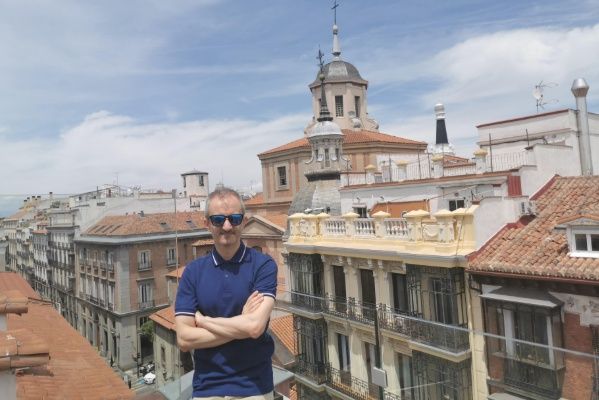
At the end of the 90s, the internet was barely making its way, and of course, none of the modern networks existed. The most important were personal and friendly relationships!
Introduce yourself in a few sentences. What does your work as daily commitments consist of?
My name is Ivaylo Haralampiev and I am a freelance journalist. I graduated from UNSS with a degree in “International Tourism”, I have pursued doctoral studies in Advertising and Audiovisual Communication at Universidad Complutense, as well as in European Integration and Development at Universidad Autónoma in Madrid. I work for Bulgarian and Spanish media, also in PR and advertising. I have also worked in the field of non-governmental organizations, mainly European projects related to education, combating bullying and discrimination, promoting reading and meditation as a means of inclusion.
In which country and city do you currently live and how did you end up there?
I have been living in Madrid for the last thirty years. I came with a scholarship for a master's degree in tourism from the Spanish Ministry of Economy, but I already had the dream to travel and live somewhere abroad, so the circumstances aligned in the most optimal way.
What were the biggest challenges you faced at the beginning of your stay?
The difference between Bulgaria and Spain in those years was huge on many levels, literally two distant worlds. The main challenges at the beginning were at the administrative level, legalizing the stay, etc.
How did you overcome the language barrier (if there was one)?
I graduated from a Spanish language high school in Sofia, so the adaptation to the language was very quick.
What resources or networks (local communities, colleagues, organizations) helped you adapt?
At the end of the 90s, the internet was barely making its way, and of course, none of the modern networks existed. The most important were personal and friendly relationships, both with some Bulgarians and newly formed ones, with Spaniards and people from many other nationalities. The great understanding and willingness to help from many Spanish institutions, including from people in general, was also positive.
What are the main differences between the work culture in your current country and that in Bulgaria?
Since I have worked as a freelancer for most of my career, I do not have a particularly strong view of corporate culture as such. Still, in both countries, especially in recent years, freelancing is becoming more widespread, accepted, and a full-fledged part of the work environment, which was not the case years ago.
What values and practices in the workplace impressed you the most?
I always say that I am in love with my work and therefore value the same, enthusiasm, love for the language and working with it, journalism as true creativity. From the media side, I am inspired by the desire and readiness to publish content that is interesting and valuable in itself, not necessarily tied to advertising or other business interests.
Have there been situations where cultural differences have hindered you?
I have always lived and worked simultaneously in both countries and respective cultures, so I have learned to constantly adapt.
How does finding a job differ in your current country compared to your homeland?
In the field of media, the process is quite similar, largely depending on personal relationships and connections, especially when it comes to freelancing.
Did you have to go through any additional qualification courses?
Rather, continuing education and training has been my initiative rather than a necessity, but logically this has probably had some influence. Today, specific knowledge and application of skills are valued much more, and the emerging AI will change the configuration very deeply.
Have you encountered prejudices or obstacles due to your foreign origin?
Although rarely, especially at the beginning, I encountered certain prejudices mainly related to the most commonly used clichés about Bulgaria in the media, which, like all clichés, carry some reality. At the end of the 90s, one of the most negative was about Bulgarians as luxury car thieves. On the opposite pole, I remember how in 1999 the topic Bulgaria opened a leading TV news broadcast with two news stories, united by the statement that Bulgarians are certainly a very persistent people, as they continued for three days trying to bring down the mausoleum, and they are also the last ones still searching for survivors from the earthquake in Turkey.
What would you advise people who want to take a similar step?
To prioritize whether they truly wish to share a certain way of life and values, rather than purely career expression and analyzing many other “real” factors.
If you could go back, would you choose the same path?
As hypothetical as it may sound, without any doubt, especially regarding my establishment in Spain and specifically in Madrid, where to this day I am strongly impressed and daily stimulated by the cheerful attitude towards life.
What do you miss the most from your homeland in professional and personal terms?
Always the closest personal relationships, but I have always traveled often, so this constant “bridge” is a huge additional advantage, both personally and professionally.
Have you considered returning and under what conditions would you do it?
Only abstractly, although in today’s increasingly dynamic and easily mobile times, such changes always remain on the agenda.
What do you think about money? What is its influence on your life? What is your advice to people who often ask themselves questions related to money and how sufficient they are?
One of the basic and leading driving factors in life. Important and (in) sufficient, always in relation to time and accordingly necessary for life to be achieved. It depends a lot on what the ultimate goal is. Very often, this ultimate goal can be achieved even more optimally by “skipping” money.