The world will not give you answers, but it will ask you better questions
· Yanko Chuklev
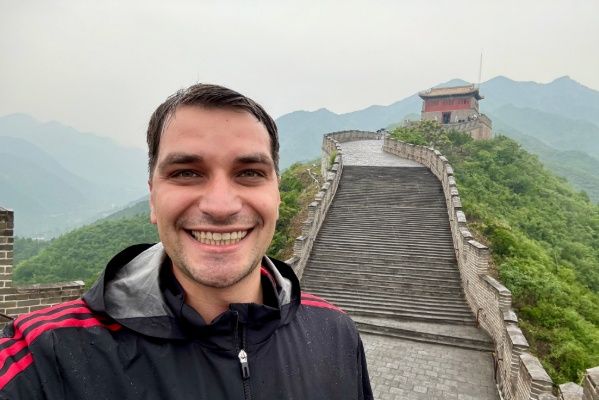
The transfer of ideas between cultures is the best capital!
Introduce yourself in a few words..
An advocate for the development of science, technology
and innovative businesses in Bulgaria.
Founder of a technology association, member of the board of one of the largest
business organizations in our country.
For you, traveling the world is?
The most fun way to learn. Emil
Zola said it: “Nothing develops the mind like travel.” Every country is a
new word, every city is a new sentence, and every new experience while
traveling leaves lessons for a lifetime.
How many different
countries have you seen so far? Share an interesting story or highlights from your
travels?
I am not one of those collectors of
countries who count visas like trophies. But in every place I have visited – from
the hot nights in the UAE, through the fog over the Thames, from the tall skyscrapers of New
York to the quiet shores of Montenegro. Everywhere I have left something of myself
and taken something that has shaped me.
We were in a business meeting in London with
a Finnish company. I was the only Bulgarian in the room. When it came to the question
of where I am from and I said “Bulgaria,” one of the Finnish colleagues said: “I know
that country very well, my uncle was the Prime Minister of Bulgaria!”. It turned out that the person is a relative of Yohan Kazimir Ernrot.
Do you like to repeat destinations? Give examples and
motivation “for” or “against”?
I am one of those people who love to
repeat destinations. The first visit is like a surface meeting. It is difficult
for a person to go beyond the tourist layer. In my opinion, the first time you discover,
the second time you understand, the third time you create connections. Repeating is not going
back, but a deeper immersion into the local culture,
mentality, and creating new friendships.
What was your first
trip that truly changed you as a professional and can be said to have
changed your thinking?
London. Not because of the architecture or
the pace, but the colorful palette of people I met. I learned a lot about
world finance, how the best universities in the world are built, how business etiquette
is enforced in the city. There I learned that improvement requires
change, and perfection – constant change. I realized that culture is not just
cuisine and music, but a system of invisible, yet powerful mechanisms: how we learn, how
we fail, how we succeed. All of this significantly changed my thinking.
What do you learn about
yourself and your professional skills when you are in a new cultural environment?
I learn that the new activates me. It makes
me more alert, more flexible, more attentive. In a world that changes with every sunrise,
the ability to adapt is gold. That is why I love both travel and
technology - both keep you in a state of (eternal) evolution.
Have you met people or ideas during your travels that
have influenced your career path?
Yes. A Greek financier in London told me
about his journey and how “Alexis Zorbas” changed his life. Not
a university, not a business book, but a classic novel. How knowledge about the structure
of ships from the ports of Thessaloniki turns into a master's degree, and from there –
business for financing ship assets in the City of London. In Kazantzakis's novel, there is a nice quote: “The only truth is to live. Not to
talk about life.” The Greek financier practiced it with many bold
decisions. Until I met him, I thought that some of the ideas from the Balkans are difficult
to apply in the rest of Europe, America, and Asia. He taught me that exactly
the transfer of ideas between cultures is perhaps the most powerful capital.
Do you think that traveling helps you expand
your professional network? How?
It helps everyone, perhaps one of
the main ways is that it removes prejudices. Traveling means discovering
that everyone is wrong about other countries. When you communicate face to face, distances
melt away and only trust remains. Trust is the foundation upon which every professional network is built.
What skills do you develop the most when you travel, and how
do they affect your work?
Writing skills, because I want to
chronicle everything. Language intuition for all kinds of languages – from Arabic to
Mandarin. Strategic thinking, because I often ask myself, “If the UAE created and developed
this industry in 10 years, why not in our country?” There is a saying: “A mind that is
stretched by a new experience can never go back to its old dimensions.” Perhaps it synthesizes best this collection of acquired skills.
Is there a city or country that has inspired you to
start a new business or project?
Not one specific place, rather the palette
of things. From the UAE I learned about vision, from China – about scale, from Italy – about aesthetics.
When you are in
an unfamiliar country, do you feel more motivated or more distracted? Why?
Both. Motivated because everything is
new. The new country pulls a person out of routine, comfort zone, and the familiar. This
is often a stimulus for learning and thinking outside the box. However, in global megacities
like New York, London, and Shanghai, excessive novelty can also be distracting.
There is always another museum, park, panoramic bar, or bookstore to visit. However,
despite that, balance comes with experience.
Are there destinations
that act as a “restart” for your creativity and ambition?
There are many. In the small villages near Volos
or among the cypress trees of Nea Anchialos, I learned that creativity is often
suffocated by noise. In Italy, especially in Tuscany, the restart comes through aesthetics.
There, even the farmers' market looks like part of an art installation.
Beauty is not a backdrop, but an active part of everyday life. In Bulgaria, sometimes
the simplest forests, paths, and reservoirs give me the deepest restart.
How do you manage the
balance between work and pleasure when you travel?
With a clear framework – structure: morning meetings,
afternoon walks, evening work.
How have travels changed the way you perceive
the value of money?
They showed me that money can
create realities, turning sand into a metropolis. However, money alone does not build.
They build when they are in the hands of a dreamer with a vision, an engineer with an idea,
or a builder with patience. Then they draw new horizons. Right there, travels
changed my perception of money - not as a tool for accumulation, but as
a means to accelerate change, as long as you know where you are headed.
What lessons about
financial independence have you learned from different economies and cultures?
In China, I learned that financial
independence is neither a sudden victory nor an individual sport. It is
a sum of small, consistent steps. There, you can see how entire families and
generations work together with a thought for 50 years ahead, not just for tomorrow. Also in Asia,
I learned about Buddhist economics and why consumption should not exceed
your peace of mind. I was surprised that entrepreneurs find time for
meditation every day because they believe that without inner peace, the outer is not sustainable.
Do you think it is better to spend on experiences
rather than material possessions?
Yes, because experiences do not
depreciate. On the contrary, over time they become more valuable and more vivid. Unlike them, things age.
How do you see the future of digital nomadic life?
It will become the norm for many professions. At
the moment, countries are competing to attract digital nomads. Even in
Bulgaria, such legislation has been adopted. One of the greatest minds said that the future
belongs to those who are independent of their location. I tend to
agree.
Are there specific
countries that are more favorable for work and investments?
The countries that are leading in the ranking
Doing business of
the World Bank are such. The combination of capital, talent, and legal security,
which they have makes them a magnet for capital from all over the world. Currently, these are
New Zealand, Singapore, Hong Kong, Denmark, South Korea, America.
If you could choose one place in the world to
develop your next big idea, where would it be and why?
In Bulgaria. Here I am connected to the people,
with the land, with the language. Moreover, when I feel the change around me, it turns
into fuel for even more momentum. I feel the progress in every project in
Bulgaria as a much greater reward than if it were realized abroad.
What are the destinations you would definitely
recommend to be visited and why?
China for the clash between the ancient and
modern, UAE for the touch of the future, America for the meeting between
talent and opportunities.
What is the career advice you would give based on
what you have seen around the world?
The world will not give you answers, but it will ask you better
questions. And it is in them that growth is born. Work hard. Travel harder.