Think, but make quick decisions and listen to your instinct
· Valentin Kuntorov
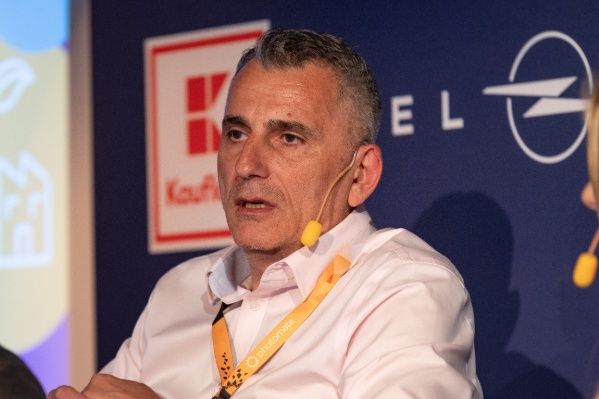
Think, but make quick decisions; in case of a mistake, don't waste time in self-pity, acknowledge the failure and start to recover the damages!
Introduce yourself with a few sentences!
Valentin Kuntorov, proud father of Daniel, 23, and Michaela, 18 years old. I am happy that we managed to create and raise wonderful young people, educated with values and morals. Professionally, I am a trader with over 26 years of experience. Currently, manager at Mercato Service, one of the major distributors of myPOS and for 3 years a consultant on trade issues to Vivacom.
What did you dream of becoming in your childhood?
At first, I was mainly influenced by adventure novels, I went through everything - Indian chief, pirate, knight, etc. After I started to take basketball more seriously at Levski, logically my dreams were related to sports. I continue to dream even today, some of the dreams are influenced by what I am dedicated to at the moment. Perhaps if I had to highlight two, let's say more constant, through which I still relieve stress, it is to open a bookstore and to coach a children's basketball team. The common thing between the two is that I have not taken a single concrete step towards realizing them 😊
At what age did you earn your first money? Tell us an interesting story?
Perhaps it is right to say that I grew up in the days of mature socialism, and my youth and student years passed in the wild transition with unclear rules, unlimited opportunities, and a hunger for everything new and Western. The first money I earned, if we don't count the caroling on New Year's, was from loading and unloading work in the shops in the neighborhood. The first more serious money, meaning pocket money for the sea and a new t-shirt, I earned during one of the last summer school vacations. In the garden of Kristal, something like an unregulated market mainly for Western brands of cigarettes had formed. At that time, there were still Korekomi where shopping was done with currency and diplomatic shops. For the latter, a diplomatic passport was required; in the neighborhood, we had a friend with a well-known dad, they had the same names. It wasn't hard to convince him to take his father's passport and shop for cigarettes from the diplomatic store, then we sold them at Kristal on a folding table. The difference between the black market price and the state store for selected items was impressive. There were days when we had to restock several times. I can't say I was the brain of the operation; rather, I was responsible for sales and monitoring the competition. I kept an eye on prices and offerings at the neighboring tables; the moment it turned out that a certain brand was only with us, we raised the prices and vice versa, we also did bartering with the other traders. I will never forget how I exchanged packs of cigarettes for cans of Russian black caviar, which we later failed to sell. We had to take them home and come up with ridiculous stories about their origin.
What are the main factors and examples that shape us as individuals at an early age and form our interests? What is your recipe for curiosity, sources, and wells of information and inspiration at this stage of our human development?
The formative factors in my early age were family, sports, and the environment. I read a lot; it was never forced or obligatory, somehow my family managed to provoke me, to create interest, so that I would reach for books and the decision would be mine, not taken under pressure. Sports taught me discipline, teamwork, independence, and relentless pursuit of every task. The environment I grew up in, it was normal for people to greet each other even without knowing each other and to wish each other a “Good day,” to help the elderly and mothers with children. I remember that I loved to listen to stories about the times when grandmothers and grandfathers were young and there were no pioneer ties and Komsomol.
Everything starts in the family; there the foundation is built, which is built upon in school and the surrounding environment. It is also very important for every child to play sports, but without sick parental ambitions and pressure for a professional career at any cost.
Has there been any significant change in your perceptions at a more mature age about what motivates you to do or not do something?
I clearly realize that as the years go by, active time decreases, and I try not to get distracted by trivialities or waste time doing nothing significant. Perhaps the most important change that occurred is that I realized that I cannot impose my views, value system, and way of life on the people around me in personal and professional terms, even on my own children. And that I have not succeeded, not to take it as a tragedy and failure. My motivation is to feel good and satisfied, not to do anything to please someone or out of obligation. I run because it is pleasant for me, not to imitate; I work in this company because I pursue a specific goal, and my work brings me pleasure. I notice that as the years go by, my internal radar works better and with smaller deviations, quickly detecting people who are not from my galaxy and do not share my values, but unlike before, I do not try to change them; I simply cease or limit contact as much as possible.
Whose decision was it where to pursue higher education and what to study? Was that decision correct, looking at it from today's perspective?
As I shared, I was seriously involved in sports, I was a main player in all representative teams for different ages in Levski. Looking back today, I am grateful to my parents for the deal we had - I train, travel with the team to tournaments and camps, but I do not neglect my studies and good performance. At one point, I was the only one not in a sports school, and I took it as a real tragedy. Regarding the choice of university, I did not have the opportunity to study abroad; besides, I was on a study break for 18 months in a unit of the Internal Troops. At that time in Sofia, the most prestigious universities were - Technical, Sofia, and Economic. Technology and mathematics have never been my forte, so I naturally turned to UNSS. From the options available to me and my parents, this was the most correct choice for me at that moment. Most likely, looking from today's perspective, it could always have been better, but I do not regret it. At the very least, I met a large part of my close friends and my wife there. One never knows what life will offer and how it will twist. I mentioned above that technology was not my forte, but that did not prevent me from being a partner and managing quite successful computer stores for their time. Over time, thanks to good performance and results, I was invited by a large Greek chain to start and manage a chain of specialized technology stores in Bulgaria.
Share more about your interests, knowledge, skills, and hobbies?
I play sports. I try to exercise at least every other day – I play basketball, run, go to the gym, cycle, and hike. It may be an impression, but on the day of an important meeting, I prefer to go out for a run; it gives me additional confidence and assurance. On the other hand, when I run, I manage to focus best and run through different scenarios and possible reactions in my head. I love to have fun in my free time with family and friends. I do not have a hobby; I am not a fisherman, hunter, or collector. Year-round, I prefer warm destinations and proximity to water. Levski is the team of my heart, and when I have the opportunity, I am at the stadium or in the hall, regardless of the ranking and the opponent. As the years go by, my interests expand; they now even include politics. I love to stress myself and pull myself out of my comfort zone. I am very afraid of the routine of everyday life, and to the horror of my colleagues, I constantly stress the atmosphere in the office. I try to continue reading.
Would you change your profession today, and which areas of activity capture your interest?
Above, I shared my two dreams - to be a bookstore owner, perhaps with a cozy café with a few tables, where I can smoke cigars and tell stories from the army, or to coach little kids. Why not both?
They say that personal branding is everything that people say about you when you are not in the same room with them. What would you like to hear today?
A father as an example. A loyal friend and a fair boss, a man who keeps his word. Funny, with a cool sense of humor and the ability for self-irony.
Emotional intelligence, adaptability, and flexibility, as well as our soft skills, are key conditions for success in recent years. How do you cope with the daily challenges of life to stay in good shape and mood?
At certain stages, my career has seriously suffered from a lack of adaptability, flexibility, and soft skills towards managers and various acquaintances with opportunities. Of course, the process of adaptability and flexibility is permanent and key. Every conversation with my eighteen-year-old daughter is an attempt at adaptation, a display of flexibility, and a test of my emotional intelligence; in the office, the situation is absolutely the same. Despite the variable success, that is exactly what keeps me in shape. At the beginning of my career, salespeople were managed with predominantly military tactics – from the morning inspection of appearance and clothing, motivating meetings often garnished with shouts and screams, daily pressure through texts and checks. It seemed there was competition among managers for more original punishments, including shaving on the spot for the young men. For better or worse, I have been part of that; I even managed to build my own style. Now much more liberal methods are applied, but the results are by no means worse than what we achieved with stress and quarrels. Some would say that I have simply aged, an indisputable fact. But the main reason is that I adapted to the changes and perhaps upgraded my emotional intelligence and not only that.
What are the most important conclusions you have made so far about maintaining proper communication considering the different characters of the people you meet daily – colleagues, friends, close ones?
I am a trader; I have learned to get in tune with the person in front of me. Over the years, thresholds have appeared below which I do not fall in the name of good communication with the other party. I try to be natural, to express my opinion, and not to hide in case I do not share the views of my interlocutor. I am proud that over time I have learned to listen. I love to argue, but I do not like to communicate with people who love to argue just for the sake of arguing.
What do you think about money? What is its influence on your life? What is your advice to people who often ask themselves questions related to money and how sufficient they are?
Money should be respected, regardless of what resources you have. Their influence is huge; they provide a standard of living and education for children. Throughout my conscious life, I have tried to earn as much as possible and continue to try. The difference between different individuals is what they are willing to do to earn money and what they would spend it on; here we return to the topic of upbringing and values.
There was a saying that a part of our body knew 2 and 200; it is a fact, and a person must learn to be happy with what they have, but by no means should they settle and stop trying to have more.
What is the most valuable career advice you would give to people?
Listen to your instincts. Think, but make quick decisions; in case of a mistake, don't waste time in self-pity, acknowledge the failure and start to recover the damages. Have fun.