Vienna is a wonderful place for learning and strategic career development
· Georgi Almishev
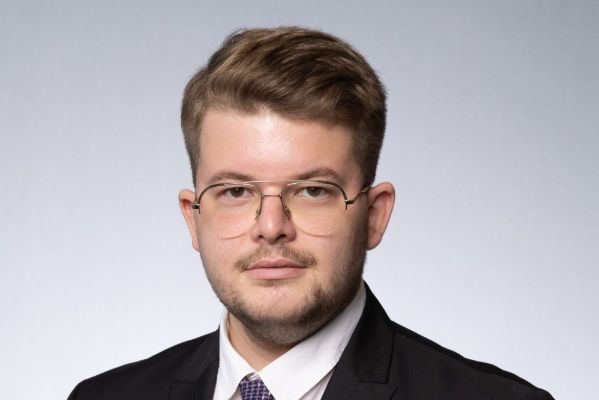
The requirements of the workplace are clear, and employees are not subjected to micromanagement, monitoring of working hours, are not restricted regarding home office, etc.!
Introduce yourself
with a few sentences. What does your work as daily
commitments consist of?
My name is Georgi
Almishev and I am 26 years old. I have been working in the "Large
Corporations" department for almost 4 years at Erste Group Bank AG, the largest Austrian bank in Vienna, with a strong presence in Central and
Eastern Europe. Starting as an intern in the department, I am currently a senior
industry analyst, responsible for assessing the financial condition of the
bank's clients, analyzing their financial needs, and preparing
recommendations for credit decisions to the board.
In which country and city do you currently live and how did you end up there?
- I have been living
in Vienna for almost 7 years, where I largely ended up by chance,
as usually happens in life.
- Taking
example from my sister, in 12th grade I applied to several universities abroad in
four countries – England, Denmark, the Netherlands
and Austria.
- At that
moment, the University of Economics in Vienna opened a new program in
economics and business in English. The program was small – with only 120 places, compared to
its German-speaking counterpart, which accepts about 2700 students each year. My admission to
this program was uncertain due to a large influx of candidates, among whom
only 15% were accepted. Fortunately, I was one of them and had the opportunity to start
my bachelor's degree at the most impressive campus I have seen (and on top of that,
with only a 20 euro fee per semester!)
- The second
year of university began with the "Great Internship Application" for
various places, which unfortunately was interrupted due to the Covid crisis. During
the pandemic, my university switched to a fully online form of education
and I temporarily returned to Bulgaria, where I managed to gain experience in the field of
accounting, at my father's company – a really good expert.
- At
the end of the third year of university, the second, stronger edition of
the "Great Internship Application" began, which went through phases of interviews,
optimism, and despair, and as a result, I received an offer for a 6-month internship in the
"Large Corporations" department at the bank. Despite the difficult start, where I understood almost nothing
about the work, I quickly caught up, and after less than a year, I was offered
a permanent analyst position in the same team.
- Gradually,
I continued to develop further.
What were
the biggest challenges you faced at the beginning of your stay?
- For
a person who is highly social, with an established circle and contacts, entering an
environment where I know no one was shocking.
- In
the university, many people already knew each other and it was difficult to create my
own circle of people. Accordingly, I started to gradually build connections and
friendships. Also, the way of communication in Austria differs from that in
Bulgaria and the initial response from those around is slightly reserved.
- Universities
in Austria give you the freedom (and impose the responsibility) to independently
shape your study program, which is another shocking change from the 12
years of school, where the first 7 hours of the day are full, followed by
almost mandatory extracurricular activities, lessons, etc.
- And
of course, the working hours of shops, which provide on one hand, labor
protection, on the other hand, are a great inconvenience for anyone who is not used to the fact that
nothing works on Sundays...
How did you overcome the language barrier (if there was one)?
- Considering
that both the university and subsequently my job are primarily in
English, there was no language barrier. English is easy for a young person from
my generation, who has largely grown up bilingual – with their mother tongue and
English.
- However,
with the German language, it is not the same. Even if you have studied it enough and can
communicate well, it requires a certain amount of effort. German is widespread in
many countries and regions. Each region has its own dialects, which are not taught in
courses, and you adapt to them later – in practice.
What resources or networks (local communities, colleagues, organizations) helped you adapt?
- My
contacts came organically – from the university and from work.
- In my school years, I was part of the Interact club, through which I met many people, some of whom later came to Vienna. I have also attended a meeting of a local Rotaract club, where I met interesting personalities. My environment is made up of people from various nationalities, which I consider one of the great advantages of living in such a cosmopolitan city.
What are
the main differences between the work culture in your current country and that in
Bulgaria?
- People
in Austria are more moderate. Even if they have strong qualities and ambition, they usually
are not on display.
- The
attitude towards work is different and more transactional. In general, employees are
diligent about their main responsibilities, maintaining a clear boundary regarding where
their responsibilities end. They also have a pronounced respect for their personal time, in
which they are rarely required to work overtime, and they rarely agree to
this. In Bulgaria, I believe these boundaries are a bit more blurred.
- Trade
unions in Austria play a significant role in the work culture and actively defend the interests
of employees, especially in large corporations. Their presence is easily felt.
- Although
I generalize, which I am not a fan of, overall, in Austria, people have a
more long-term attitude towards their profession and changing jobs, especially at
a more advanced stage of their career, is rather rare.
What values and practices in the workplace impressed you the most?
What I will
share relates to my specific workplace, which has the so-called open desk
policy, and this translates into the way of thinking. Even in the first week as
an intern, I was warmly welcomed by the team manager and the department manager, who
communicate with everyone on an equal level, regardless of their position. The
requirements of the workplace are clear and employees are not subjected to micromanagement,
monitoring of working hours, are not restricted regarding home office, etc.,
They are subjected to frequent and constructive criticism regarding the work itself,
which for a young person like me is a big positive.
Have there been situations where cultural differences have troubled you?
The department I
work in has a great diversity of people from different nationalities, ways of
life, etc. People are open to each other and alternative ways of
thinking are accepted as a richness in this environment.
How does finding
a job differ in your current country compared to your homeland?
Bulgaria has a
serious shortage of personnel, which makes finding a job easier and faster,
while Austria, and specifically Vienna, is a highly desired destination for education,
living, and work, consequently increasing the competition. Adding to the fact that
many foreigners do not have sufficient German language skills, positions in English are highly
sought after by potential new employees and can be a "nerve-wracking experience"
for any foreign student.
Did you have to
go through any additional qualification courses?
My employer actively encourages and supports further education, courses, and qualifications. Over the last 4 years, during which I have been in this department, I managed to complete my higher education, to fail twice at CFA (a matter of time 😊), to successfully obtain GTC and CTFP qualifications, and to start an internal development program that I am currently doing. My program is two years long, and I was accepted as one of 21 participants in it. As part of the program, we visit and work in all departments of the bank in seven countries, with the goal of being prepared for leadership roles in the coming years.
Have you encountered biases or obstacles because of your foreign origin?
To be honest, I haven't encountered or at least I haven't understood such a case. I even joked with Austrian friends that just a few months ago I learned about the jokes directed at foreigners, which sometimes roam in the space. I still haven't heard them directly or indirectly addressed to me, which makes me very happy.
Vienna is truly a cosmopolitan city, and there are people from all over the world around me. I believe that the time for prejudices based on nationality here has passed.
What would you advise people who want to take a similar step?
- As for education in Austria, it is of very high quality, and at the same time, it is free for EU citizens, so I can say it is an excellent investment. It is important to know the difference in the structure of education in advance, which surprises many newcomers. The saying 'Don't ask the old, ask the experienced' applies fully.
- Vienna is a strategic location for Central and Eastern Europe, and many businesses in the former Eastern Bloc are managed by offices or headquarters in Vienna. For this reason, working here provides a very good insight into these markets.
- Other advantages, of course, are the level of work, professionalism in large institutions, the attitude towards the integration of work and personal life, high standard of living, etc.
If you could go back, would you choose the same path?
- Most likely yes, although it is not just one path, but a series of paths. Sometimes the best things happen by chance if you are ready for them.
What do you miss most from your homeland in professional and personal terms?
- I am a lucky person to have a wonderful family and circle of friends in Bulgaria. Although I often miss them, I have the opportunity to jump for a weekend to Sofia – the flight takes an hour and a little, and the prices of flights are cheaper than some taxis in Sofia. This allows me to see my loved ones often. We often joke that if I lived in Bulgaria, we would probably see each other less often.
- In professional terms, I have the opinion that the environment in Bulgaria is more entrepreneurial. The moment I decide to start my own business, I will most likely start from Bulgaria.
Have you considered returning and under what conditions would you do it?
I am still young and curious, so a permanent return to Bulgaria is not on my agenda. The fact that I travel a lot and meet various people, cultures, habits, and opinions is a huge wealth for me at the moment. However, I do not exclude the possibility of returning to Bulgaria someday – a step I would take at the next stage, for family or business.
What do you think about money? What is their influence on your life? What is your advice to people who often ask themselves questions related to money and how sufficient they are?
- Money never lasts. And thank goodness, because this fosters development (excluding greed from the picture).
- Money should not be the main reason for professional decisions, especially in the first years of a person's career development. As a result of reasonable decisions and actions, they always come as a result...even if you run away from them 😊