A successful career is one that resonates with your personal essence – not one that impresses others
· Kiril Grigorov
Success is not measured by external comparisons – with neighbors, friends, or colleagues!
Imagine in a few words..
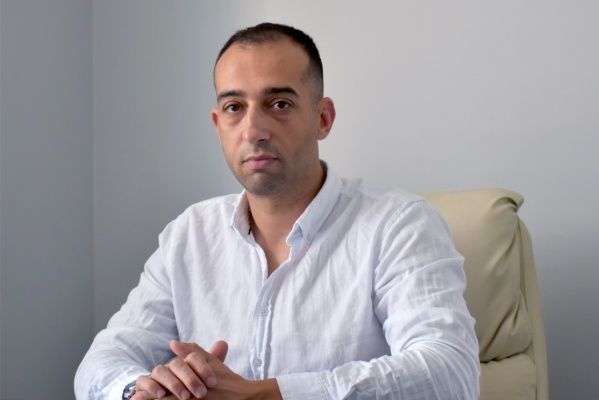
Hello, my name is Kiril Grigorov, I am the manager
of CyberOne, I am the vice-chairman of the Bulgarian Association for
Cybersecurity and I am engaged in
cybersecurity.
How would you describe your career in a few words?
Dynamic, with a clear direction of development, with a clear perspective
for the future, given the cyber threats we face. Cybersecurity
is a field that transforms every year, along with the challenges
faced by everyone who has chosen this path. I believe that the future will bring even
more interesting projects and causes for people in this industry. I am grateful
for my professional path, because I have
the opportunity to support communities and organizations related to digital
security. I strive to be helpful to anyone who wants to embark on this
route – through my participation in the Bulgarian Association for Cybersecurity, at
the university, as well as in various associations that support young people through
mentorship, training, and guidance. For me, a career is not just professional success
– it is a chance to pass on your knowledge.
What was the most important choice that shaped your path?
I couldn't point to just one. In fact, I believe that every choice we make
– big or small – plays a role in shaping our professional and
personal path. Every decision made with thought and commitment has left its
mark and has brought me to where I am today. I believe that our path
is built daily – through consistent steps, through the values we
stand for, and through the responsibility we take for our own choices. Everything
depends on us – on our internal motivation, on how ready we are to
develop and face the unknown.
What would you like to have known at the beginning of your career, but no one told you?
That the higher you climb, the more not only the responsibilities increase, but also the expectations. No one told me that a higher position does not
mean an easier daily life – on the contrary, the dynamics and challenges become
more intense. Every day requires adaptation, dedication, and a willingness to learn new
things, even when you are already an expert in a given field. However, this is also the most valuable –
development does not stop. And it is precisely in these difficulties that the true value of
professional growth lies.
How can a person understand which profession is suitable for them?
I believe the answer lies in how well you know yourself. Each of us
has unique strengths and weaknesses – and the better we recognize them,
the clearer we see how and where we can be useful. When
you understand what motivates you, what you are good at, what brings you satisfaction –
then you start to see which professions resonate with your essence. Success
comes when you find your place – not just as a title, but as meaning and
contribution.
What skills do you think will be key in the next 10 years?
If I had to point to one key skill, it would certainly be the same one
that has been essential for the last four thousand years – the ability to adapt to
the environment. We live in a time of relentless change – digitalization,
artificial intelligence, and technological innovations transform the world
around us every day. And yet, the only skill that drives us forward and prepares us
for the unknown is the ability to be flexible, to learn continuously, and to
respond adequately to new realities. Adaptability is not just a reaction – it
is proactive behavior. This means not only following trends but also
being able to anticipate them, rethink them, and turn them into new
opportunities.
How to build a network of useful contacts without appearing interested?
I see no reason to hide our interest – on the contrary, I believe that authentic
interest and transparency are the foundation of stable professional
relationships. When people know why you are there, what your role is, and what
perspective you stand for, it is unnecessary to resort to hypocrisy or hidden motives.
Transparency builds trust. It helps you state your position and find
like-minded people – those with whom you look in the same direction. Everyone who
shares your vision naturally connects and creates a community. And those
who are not on the same wavelength – in any case, your paths will not cross in
the long term.
What is the biggest mistake you have made in your career and what did you learn from it?
The truth is that I have made many mistakes – and
I continue to do so every day. But I believe that they are the foundation of
professional growth. Mistakes teach us, build us, and make us better
at what we do. Successes do not always lead to development – sometimes
they make us forget where we
started. While mistakes require reflection, acknowledgment, and work on oneself.
They are lessons, not failures. I believe it is extremely important for a person to analyze
not only when they made a mistake but also when they acted correctly. Only then can they understand what drives them forward and what holds them
back. In this process, there is no room for demotivation – there is room for growth. And
most importantly, that both
success and failure can be equally useful – or equally harmful. It depends
on how we perceive them.
How to recognize a toxic work environment and when is it time to leave?
The strongest indicator is the lack of satisfaction – when the environment makes us
feel oppressed, undervalued, or disconnected from our personal vision and goals.
A toxic work environment manifests not only through bad relationships and lack of
support but also when there is no perspective for development, and the company's vision
drastically diverges from our personal values. I believe a person
should be in a place where they see meaning and contribution.
What would you do differently if you could start over?
Absolutely nothing. Every step, every decision, and even every mistake has brought me to
who I am today. I am confident that it is these experiences that built my path
– as it should have been. I believe that everything I do is part of
the development process and will take me even further.
How to maintain motivation in times of stagnation?
The first step is to accept that stagnation is not a failure, but part of the natural
rhythm of professional development. These are those pauses when we can turn to ourselves, rethink our goals, and organize our priorities.
Analyzing our own actions – both mistakes and successes – helps us
realize the direction we are heading. When we have clear goals and strong internal
motivation, we go through these moments more easily and with the feeling that we are preparing
the foundation for the next breakthrough. Changing the work pace, reflecting on
personal dynamics, and rethinking values are elements of internal hygiene
– this way we turn stagnation into preparation, and silence into strength.
How to achieve a balance between professional and personal life?
Honestly, I do not believe that this balance is achieved through separation, but through
integration. When we do what we love, the professional and personal intertwine in a natural way. Everything that develops us as individuals – sports,
hobbies, time with loved ones, self-care – has a direct impact
on our professional capacity. Relieving stress, increased tone,
focusing, and calmness – all make us more resilient, motivated, and
quality professionals. Today, when
a large part of people work
mainly with their minds, caring for emotional and mental resilience is not
just a personal necessity, but a professional obligation. I also believe that
when we work with desire and motivation, this dedication carries over into our personal
lives – we become more present, more inspired, and able to appreciate the little
moments. Balance is not a formula – it is the result of a deep connection with oneself.
When is it time to change our career, not just our job?
When we decide to do what we really want. Changing careers is not
just a professional decision – it is an act of awareness and courage. When our
inner voice begins to drown out the daily routine, when we feel that our
talents and aspirations do not find their place in the current field – this is
the moment.
If you had to give just one piece of advice to people seeking success, what would it be?
Invest first in yourself. In knowledge, in skills, in the desire to learn and to
become better every day. Success is not measured by external comparisons – with
neighbors, friends, or colleagues. The only valuable measure is the one you
set for yourself: to be better than what you were yesterday.
What is a successful career according to you?
I believe that the definition of a successful career is deeply personal. It is not measured by
titles, positions, or social status. A career is successful when it brings
satisfaction, happiness, and a sense of meaning. It does not have to be in
a field that society considers “prestigious”. You can be an expert in your
field, a professional driver, a hygienist – and
still build a career that makes you proud of your achievements.
True success lies in feeling good about what you do, seeing meaning, developing, and being useful. A successful career is one
that resonates with your personal essence – not one that impresses others.