I am coordinating a project in the field of artificial intelligence in finance
· Valeri Andreev
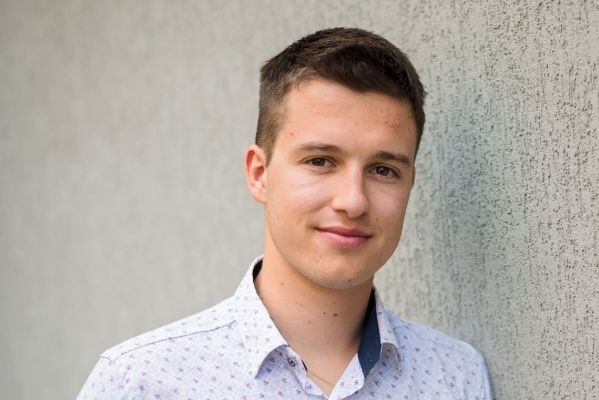
I completed my bachelor's degree in Business Information Technology at the University of Twente, and now I am continuing my master's in the same field with a specialization in Data Science & Business!
Introduce yourself in a few sentences. What does your work involve as daily commitments?
My name is Valeri Andreyev. I was born and
raised in Sofia, but in 2021 I moved to the Netherlands to study
Business Information Technology at the University of Twente. After completing
my bachelor's degree in 2024, I continued my education with a master's in
the same field specializing in Data Science & Business. For the
last three years, I have been working as a coordinator on several university projects, including one for
the largest European consortium in the field of artificial intelligence in
finance (MSCA Digital Finance). My work encompasses a wide range of activities
– from budgeting, event organization, and administrative coordination to
data analysis and making recommendations for closer collaboration between
the academic and business environments in the Netherlands. At the same time, I am engaged
as an assistant in programming and business courses, where I grade exams,
conduct exercises, and actively support students during lectures. In
addition, I prepare and publish scientific papers focused on innovative approaches and
research. Sometimes the workload requires flexibility and long working
days, especially under tight deadlines and high expectations.
In which country and city do you currently live and how did you end up there?
I currently live in the Netherlands, in the city
of Enschede - a relatively small town near the German border. I chose
the University of Twente because it offers one of the best multidisciplinary
programs in business and information technology in Europe. An additional
incentive was the university's focus on innovation, entrepreneurship, and
collaboration with industry, which aligns with my personal interests and
professional ambitions.
What were the biggest challenges you faced at the beginning of your stay?
The most serious challenge was undoubtedly the
climate. The lack of sunshine for weeks on end and the constant rain had a
serious impact on my mood and concentration at the beginning. Although over
time I began to accept it and stopped giving it so much serious thought,
it is undeniable that the weather conditions remain one of the factors I
could not adapt to.
How did you overcome the language barrier (if there was one)?
In the Netherlands, there is hardly a language
barrier in daily life, as a large part of the population speaks English at
a high level. The real challenges arose in more informal situations,
where after a few drinks people naturally switch to their native language.
This initially created a sense of isolation, but over time I began to
orient myself in conversations based on context, even though I do not speak
Dutch.
What resources or networks (local communities, colleagues, organizations) helped you adapt?
Being part of a multicultural academic
environment with a strong sense of community played a crucial role. I
joined the university tennis association right at the beginning of my
studies. There I met other tennis enthusiasts and "made" new contacts.
My social character connected me with colleagues from similar fields with
interests close to mine, and the community of Bulgarian students also
turned out to be a valuable source of support.
What are the main differences between the work culture in your current country and that in Bulgaria?
Although the work environment is international,
the Dutch culture clearly dominates. I like the direct style of
communication, the strictness regarding deadlines, and the clearly expressed
individual responsibility that my colleagues exhibit. In Bulgaria, there is often
an emphasis on ekpiniya trud, while
here individualism is encouraged. This creates a different dynamic both in
how work is done and in decision-making.
What values and practices in the workplace impressed you the most?
I was most impressed by the practical approach
to work. In the Netherlands, efficiency is valued, and there are no unnecessary
meetings; everything is purposeful and has a clear outcome. Strict hierarchy is
more of an exception, and decisions are often made by those directly involved
in the work itself. This creates a sense of autonomy but also requires high
personal responsibility.
Have there been situations where cultural differences have challenged you?
Yes, the clash with cultural differences is inevitable, especially when
you are active in an international environment. In the Netherlands, there is often an emphasis on
functionality and final results, while I am used to paying necessary
attention to details as well. Two years ago, I participated in a summer school in China together
with colleagues from the Netherlands. During those weeks, I encountered serious differences in
the communication style and approach to work between me, the Dutch, and
the Chinese. In order to avoid misunderstandings, quick adaptation was required and
most importantly, patience, which has never been one of my strengths. I had to
learn when to react and when to remain silent, a truly valuable lesson both
professionally and personally.
How does finding a job differ
in your current country compared to your homeland?
In my opinion, the process of finding a
job in the Netherlands is more structured compared to that in Bulgaria. Especially when
it comes to students who want to start their professional
path. Of course, recommendations and networking are important, but young
people are hired not only based on their academic results but also on
their social skills and motivation.
Did you have to go through any
additional qualification courses?
No, I did not have to. In
an entrepreneurial university like mine, your academic engagement and participation in
the community are sufficient. My major, which is a combination of
business and information technology, allowed me to meet professors
from various departments and receive offers and recommendations for job positions.
From there on, success depends on self-discipline, attitude, and hard work.
Have you encountered prejudices or
barriers because of your foreign origin?
Yes, the barriers for me manifested in
missed opportunities caused by the language barrier. The fact that I do not speak
Dutch limits participation in projects related to government institutions,
because the documentation is not subject to translation.
What would you advise people who
want to take a similar step?
To be active, social, and
consistent. Participation in university clubs, additional initiatives, and
discussions creates valuable contacts. These networks often prove decisive in
finding opportunities for future development.
If you could go back,
would you choose the same path?
Absolutely. The decision to go to the Netherlands
allowed me to combine academic training with practical work on international
projects. Moreover, I had the opportunity to attend a summer school in China, an academic
visit to Australia and Japan, and I met professors, students, and specialists
from leading universities and companies. This palette of opportunities, in my
opinion, is one of the greatest positives of Dutch education - practical
orientation and a multitude of opportunities for further development.
What do you miss most from your homeland
professionally and personally?
Professionally, I miss the
opportunity to develop my own activity related to consulting and web
development. In the Dutch market, this is impossible without mastering their
language. Personally - the absence of loved ones and the feeling of belonging to
the place where you grew up. No matter how long I live abroad, Bulgaria
remains "home" for me.
Have you considered returning and
under what conditions would you do it?
Yes, I have even taken concrete
steps in this direction. After I finish my master's degree, I plan to return
to Bulgaria. I maintain commitments on projects in the country and consider developing my
own business or joining the family company. I see it not as a
compromise, but as an opportunity for real contribution. Another personal motivation for me is that
many of my friends who chose to study abroad have already graduated and
returned to Bulgaria. All of them feel good as young
professionals and have excellent opportunities for career development.
What do you think about money? What is
its influence on your life? What is your advice to people who often ask
themselves questions related to money and how sufficient they are?
Money is an important tool for
independence, but not an ultimate goal personally for me. I strive for financial
stability because it allows me to choose and live peacefully. At the beginning
of my master's program, I had the opportunity to participate in a two-month study
visit to Japan and Australia, where I visited both leading universities in Osaka and Melbourne,
and the offices of global companies like Amazon. These visits gave me
the opportunity to see firsthand the mindset with which labor,
compensation, and the importance of the balance between professional and personal life are considered.
This broadened my worldview and helped me realize that money should be
viewed not just as a goal, but as a means to achieve a fulfilling
life.