I work with individual attention and value sincerity, dedication, and mutual trust
· Anna Tsolova
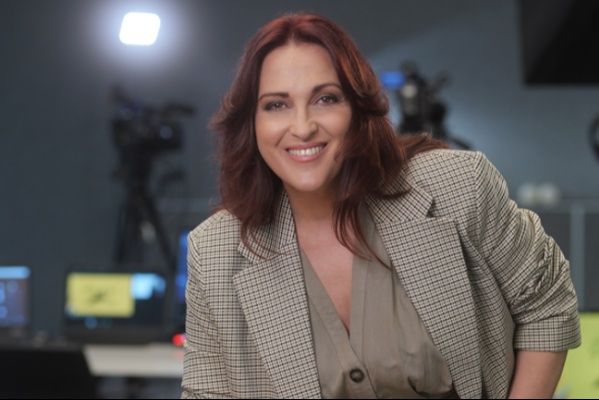
Happiness is loving what you do and having time for those you love!
Introduce yourself – what do you do, which areas of activity are of interest to you?
I am answering your questions in the month when, 7 years ago, I conducted my first training in public speaking. We have a birthday. The first seven have passed.
Otherwise, I have been speaking in front of an audience since the last century. In total, 26 years. 19 of them as a television journalist. In the last 7 years of this century, I found my professional happiness in teaching – I created “Speak to be seen!” and conduct training in public speaking.
Behind me, I have nearly 15 000 interviews, reports, and films as a host, reporter, and producer of news and news programs.
For 13 years, I said “Good morning” as an author and host of the morning block on the two largest private television stations in our country.
I have always believed that if you lose your passion for what you work on, you should stop doing it.
I know that numbers have no soul, but here are a few more numbers – I have accumulated experience in teaching with nearly 500 individual and group trainings. Through our main training program, nearly 3000 people have passed. Some of them have already gone through the advanced form of some of the trainings, which is called UP/UP.
I believe that a person learns most effectively through experiences. That’s why my trainings are conducted in a small group, with individual attention to each. I have the privilege of learning every day from the people I work with. People who believe that speaking impactfully, clearly, and accurately, especially today, is of great importance.
When did you realize that you wanted to be an entrepreneur, not just an employee?
To work by the rules of integrity, not having to compromise on the quality of what you create, to be free to choose who and how to work with, is the foundation for me. The path to entrepreneurship and the start of independent activity for me came this way. The freedom of action and integrity in work are paramount for me.
What have been the most defining moments in your professional path so far?
I realized that learning through experience and emotional contact with the participants in the trainings is the most fulfilling way of teaching. In fact, I can’t do it any other way. I actively immerse myself in the topics and issues in communication that the team or the person in the room in front of me needs to solve. I grab the participants and keep them actively engaged in the topics of their public appearances. This is exhausting but also very rewarding. We, humans, remember through our emotions, and it gives me a lot of meaning when I hear or receive an email later with the words: “I was energized and enthusiastic days after the training day” or “The notebook I wrote in during the training is like a reference book.” Yes, that is the meaning of everything I do - to have, even a small contribution to the professional development and positive change for the people who enter the room, is very satisfying.
As important moments, I would also define the moments when I made mistakes. I had the opportunity to be the whirlwind of significant events, daily. I made mistakes and learned from them. These are the most valuable lessons.
In the training rooms, we have created a laboratory environment. We place the participants in the trainings in real situations close to their public appearance. We record different performances - presentations, interviews, podcasts, and then analyze them. And I always tell them: “Make mistakes, now is the time to see your mistakes from the outside. This way, you won’t make them again.”
Has there been a turning point that changed your vision of success?
Success is to work and create something you love, without compromising the honest relationships with the people you work with and the people for whom you create the product. Whether it is a television product or training, or consultation for public appearance, it doesn’t matter.
For me, success is to maintain the pleasure and satisfaction from what I do. To have the freedom to develop, enhance, and improve it as I wish. In this regard, my departure from television is what you call a turning point.
How has your role in business changed over time – from creator to leader? Where do your ideas come from – intuition, market, need?
I will answer with two examples. I developed separately and independently a one-day and several-day training for crisis communication, due to the needs of the business. Years ago, the module for behavior during a crisis was part of the standard media training I conduct. How did I learn about these needs? When more and more companies were looking for specific skills on how to speak to the media (and not just to the media) during a public crisis. They were increasingly seeking me for consultations on crisis communication. That’s why I developed a detailed and intentional training “Behavior during a public crisis.” We live in such times. Public communication is often a game of nerves. As a journalist, I have covered hundreds of public crises with various protagonists and I know how important it is to be able to respond briefly, clearly, adequately, and timely. There are situations where every single word or nonverbal gesture is important.
After quite a few inquiries from various companies and people, the training “How to make a successful video podcast?” was born. It wasn’t hard to build it because I did this in television and now I have another opportunity to pass on this experience. How to lead the conversation, so that interesting and engaging stories can be drawn from the interlocutor?
How to ask such questions that predispose the interlocutor?
What are the techniques for formulating questions so that you receive candid and substantive answers. How to prepare - from researching the guests to building a script. And of course - the language of the body, the voice and the techniques that help us to lookand sound confident in front of the camera and so on and so forth.
How do you understand when an idea has value and potential, and is not just sounding good?
I immediately start to envision it (in detail) in practice. I look at it from all angles. If it’s about a new training or a new simulation game for one of our trainings, I immediately think about how to apply it in practice. And I reconsider what skill it would provide to the participants in the trainings. I am a practical person. Almost everything I know and can do has been accumulated and learned in the field of practice.
How do you approach the creative process – do you have rituals, methods, or do you rely on “the moment”?
My preparation for each training requires creative thinking. I prepare the simulation games and tasks according to the needs of the team and the company I work with. This process, as routine as it may be because I know the steps well, is also a creative process. It is necessary to tailor the trainings to the measure and needs of the people who have trusted me. Sometimes inspiration comes to me in incredible places and moments. I catch it and don’t let it go. I am everywhere with my laptop. Three years ago, I wrote the scripts for a new video training while traveling by train during a tour of Italy. Sometimes I involve my husband and my son in this. My son is a teenager and finds it very interesting. This way, he learns new things and gains knowledge that is useful to him. Interesting conversations begin…
What inspires you outside of business – art, people, travel?
I love being with my favorite men – my son Kaloyan, my husband Vasil, the dog and the cat. The last two are also men. :) At home, we talk a lot, discuss everything that happens in the world and around us. Like most people, we enjoy traveling together. We love exploring new places, traveling by car.
Music. Music is an important part of my life. I love driving, relaxing behind the wheel and listening to music.
During the year, I read more
professional or documentary literature. In the summer, when I crave
fiction - I catch up. For example, I read with interest all the
books by the Swedish writer Fredrik Backman. I mention this because this summer, at
the beach, one of the books I read was his new novel "My
Friends".
What are your unchanging
principles in work and life?
I have said "no" to offers for conducting training.
I believe that refusing is sometimes stronger than doing it at any
cost.
In my work as a
journalist, and in my work as an entrepreneur and teacher, and in purely human
relationships, I value the freedom to say "yes" and when to say "no". On one hand,
it's not easy, but on the other hand, life is easier when you don't make compromises.
As they say: "Don't be
afraid to lose a deal because of your principles - be afraid to lose
your principles for the sake of a deal."
Each participant receives at the beginning of each
training "My 13 Rules" for good public performance. On each
card with the rules, I write by name for each: "Thank you for your trust".
I believe that trust is earned and is nourished not only by professionalism but also
by sincerity and dedication to achieving the goals of each company,
of each person, and my approach to each training.
What does the word "success"
mean to you today – and is it different from five years ago?
Success now and five years ago, I would define as that stage of life where you can feel
satisfaction and harmony in your work and in your life with your loved ones.
A stage, where you can enjoy and have moments to
be happy about what you have created (in every sense of the word, not just as
business). A stage, where you can honestly say to yourself:
"Thank you!". The ability to appreciate, evaluate, and consciously express gratitude. That for me is
success.
I don't know who said it, but
I have matured to understand that for one person success is fame, for another it may be the peace of falling asleep at night with a book in
hand. Both successes are equal.
Today I can say that success is being able to look
people in the eye, despite the trials and tribulations.
If you had asked me this question 25 years ago, I probably
would not have answered this way. Everything is a matter of life and professional
experience, of accumulations.
What place does ethics
hold in entrepreneurship according to you?
I don't want and can't
teach anyone how to lie, deceive, and manipulate through words and public
appearances.
In the end, I know,
that humanity is measured and assessed not by how much one knows, but by
how one uses their knowledge.
A few months ago, during one of my trainings with managers from a large European company, they asked me something.
The training was dedicated to crisis communication:
"Against the backdrop of a wave of lies and the lack of desire of some
people to seek arguments for what they hear, what is our chance to be
heard by the audience with the truth and facts that we share?
In the last two to three years,
I often receive
similar questions from people, with whom
I work and people, who see how poisoned the information
environment is around the world and in our country.
Yes, global and local rulers and their "spokespeople" contradict each other daily, make up stories, and often have no shame in their words. They take
inspiration from each other. They call freedom slavery, truth a lie…
And it seems that honest words have no chance, especially in contrast to
that other.
But I believe that authentic and sincere expression and speaking
is increasingly needed.
Especially against the backdrop of strong bombardment with ignorance and
inhumanity from all directions.
Speaking of ethics, a few days ago I learned that
the Prime Minister will have an advisor on integrity. If we assume that
integrity is the practice of ethics, then integrity cannot be brought in
from outside to an adult person. That's what I think.
Integrity is not like new software that is "installed" and then a person is needed for maintenance.
Of course, every person
has temptations along their path and needs a compass in such moments, but integrity is
an internal compass. It is not appointed and is not described in a job description.
It is the same in companies.
No matter how many ethical codes are signed and how detailed the values of the company are written, if there is no qualitative understanding of morality, ethics, and
integrity, there is no way for a person to be honest and moral by obligation. Usually, this does not
last long. Integrity is quiet; if you have to explain it, it may
mean that it is absent. People are the only important ones. Their qualities and way of
action.
Do you believe in the balance between
personal and professional life or do you accept that it is an illusion?
Someone will say that there is no
recipe for this balance, but I will use the metaphor of a recipe because I love
to cook. Just like in cooking - one learns from their mistakes. Balance between personal and professional life is like a
recipe - if you overdo
one ingredient, the taste is lost and
often the dish is not suitable for eating at all.
It is difficult for me, even impossible, to leave my work in the
rooms where we conduct trainings and consultations. This will not change,
if you truly burn for what you do and believe that it should be done
in a certain way. That's how I functioned when I was part of a large organization,
that's how I am today, when, as they say, I manage the processes myself.
But as they say, happiness is to love what you do and to have time for those you love. In this regard, I have happy moments. :)
What is the most valuable lesson
that you have learned "the hard way"?
That sometimes the most correct
and best for everyone is to be able to remain silent.
Knowing when to be silent is like playing chess , sometimes the strongest move is to not move the piece.
How do you motivate yourself in
moments of doubt or failure?
Not to stop acting,
to learn, to change. I tell myself this in such moments. One day can be a
wasted opportunity if you haven't learned something new.
I believe in lifelong learning.
What legacy do you want to
leave behind – as an entrepreneur, but also as a person?
I admit that I haven't
thought about this question. I have never had a sense of any mission. I love
what I do and I know thatthe world will increasingly need
professionals who can engage people, to speak in a way that they can be understood, to
create an emotional connection with their colleagues,
with their partners and clients. Those who can persuade and express their ideas impactfully, will
be highly valued. Many of
these activities will be able to and are already being performed or supported by Artificial
intelligence. What will be leading for us, humans, is the ability to
listen and hear. The ability to learn every day. The ability to communicate
effectively and the ability to speak expressively, persuasively and impactfully. The ability to change.