Seek the approval and support of your colleagues and your team, not just the leaders
· Chavdar Vlachkov
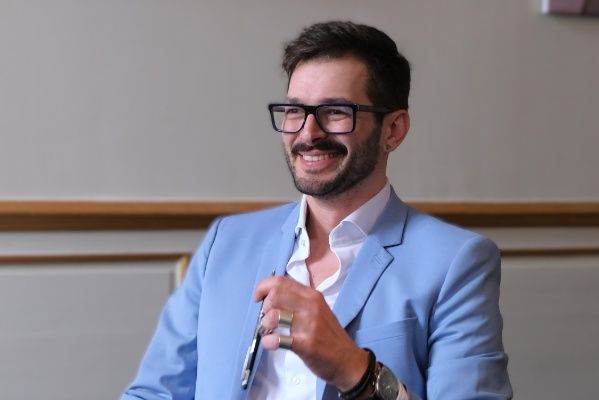
I was lucky to grow up with a journalist mother and an electrical engineer father – slightly caught between the humanities and the exact sciences!
Introduce yourself in a few sentences..
My name is Chavdar Vlachkov – a person of eclectic
opposites, which I constantly try to connect into one personality and one
career.
An economist, financier, and director of strategic transformations with a 15-year
career in Brussels. At the same time – a professional career consultant, coach, and for
20 years a dedicated volunteer in social causes. In Bulgaria, I work for the development of
communities, civic participation, and inclusive public policies as a representative
of the “National Network for Development”. I am also a lecturer on so-called soft skills and
career development.
What did you dream of becoming in your childhood?
I was one of those kids who never had a ready
answer to that question and felt unprepared when someone asked me. I grew up in the 90s in an environment with excessive access to information and news and wanted
to understand how and why things happen around me, but I didn’t know which
profession would give me that answer. One of the many correct answers turned out to be economics.
Also, as a small child, I have mentioned more than once to my parents that I wanted to become a garbage collector, which must have been
because of the impressive garbage trucks that were collecting waste in Bulgaria back then! But I guess that’s a dream of every little boy.
At what age did you earn your first money? Tell us an interesting incident?
During my student years – I worked in an exchange office in Golden Sands. Twelve-hour shifts, during which I regularly fell asleep… but I was
the person who caught the most counterfeit banknotes. That’s how I learned the life lesson
that sleep sharpens the senses.
What are the factors that shape us as individuals at an early age?
For a long time, I didn’t realize that a large part of
my career would not be based on deep expertise in one specific area, but on solid knowledge from various fields and a lot of common sense, which is formed at an early age. Critical thinking develops when you grow up in an environment with a pluralism of opinions and have the freedom to make mistakes. I was lucky to
grow up with a journalist mother and an electrical engineer father – slightly caught between
the humanities and the exact sciences. This combination always encouraged questions,
doubts, and analysis. That’s where my desire to understand what drives the world
– both from an empirical and a social perspective – began. And this understanding later turned out to be key to being able to make a business successful.
Did a significant difference occur in your perceptions at a more mature
age regarding what motivates you to do or not do something?
Since I was little, I did what I “had to,” hoping that one day I could do more of what I wanted. Two decades of this approach brought me to a position where I have no “comfort and discomfort zone” – every task is achievable and doesn’t weigh or rather weighs equally little. So regarding my work commitments, I am slightly skewed by my approach to myself. Motivation comes when we see meaning and
value in a given task and how it contributes to our long-term goals or personal development.
Whose decision was it where to pursue higher education and what to study?
My parents gave me full flexibility, but they asked me what I wanted to do and based on that advised me on what to study.
The only condition was to build on and not be afraid to try new
things.
So first I studied at the Mathematical High School in
Varna (grades 5–7), then I continued my secondary education at the First Language
High School with German, with the clear desire to test my skills in a maximally
competitive environment. Then came Sofia, followed by Brussels.
Even then, I knew that I wanted to engage in
politics or rather with the content of policies. That’s why I chose
International Economic Relations and Finance as my first two majors,
which I completed in parallel at UNSS. After graduation, I went to Belgium, where
I started working and subsequently continued my education in Management Science, combining it with
professional experience.
Was this decision correct, looking back today?
Yes, absolutely. Education is a business card
and very often a general culture from which you can build on. Also, it is rarely
calibrated with your future work characteristics.
Share more about your interests, knowledge, skills, and hobbies?
I actively play sports and mainly swim – normal
for a Varna resident. There is no economic or political podcast that I don’t follow, and
at the same time, I consume a huge amount of fantasy literature.
My biggest temptation is my fantasy band in Brussels – we are heroes of
tabletop role-playing games. It is also indicative from my Instagram profile that I have
a problematic affinity for cats.
Would you change your profession today and which fields of activity attract your interest?
No. I like the eclecticism of my different
professional roles and the fact that I connect them through my volunteer work in
Bulgaria. Coaching, management, building sustainable organizations and teams,
interpreting economic and social processes – I weave all of this into my volunteer work
Otherwise… I also have a few amateur experiences as
a stand-up comedian. 😊
They say that personal branding is everything that people say about you when you are not in the same room with them. What would you like to hear today?
I have always joked that it doesn’t matter what
people say behind my back, as long as they say I have a good sense of humor.
But putting humor aside, it is important for me that people recognize the sincerity
of my relationships with them.
Emotional intelligence, adaptability, and flexibility, as well as our soft skills are key conditions for success in recent years. How do you cope with the daily challenges of life to be in good shape and mood?
Fear that we won’t manage is what hinders us the most. If we remove this element from the equation, problems seem much simpler. I love to combine the useful with the pleasant – I listen to audiobooks while swimming, or music while working. This way, balance comes naturally.
What are the most important conclusions you have made so far about maintaining the right communication considering the different characters of the people you meet daily – colleagues, friends, relatives??
Sincerity and openness – basic, but not
sufficient. It is important to accept that people do not think like us, they do not necessarily
have our worldview, that they often talk about themselves when they talk to
us, and that there is nothing wrong with saying “sorry” I made a mistake. These are the foundations of
quality relationships – both in work and in life.
I always follow the basic rule and require
my team to leave their ego at the entrance of the meeting room, because
it hinders good communication.
What do you think about money? What is their influence on your life? What is your advice to people who often ask themselves questions related to money and how sufficient they are?
For me, money represents independence and freedom – and these two
are not quantitatively measurable. It is important to realize that income should be
proportional to our added value and qualities, and to have a sober assessment
of them. The more we develop our skills, the more independence
we can and should demand in return.
What is the most valuable career advice you would give to people?
Seek the approval and support of your colleagues and
your team, not just the leaders. In other words — work for trust horizontally and
vertically downwards. Your team is your engine — this is the healthiest symbiosis in the corporate world. You are there because of them. Every
time I have been promoted, it was because my colleagues and teams expected it and insisted
before the leaders. And good leaders always consult with the teams on the ground.
If you work in an organization that encourages
the opposite, that is a clear sign of an unhealthy environment.