True confidence is born from within
· Kalina Donkova
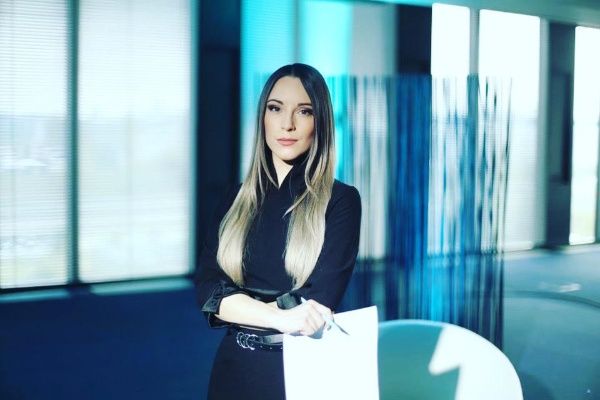
Don't take life too seriously, not everything is at any cost!
Introduce
yourself in a few sentences..
My name is Kalina Donkova and I have been a journalist for almost 15 years. My experience in the media has gone through various
professional levels. I have actively worked on some of the most important topics for society
such as politics, healthcare, economics, energy, and social policy.
My career path started in 2011 at “Darik Radio”, where I was a reporter in
news. As of today, I am a producer and host at the television Bulgaria ON AIR, where I deal
daily with journalism and the most current topics of the day. For several months now, with amazing colleagues
and friends, we have also become part of the digital space, developing a very
interesting and meaningful podcast on YouTube, called “The Jury”.
What did you dream of becoming in your childhood?
This question always brings a smile to my face. I grew up
in a family of journalists and somehow there was never a dilemma for me about what
I would do. Not because someone required it of me or insisted that I continue the family profession. The truth is that thanks to the example I
had before my eyes every day, I understood very early what it means to engage
in something through which you can be useful. And this continues to give me meaning
and direction even today.
At what age did you earn your first money? Tell us
about an interesting incident?
Recently, while walking in the city, a group of children approached me,
offering to buy a bracelet or keychain from them.
This took me back to my childhood when my friends from the block and I would gather all kinds of
toys from home that we were ready to part with and sell them to people in
the neighborhood. I think these were my first earned money, I might have been around
6 years old. But the most exciting day for me remains the day I received my first
fee as a journalist. I was 18 or 19 years old, the amount wasn't large, but it
didn't matter at all, what mattered was the satisfaction from the work.
What are the main factors and examples that shape us
as individuals at an early age and form our interests? What is your
recipe for curiosity, sources of information, and inspiration at
this stage of our human development?
Categorically – the foundation is family and the environment in
which you grow up, shaping your perception of the world, the surrounding environment, and your radar
for good and bad. I am convinced that critical thinking is instilled from childhood.
Developed curiosity goes hand in hand with critical thinking, something
that today we have a huge need to work on as a society, a topic that
we journalists should not stop discussing. In the era of fake news,
disinformation, and artificial intelligence, when every piece of information must be
subjected to thorough verification, this is extremely important. Today we witness
representatives of institutions, politicians, who create and
reproduce fake news. This is truly frightening, and I hope there will be someone
who thinks about the children and adolescents, who often become victims of
manipulations and are increasingly susceptible to harmful influences, especially in the online
space. So that we have more curious and open-minded children,
who will become the same adults in the future.
Has there been any significant change in your perceptions
in more mature age regarding what motivates you to do or not do something?
To some extent, I am glad that I have retained my naive
faith at times that everything can change for the better and that sometimes one person is
enough to initiate the process of change. Over time, however, I learned, of course – the hard way, that not everything happens with revolution and rebellion, but
often slow, purposeful, and consistent work in a given direction is needed to
make changes. I continue to be motivated by my inner desire to be
useful through my work and to give meaning and context. I am motivated by the people from
whom I have something to learn. One of the best things about our profession is to
work with colleagues who are often also your friends, with whom you push each other,
motivate each other, and together grow and provide more added value to your work.
I remain convinced that the media and
journalists within them have a huge responsibility to society and have the power to
change policies.
Whose decision was it where to pursue higher education and
what to study?
My decision to study journalism at the Faculty of
Journalism and Mass Communication at Sofia University “St. Kliment
Ohridski” was entirely mine. My family made tremendous efforts to dissuade me,
hoping at least one of us would live a calmer and less stressful life. This,
of course, I say in jest, because I have always had the support of
my loved ones.
Was this decision correct, viewed from today’s
perspective?
I have never asked myself whether I made the right
decision, I just did not want another path for myself. The truth, however, is that in
many other professions, real knowledge and skills are acquired in a real environment,
through fieldwork.
Share more about your interests, knowledge, skills, and
hobbies?
I am very interested in politics and geopolitics. The crises
in domestic and foreign policy in recent years have intensified this
interest even more, as well as the need to explain the world more clearly to myself. Lately, the
literature I read is mostly focused on this. Aside from serious
topics, trivially, traveling is what gives me space and peace. From
a very young age, I have been interested in sports and love watching football.
Would you change your profession today and which fields of
activity capture your interest?
After almost 15 years in journalism, I sometimes ask myself
whether and what else I could do. I don't have a definitive answer at
the moment, but it is extremely important for me that my work is meaningful and
socially beneficial, and that I do not stray far from the field of communications.
They say that your personal brand is everything that people say
about you when you are not in the same room with them. What would you like to hear
today?
I hope people see me as a responsible and honest
person who does not compromise on their principles. I value clear
communication between people both professionally and personally, so I
hope that I manage to be an open and good person.
Emotional intelligence, adaptability, and flexibility,
as well as our soft skills, are key conditions for success in the last
few years. How do you cope with the daily challenges of life to
stay in good shape and mood?
The last few years have brought numerous crises and
fears of all kinds – we went through the Covid pandemic, the war
in Ukraine came, followed by a political crisis, more military conflicts, and turbulent
events around the world. This inevitably has a significant emotional impact.
The accumulation of these processes has made me personally much more restless and
worried about the future. Conversations with close people, sports, and distraction from
daily activities through books and all kinds of art are the things that
work for me, helping to restore my inner balance and heal
my worries. Good communication skills and empathy allow us to be
more flexible and adaptable in different situations and periods. The pandemic and the transition
to working from home for many people seems to have taken away a serious part of
the skills for interaction. In the long term, I see this as detrimental not only
personally but also professionally. As a person whose profession requires only
and exclusively work in a real environment, I notice the difference between people like me and
employees who stayed at home, some for a full five years. Live communication
is irreplaceable and is often at the core of good successes.
What are the most important conclusions you have drawn so far about maintaining proper communication considering the different characters of the people you meet daily – colleagues, friends, close ones?
For me, the key is understanding and the ability to put yourself
in the other person's shoes. When you are younger, you are much more likely to disregard others'
opinions and insist on your own position. Over time, you realize that
not always are you right, and when you are, it is not always necessary to defend your thesis in
a loud tone. Honesty and acceptance are the foundation of good communication. This does not
mean that you should not stand by your opinion; on the contrary. I have always
believed that debate is useful and develops communication skills. Over the years, I
have learned to listen carefully and accept differences in character, which
helps me a lot.
What do you think about money? What is its influence on
your life? What is your advice to people who often ask themselves questions
related to money and how sufficient they are?
Our attitude towards money is conditioned by our attitude
towards ourselves and our understanding of the world, as well as by our immediate needs.
Money should not be a primary goal and pursuit, but it is a means that can give us
freedom and provide us with peace. In this sense - sufficient means different things for each person. No amount should be at any cost, and before
we accept, for example, a job for good compensation, we should be
sure that it corresponds with our principles and personal boundaries.
A peaceful life does not rely solely on money, but mainly on our integrity.
What is the most valuable career advice you would give to people?
If you are unsure about something – ask. Ask questions of
yourself as well. There is no way to always be sure of yourself, but it is important to be
sure of the path you are on and, if necessary, to remind yourself why you have
chosen it. Listen carefully, argue your position intelligently, and do not
stop reading and learning. Confidence comes from within us, it should not be solely the result
of external factors. And do not take life too seriously, not everything is
at any cost.