When You Become Good: The World Begins to Seek You
· Kiril Grigorov
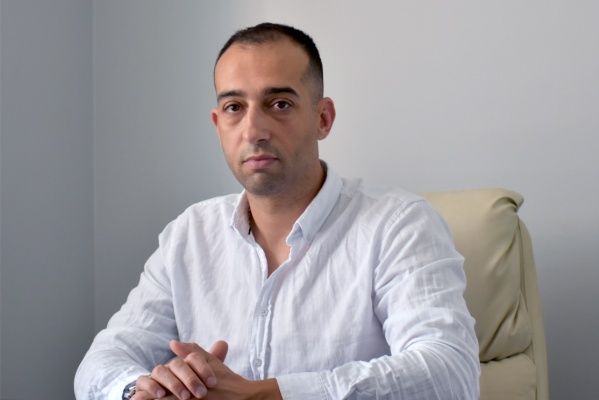
Invest time and effort in what you enjoy doing!
Introduce yourself in a few sentences..
Hello, my name is Kiril
Grigorov. I am the manager of CyberOne – a company specializing in
cybersecurity, and I teach at Plovdiv University and I am the vice-chairman of the Bulgarian
Association for Cybersecurity.
What did you dream to become in your childhood?
In my childhood, I dreamed
of becoming a pilot first, then a doctor, and then other typically
childish professions appeared that seemed extremely exciting to me at that age.
At what age did you earn your first money? Share with us an interesting incident.
Relatively early – at about
13 years old. That was also my first job. Interestingly, my friends and I
literally responded to wherever we were invited. Our idea was to earn
money and feel financially independent – as much as possible at
that age.
What are the main factors that shape personality at an early age and form our interests? Howis yourpersonal “recipe” for curiosity and inspiration during this period?
I will return to the previous
question – I believe that the earlier a person starts working, the better
work habits are formed and the easier it is to adapt to the work environment. As for
information gathering – in my opinion, this is a key skill for
career development. The ability to collect, process, and apply information
in a way that allows you to grow every day is a true superpower. If I had to point out
one key skill that leads to success – it is the ability to self-learn.
Has your motivation changed with age – has there been a significant difference in what drives you forward?
Actually, no. I have always been
guided by my inner convictions since a very early age. I believe that
one should do what they consider right and not be influenced by external
motivations like money. When you do what makes you feel good –
then motivation comes, along with financial results.
What was the decision to pursue higher education and what to study? Was this decision correct in hindsight?
It was entirely my decision – both
what to study and where and when. Working from an early age helped me to
orient myself, and that’s why I never had any doubts about this matter. I have never
regretted my choice and today I consider it completely correct.
Share with us more about your interests, knowledge, skills, and hobbies
When it comes to my
professional path – I believe that what I have achieved, the positions I have held and hold, speak clearly enough. I am not one of those people who need
many words. As for my personal
skills, knowledge, and hobbies – I possess the ability to learn from everything and from
everyone, and I believe that this is one of my strongest traits. Learning is not just a
habit, but a principle that I follow daily. Every day is a new challenge and
a new lesson, as long as one is ready to accept it. Hobbies, in my opinion, are a reflection
of our inner world – something that keeps us alive, energetic, and adaptive. They
should not be ignored, because through them we develop qualities that often
prove valuable in the professional sphere. Personally, I am passionate about extreme
sports – I have been practicing martial arts since childhood, I ski, ride a motorcycle, I love
anything that raises adrenaline and puts me out of my comfort zone. Such
experiences give me a sense of balance, strength, and freedom – things that I value
highly and that help me stay focused, motivated, and in good shape.
Would you change your profession today and which fields of activity capture your interest?
Categorically, I would not. I have the fortune and privilege to be engaged in something that truly inspires me, and at the same time allows me to lead a sustainable and unique way of life. My work at the moment brings me deep satisfaction – not just as a profession, but and as a personal mission. I believe that when a person discovers their calling and follows it with dedication, there is no need to seek anything else. I hope in the future this feeling of meaning and satisfaction will deepen – not because the direction will change, but because I myself will continue to develop and find new values in what I do.
They say that personal branding is everything that people say about you when you are not in the same room with them. What would you like to hear today?
I often think about this
question. For me, personal branding is not related to showiness or wealth, but to
the imprint that a person leaves behind – something meaningful and valuable that
cannot be measured in money. I have never pursued
material success as a primary goal in my professional development. Instead, I
strive to be useful, to provide value, and to invest time and energy in
young people – because I believe that they are the future we can build now.
I hope that through my teaching activities I have managed at least a little to
contribute – to motivate someone, to help them find their path, or to give them
the confidence to take it. The greatest recognition for me would be if one
day someone looks back and says: “You were the person who helped me change
my life.” This is
human legacy.
Emotional intelligence, adaptability, and flexibility, as well as our soft skills, are key conditions for success in recent years. How do you copewith the daily challenges of life to stay in good shape and mood?
I return to the question about
hobbies – that’s where the essence of my resilience lies. Physical
activity is not just part of my daily routine, it is the foundation of my
inner balance. I start my day with a workout at 6:45 in the morning – a ritual that not only
charges me with good mood and positive energy but also builds my mental
stability, necessary for dealing with any challenge. Sports
are much more than movement – they are discipline, persistence, and mental attitude.
Especially the martial arts that I have practiced since childhood have taught me key
life lessons. The first thing that sports
instills in you is respect: for yourself, for your opponent, for
different perspectives. Realizing that you are both there for a reason – this builds maturity and gives meaning to
every action.
Secondly – sports taught me adaptability. In
a dynamic environment, you need to react quickly, think strategically, and
anticipate several moves ahead. This skill may seem unnoticed by
an observer, but it is crucial – both on the mat and in life.
And last but not least – sports instilled in me a sense of teamwork. To
respect my
authorities, priorities, and personalities around me. To be able to combine individuality with
synchronization. This builds a way of thinking that is applicable everywhere – in
business, in personal relationships, in everyday communication. For me, success is not
accidental. It is the result of constant inner work – on the body, mind, and spirit
and most importantly - to think several moves ahead.
What are the most important conclusions you have made so far about maintaining proper communication considering the different characters of the people you meet daily, colleagues, friends, and family?
I think there are several
universal principles that apply to everyone – regardless of character. The first
rule I follow is not to take myself too seriously. It is important for a person to
approach with ease, but also with respect – for themselves and for others. Respect for
the perspective of the other side is essential. Someone else's position is not necessarily wrong or right – it is simply different. And that is
something we should accept and learn to understand. It is extremely
important to put ourselves in the other person's shoes, to try to see the world through
their eyes. Only then do we truly begin to enrich ourselves – because every
perspective carries value and a lesson. This can happen literally from every
person, as long as we are open to it.
One of the most valuable qualities instilled in me by
my parents is respect for all people – without division, without prejudice, regardless of external or
internal traits. Being able to appreciate the value of every person – this is the foundation for
a healthy and authentic communication.
What do you think about money, what is their influence on your life, what is your advice to people who often ask themselves questions related to money and how sufficient they are?
We live in a reality where
money is a necessity – it provides a home, food, access to resources and amenities
of all kinds. They are undoubtedly important when it comes to the foundations of
human life. But under no circumstances should they become a primary priority.
I believe that when you do something you love, in the way you
believe it should be – then money does not lag behind. It simply
follows. Because success is a product of skills and thinking, not of chasing numbers.
When you act with personal conviction and dedication, when you are sincere and goal-oriented
– the results come. And with them – the means that are necessary. Once the
basic needs are met – happiness and satisfaction are not determined by
the amount in the bank account, but by the inner mindset. How much you have depends
entirely on what you carry inside yourself. I know people with huge financial
resources who feel lost and unhappy. And at the same time, I know people
with far more modest means who radiate joy and harmony.
Ultimately, happiness lies not in how much you have, but in
what is enough for you, to feel good and fulfilled. And not least – we live in a part of the world, for the world in which we should be grateful.
We have the freedom to be ourselves, to live
without war, in a country with democracy, peace, and opportunities. These are values,
that we should not take for granted. They create an environment where everyone can
pursue their dreams, choose their path, and live as they see fit. Here mwe can make the right choices. The most important thing is that we have
the opportunity to make them.
What is the most valuable career advice you would give to people?
This question has both a short and a
deeper answer. I will focus on the latter. We are fortunate to live in a country and
an era where everyone has the freedom to be whoever they wish. There are countless
opportunities, access to knowledge, and there is no force in the world that can stop a person if
they truly know what they want and are ready to fight for it. This is extremely
valuable – and often forgotten advantage. Therefore, if I have to
give the most valuable career advice, it would be: choose what you truly want
to do, what makes you burn, believe, and get up in the morning with
desire. After that – invest time. Invest effort. Learn every day. Do not
be afraid to make mistakes, because it is precisely through experience, through persistence and
the desire for improvement that you willreach the essence. When you do what you
love, and develop in it with dedication – there is no way you won't become good. And
when you become good – the world starts to seek you.
This is what turns a career into not just a profession, but a
personal path – one that brings satisfaction, meaning, and pride.