Accept that you will not have a second chance
· Kalin Kavrăkov
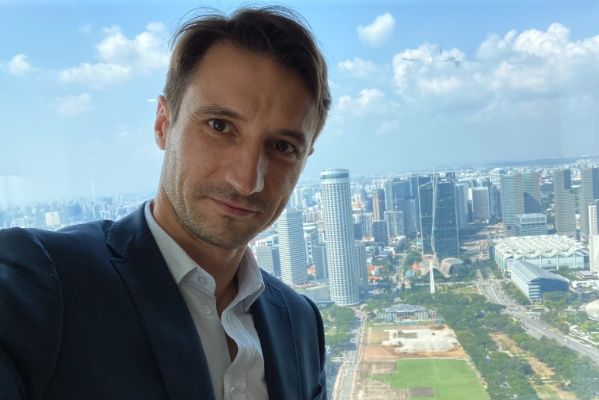
An incredible lucky person who has never been bored professionally!
Introduce yourself in a few words..
My name is Kalin Kavrakov and I am the Manager of Pentax Medical Bulgaria, one of
few companies in the country engaged in the repair and production of high-class
medical equipment. A large part of my career path has been spent in the field of
fast-moving consumer goods, having gone through all levels in
the hierarchy – from Intern to Operations Director. The companies I have worked
for include: Kamenitza AD, Prestige 96 AD, Carlsberg Bulgaria AD, and Ficosota OOD.
In the past year, I started my coaching practice,
helping middle-aged men break free from monotony and
unleash the exciting part of their lives.
How would you describe your career in a few words?
I am an incredibly lucky person who has never felt
bored professionally. I was fortunate to find myself from day one in
a steep learning curve environment, surrounded by people with a personal interest in my
development. I acquired many diverse skills in various areas of business,
which ultimately provided me with enough tools to effectively lead it today.
I have worked in technical support, engineering,
manufacturing, and have been involved in research and development. I have held responsible
positions in three quite different industries. My career path is not a story of narrow
specialization, but rather tells that life is colorful, yet fundamental business
principles are valid for all.
What was
the most important choice that shaped your path In?
I am not sure there is one choice that is critical
enough to shape my entire professional path. If I had to point out one thing
that stands above the rest, it was the choice to work for knowledge, not for money.
When I stopped basing my decisions on immediate financial gain and started to
invest in myself, my life began to change at a much faster
pace.
What would you like to have known at the beginning of your career,
but no one told you?
Before I answer, I want to emphasize that I highly value
scientific work and written forms of education. I consider it not only important but
mandatory.
Despite these beliefs, I think that at the beginning of
my career, I underestimated the knowledge you can gain from other people. What
I did not realize then was the vast amount of knowledge accumulated by humanity.
Due to the nature of the scientific method, it is very difficult to make accurate
generalizations, summaries, and to provide strict recommendations for action.
It is impossible to study everything in a controlled environment, nor can it be
read and remembered by an ordinary person like me. In practice, we often need
summarized, clear answers and the so-called “rules
of thumb”.
Some professionals and practitioners, however, have no
problem providing you with ready-to-use solutions and techniques. Unfortunately, many
of them also claim (often without basis) that their method is the best,
the only one, and it is certainly worth paying them handsomely to pass it on to you. Some of them are pseudo-scientific, and yet they work. Now I know that
it is worth getting acquainted with these techniques, and learning to “filter”
and “distill” them for personal needs.
The fact that something can work in practice, even though there is
currently no clear scientific explanation, is a fact that I have had to
accept over time. For this reason, I am much more inclined to listen and learn
more about people and their methods of achieving their goals. I do not always agree,
but I always listen carefully.
How can a person
understand which profession is suitable for them?
Choose something that you think fits your
temperament and to which you have a natural curiosity. Start working in
the chosen sector, and do not stop being curious. Do things that do not
fall within your “job description” and “are not your responsibility,” but without
compromising your core duties. I think this way you will “taste” the
different roles and will be able to feel what is closest to you and brings you
pleasure. The most reliable way to check what is suitable for you is to expose
yourself to the work that occupies the time of the respective professional.
Once you know this, just try to imagine the next 10 years, doing this activity. What feeling does this create
in you? Here is the answer to the question. However, everything starts with putting in
real, useful work for society and/or the economy. Sitting on the couch and
theorizing with friends while playing Call
of Duty, will not lead to deep insights regarding the desired profession…
Which skills
according to Inyou will be key in the next 10 years?
My crystal ball has been giving defects lately, but there are
some skills that I find key for every person and valid for all times. I believe
that most of the best things in life take years of purposeful work.
That is why discipline is the most crucial skill that has helped people in all
fields of activity since time immemorial.
The skills to manipulate ourselves to do what we
know should be done, rather than what our primal instincts
dictate. The ability to self-motivate and pursue goals is something that is
acquired and must be practiced. If you work on one thing, let it be
discipline.
How to
build a network of useful contacts without appearing interested?
To have useful contacts, you must be
useful yourself. Always maintain a high level of professionalism and help
people whenever you get the chance. By demonstrating
cooperativeness, competence, and investing your own time even when
you are not obliged, you will help build a network of contacts with whom you can
be mutually beneficial.
What is
the biggest mistake you have made in your career, and what did you learn from
it?
I have made many mistakes throughout my career. It is hard
for me to choose just one, as well as to rank them by magnitude. One of the big ones
was allowing work to become the only and most important thing in my life. To
define your career as the top priority is not a bad thing in itself.
The problem arises when it becomes the only priority. When you carry a great
responsibility professionally, there are many things that can go wrong.
A delayed project, financial problems, workplace accidents, epidemics, wars, etc.
When an inevitable work crisis occurs, if work is
everything to you, you fall into a severe psychological state, which ironically leads
to a deterioration in your performance. You enter a downward spiral from which it is
very difficult to escape. Family, friends, healthy hobbies, and social groups and
communities different from work can help you break the negative cycle and get back on your feet faster.
How to
recognize a toxic work environment and when is it time to leave?
Recognizing a toxic work environment is not difficult.
Just type toxic work environment into Google and you will
get many examples, all of which are true to varying degrees. Recognizing
when to leave is a much more difficult and strictly individual decision. For me
personally, it becomes time to leave when the toxic work environment and the things I
have to endure are not balanced with a steep learning curve or monetary
compensation far above market value. In other words, if I am no longer learning new things and
not increasing my savings, then there is no point in enduring the harassment.
Each of us can find ourselves in a toxic workplace.
We can gain a lot and accumulate experience in such places, as long as we do not
fool ourselves about reality and do not normalize the situation we have found ourselves in.
I personally would not be able to take a stance now if I had not experienced it myself. Although it is difficult to recommend them to anyone, toxic workplaces have their place in the sun, as well as a role in the career of a well-rounded
professional.
What would you
do differently if you could start over?
I have no desire to start over. I take full
responsibility for who I am, where I have reached, and all the mistakes I have
made along the way. Accept that you will not have a second chance. Act accordingly. Take responsibility
for the consequences – good and bad.
How to
maintain our motivation in times of stagnation?
Personally, I often turn to the philosophy of stoicism in
such moments. Practically, I most often use the method of
breaking down tasks and goals to maintain momentum in a moment of
stagnation. Sometimes this breakdown needs to reach grotesque proportions, with
tasks like: “create a folder named after the report, and put all related
documents in it.” I know it sounds ridiculous, but it works for me.
There are many techniques and ways to create and maintain
our motivation. I believe that this is one of the most important skills in life.
It is worth everyone to study, test, and choose the combination that
works best for them.
How to
achieve a balance between professional and personal life?
Unfortunately, there is no single answer to this important question,
that we can apply to everyone. To make it even more interesting, the answer that is true for me
today may change next year. I think the key lies in reflection,
self-awareness, and communication with our close ones.
It is very difficult for a person to analyze their way of thinking and
what makes them feel a certain way. Difficult, but possible. I think that
this is the key to achieving and maintaining balance in our lives.
The problems and difficulties in achieving balance are one
of the reasons for the existence of the role of the professional coach. Years ago, I myself
sought such help and it worked for me like magic. Do not get me
wrong, it required a lot of work, which continues to this day
on my own. However, I can testify that my coach saved me years in
professional and emotional growth. The experience motivated and inspired me
so strongly that I decided to embark on this path and qualify myself.
I recommend working with a professional coach if you really want to accelerate and
deepen your search for balance in your life. Nowadays, it is relatively easy to
find someone who suits you, and if you are serious about seeking balance, I
recommend exploring the options.
When is it time
to change our career, not just the job?
When you have started achieving your career goals,
according to your personal definition of “successful career,” but do not feel
satisfied. At that moment, I recommend deep self-analysis to discover
the root of this emptiness. If it turns out that it is endemic to the career path you have chosen,
then perhaps it is time to reorient.
If you had to
give just one piece of advice to people seeking success, what would it be?
Clearly define what you personally put behind
the word “success.” Then write it down, preferably by hand and on
paper.
Define several parameters that define the definition you have written,
and seek them every time before you say “Yes” to a new
challenge. Give as much specificity to this definition as you can,
so that you can pursue the goal effectively and not waste your time chasing other people's dreams.
What is Inyour definition of “successful career”?
Here is what I want in order to boast of a successful
career:
- My work creates measurable and unambiguous value for
the company for which I put it in.
- To take full responsibility for as much of the business as possible.
- I want to work with people on a daily basis. I want to work in a team.
- There should be a dose of uncertainty and challenge, which I consider to be the driving force of personal progress.
- The people and the company where I invest my time should be part of the same social community (city or at least country) where my children will grow up until they turn 13.