For everything, a strategy is needed, not a sixth sense
· Silvia Georgieva
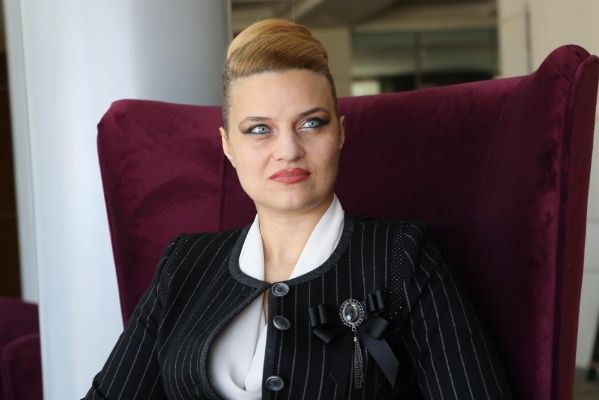
A person must always fight first and foremost with themselves – to control themselves constructively, not to act based on emotions!
Introduce yourself
– what do you do, which areas of activity are of interest to you?
With strategy,
international business development, and technology, specifically PropTech.
When did you realizeyou, that you wantedto
bean entrepreneur,
not just an employee?
That moment was not pleasant. It had a quite strong bitter taste. Ten years ago.
I realized that I had no other choice but this. The moment was when a classmate of mine from the English High School in Plovdiv, but from my sister's graduating class, who at that time was the Executive Director of an IT company, called me on the phone and said: “I just want to hear how a person with such a CV like
yours sounds. I don’t have a position for you, but I still wanted to hear how a person with such a
professional level sounds.” This was after 125 applications submitted CV and only 2
phone calls.
So it sounds quite false to me when it is claimed that there is a lack of qualified
staff, that they cannot find people, etc. No one wants people who are
qualified because they are not manipulable. That is the simple truth.
What were the most defining moments in your professional path so far?
Graduating from MBA degree
in the UK in the field of Strategy and international business
development. This MBA is in the top 1% of MBA
programs in the world and lasts 5 years, not 1 or 2
years like the mass ones. Why was it defining? Because it unfolded and developed
my potential in the field of strategy – an area where I have a strong developed
talent and abilities.
Was there a turning point that changed your vision of success?
My vision of success
has always been the same – unfolding my personal potential. I have had this vision
since childhood. No one imposed it on me. These are my understandings, which I have
reached on my own since my early childhood. I will write more on your next question below.
How has your role in business changed over time – from creator to leader?
It has not changed – I have always
been a creator and leader because we are not many people who feel in our
element when there is a problem that needs to be solved.
Most people hide even at the mere hint of a problem because they do not
want to take responsibility, they do not want to strain, they find excuses,
get sick – of course, feigning, go to the sea or skiing (nothing
against that, but when there is a problem and someone is enjoying themselves while others
are facing the “fire”, it is not acceptable) etc.
Where do your ideas come from – intuition, market, need?
From everywhere, but mostly from
intensive analyses, some of which last for years.
How do you understandwhen an idea has value and potential, and not just sounds good?
This is part of the process of
strategizing. There is no short answer to this question. The answer is the result of
serious analyses, not of sixth, seventh, eighth, etc. sense.
How do you approachthe creative process – do you have rituals, methods, or do you relyon the moment?
This process is different
for each person. For me, creativity is expressed in strategic thinking,
finding a strategy to deal with difficult – sometimes unimaginably difficult –
situations.
What inspiresyou outside of business – art, people, travel?
Books on archaeology,
history, the Bible. And nice people. There are very few.
What are your unchanging principles in work and life?
The principles in personal life
and the principles in work relationships must necessarily be different to
some extent. Many people have unhappy relationships because they apply in
their work principles that should only be for their closest people, and
vice versa.
Ethics first.
It applies necessarily to both areas.
Reciprocity in business. Mandatory. But it is not good to seek reciprocity
at any cost in personal relationships.
Setting boundaries on
the demands, expectations of others. Always. In both areas.
In conflicts in personal
life, one works with persuasion and mutual assistance, not with rejection and threats.
In conflicts at work, one works with negotiations. If the other party is not
willing to reciprocate, the relationships are terminated either immediately or for
some period, but necessarily.
What does the word “success” mean to you today – and is it different from five years ago?
A huge part of
manipulations in business are an emanation of the concept of success – personal and
professional. Even adults and, presumably, mature people constantly
compare themselves to someone else and thus measure their success. For me, this behavior
is, to put it mildly, immature.
For me, success has always – since childhood – been to realize my personal potential,
as well as the personal potential of my closest people, as well as of quality people
around me. And every person is different. Therefore, it is not possible to have one formula
for success.
For me, my personal
potential has never been based on my appearance, even though I am a woman, but on
my intellectual capacity. This is extremely rare. Since I have never
identified myself in the template of little princesses, I do not have such behavior
and in many businesses and hierarchical levels dominated by men, I have felt
completely at home.
Understandings of success are also
entirely based on the value system of a given person. For someone, it is
success to deceive, to steal an idea without punishment, to slander someone and thus
take their position, etc. For another, success is to help a person in need on
the street and for no one to know about it.
What place does ethics occupy in entrepreneurship according to you?
It occupies first place. If
a potential business partner is not ethical, they will never become our partner. If
a real business partner decides that they can only pursue their own interest at
our expense or at the expense of another partner, they immediately become a former partner
and others are warned to be careful when working with the respective company or
individual.
Do you believein the balance between personal and professional life or do you acceptthat it is an illusion?
I believe that personal –
family and/or intimate relationships – must necessarily have nothing to do with
professional realization, workplace, etc.
So that is not the right question -
everyone decides for themselves what balance between their personal and professional
life means.
The right question is to what extent a given person has personal relationships at their
workplace. From here come a huge part of the problems in the professional environment.
What is the most valuable lesson you havelearned “the hard way”?
Self-control. A person
must always fight first and foremost with themselves – to control themselves
constructively, not to act based on emotions. Every person must struggle with this,
but few do. Even the Western culture that is taking over Bulgaria is like this –
emotions are elevated to cult status, not reason. That is why people shout, yell, everyone does
whatever they please, and there is no analysis, no striving for making sober,
balanced decisions that balance the interests of as many parties as possible in
a given problematic situation.
How do you motivateyourself in moments of doubt or failure?
There is no failure. From the lemon,
you must make lemonade.
A person takes their lessons, steps on the ruins, picks up the pieces and creates something new
and constructive as illustrated by theJapanese technique of broken vessels – kintsugi
(Kintsugi), which literally means
“golden joinery” or “golden repair”.
This technique is an ancient art of
restoration, where the cracks are not hidden, but highlighted with gold
(or silver) powder and special glue.
A person has no reason to hide the scars from their battles – they are proof that they
have risen and continued.
What legacy do you wantto leave behind – as an entrepreneur, but also as a person?
I want to be able to influence
more people to be critically thinking, not led by the masses;
analyzing, not emotionally fluid; seeking to uplift others, not themselves at any
cost; charging from critical situations because they see in them
an opportunity to help someone in need, not cowards; using
the material as a means, not striving for the material as the only goal that gives meaning to their life.