From beach lifeguard to Harvard: a life gathered in stories that you can't make up
· Stamen Tasev
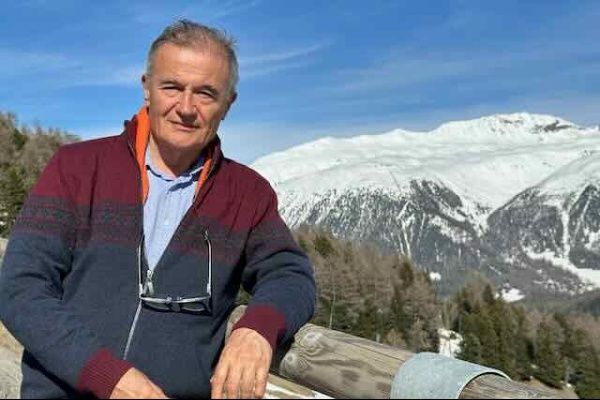
There is no excess experience: even random skills can change your future!
Introduce yourself in a few
sentences..
I have been a pensioner
for about ten years, my wife is my classmate, also serving as
external memory, I am the father of two sons, and a grandfather of two girls and two boys,
who live in the USA, I have worked in several places in the state administration and
in international companies like “Sony”,
“Barents Group”, “Newton Finance”, “Expandia Group” and others. Currently, I am not a member of a party, but I am a member of the largest
non-governmental organization in the world – “Rotary
International” and I
try to live in Sofia!
What did you dream of becoming in
your childhood?
As a child,
I loved playing football because we lived near the “Gerena” stadium and often jumped
over the fence to watch Gundi's training! I continued to play and my team
at the Central Statistical Office reached 3rd place in the city championship!
As a kid, I also loved to dance, especially to the rhythm of the then unpopular pop
and rock music, but while I couldn't succeed, and there was nowhere to learn more,
my sons both attended modern dance schools!
At what age did you earn your
first money? Tell us an interesting story?
Like most children at that time, I earned my
first money as a caroler, and as we grew up, we collected and returned empty beer bottles and others. In the army,
I was a trajectory calculator for rockets and already as a regular student, I went
on a student brigade. After hundreds of virtual rockets fired at targets in
Turkey and Greece, I had to peel pears for compote! I was so disappointed
with the brigade that I took the courses of the Bulgarian Red Cross and signed up as a lifeguard in
the International Youth Center in Primorsko, because lifeguards were exempted
from brigades! Well, there I earned my first salary and in three years I gained foreign language
experience in several European languages, focusing on English and German! To this
day, when they ask me about English, I tell them the story, but when I
say “my English is from the beach”, they hear “my English is from the bitch”! And that’s why I say further that there is no excess experience, i.e. there is a great
chance that any experience gained randomly may turn out to be crucial at the next
moment. After about 20 years, it turned out that the accumulated experience from live conversations
in English helped me get a good score on “listening comprehension” and to go at an old age – at 40 to study at Harvard, and
to obtain a Master in Public Administration!
What are the main factors and
examples that shape us as individuals at an earlier age and form our
interests? What is your recipe for curiosity, sources and wells of
information and inspiration at this stage of our human development?
In my
early age, there were no information technologies and we were mainly influenced by
our close environment and by print media and television. We were also influenced by
what the environment expected from us – school, family, neighbors, friends, etc., because we depended on it and there was no mobility, i.e. most often people
died where they were born. Curiosity was satisfied mainly with
books, watching movies, or listening to “Top
Twenty” on BBC on short waves, while parents secretly listened to “Free Europe”! At that time, more enterprising parents bought various multi-volume
encyclopedias for their homes, which are now found in secondary raw materials. Strong
connections were used to buy not only jeans but also books by western authors. My class teacher in
high school taught English and instead of teaching us English, she
investigated who wet the chalk, who tore a page from the diary or broke a window, etc. That’s why I learned English through Russian, buying
adapted literature in English from the Russian bookstore with an Anglo-Russian dictionary
at the end of the book.
Did any significant change occur in your perceptions in more mature age regarding what motivates you to do or not do something?
After I retired, I lost/missed about 40,000 BGN from
my due pension because of the existing cap on pensions at that time.
I looked equally critically at life decades ago, just as I now look with
disdain at the accompanying perversions in many areas. Unfortunately,
my disappointment is greater than it was years ago.
I am convinced that it makes sense not to remain silent and that we should try to
help acquaintances and strangers.
Whose decision was it where to pursue higher education and what to study? Was that decision correct, looking back today?
I was an excellent student, but I had two fives, so my score did not allow me to fulfill my mother's wish to study in the specialty “Foreign Trade”, and for this specialty, students applied who had various privileges due to their background and achievements of their parents, which reached the letter “Z”! My score allowed me to fulfill my father's wish and study to become a statistician. He had worked in state structures with a wide application of statistics and saw its benefits! The decision was correct because my statistical training made it easier for me to quickly orient myself in various sets of tabular data and not to be misled.
Share more about your
interests, knowledge, skills, and hobbies?
I participated in
a TNT project “Get there on time, ride a bike!” and along with the orange bike that
was gifted to me, I bought an orange hat from Old Navy in New York for 5 dollars. I wore it out
and after 2 years I found the same one in hunting and fishing stores in Sofia,
but at a price of 65 leva. I made about ten samples, went to the hunting and fishing union and
offered them. They said they could sell them to their members for 20-22
leva. I asked them for 8 leva, which instead of giving to me, they should donate to my neighbor, who
adopted a brother and sister. I bought fabric in bulk, sewed the first hundred, and when I
brought them, they asked me to embroider
their emblem. I accepted the embroidery
without changing
the price because I had no choice. I embroidered several hundred and when I brought them, they
surprised me that they would take them, but
not for 8, but for 6 leva. I took my hats back and told them that I would give them to decent people after I tell them the story.
I have distributed/given away more than 500 unembroidered
and if you pass by the Zaimev park, call me to receive one of them! Such hats are worn by many politicians and stars from show business, whom I
like. I had committed to purchasing large quantities of fabric, so instead of orange fabric, I took many other colors and now I make hats of type beanie for
friends! It has become a hobby for me and now I make hats for friends and acquaintances!
Otherwise, I can lay bricks, make rough and fine plaster, mix
concrete (my grandfather was a bricklayer), paint, put up wallpaper (I was in
a painting brigade, with which we put washable wallpaper in the toilet and bathroom of
T.J.'s office in the National Assembly), install plumbing, sewage, and
electrical networks (skills from my uncle and father), woodworking skills (from my grandfather's brother – a carpenter). That’s why I feel sad that my grandson would have a hard time hammering a nail,
but in return, he has a multimillion audience on the Internet, performing
under the pseudonym Rarin.
Would you change your profession today and which fields of activity capture your interest?
There is no need
to change my profession because it is universal from a cognitive point of
view. Tell me in which area of human knowledge or in which human activity
there is no statistics. It is everywhere, but unfortunately, those in power underestimate it and it
hurts me that most do not distinguish between a figure and a number, as well as between
a percentage and a percentage point! The drastic polar change in voter preferences from one election to the next,
in combination with an unusually high
activity of 95% is more than statistical evidence of bought votes, but
it is not so in our country!
Emotional intelligence,
adaptability and flexibility, as well as our soft skills are key conditions for
success in recent years. How do you cope with the daily
challenges of life to stay in good shape and mood?
I have managed to create a respectful attitude and attention to encourage
employees to share even personal problems, for which I have given them solutions or
important contacts. Otherwise, I relieve stress on the roof of the block where
I live! I have an outdoor garden with a view of the “Alexander Nevsky” cathedral! I grow
various herbs, such as dill, celery, parsley, mint, spearmint, etc., and
sometimes I gift them to nearby restaurants. I gave up growing peppers, tomatoes, and
cucumbers because they burn and focused on root vegetables – beets,
carrots, and potatoes. Visits to me are free, and everyone picks
whatever they like.
What are the most important conclusions you have made so far about maintaining proper communication considering the different characters of the people you meet daily – colleagues, friends, close ones?
I do not divide
people by any external or other criteria and treat everyone equally politely
regardless of whether they are high-ranking politicians, show stars, or employees of
the capital's cleanliness! I respect every opinion and am ready to change mine
as long as I am presented with strong enough evidence.
What do you think about money? What is
their influence on your life? What is your advice to people who often
ask themselves questions related to money and how sufficient they are?
Money
is relatively harder to earn and accumulate compared to how quickly and
easily they can be spent or lost for various reasons! Not always, but in
most cases, money is necessary for a person to realize even the most ordinary
desires. I valued money the most in the years when I had the least. In high school, I had classmates, children of prominent politicians, whose
wallets were much fuller than mine, but I did not envy them. I did not always have money
to go to the cinema, and that was one of the greatest pleasures!
As a student, I received 5 leva a week from my parents, while lunch coupons
were 30 stotinki. As a young specialist at the Central Statistical
Office, I saw money when I was sent on a 45-day brigade in construction.
I was for a year in Tashkent with an incredibly high scholarship through the UN, and
later with a several thousand dollar salary as a trade representative of
Bulgaria in New York. During the rest of the time, I did not work for money, but rather for
career advancement. That’s how I became Deputy Minister in the Ministry of Finance and
had to work with the state’s millions. I made an unsuccessful attempt to launch
a Law to limit cash payments, but elections were coming and the PR
scared the minister that we would turn the business against us. I had to take part in
a competition for executive director of the Bulgarian Forum of Business Leaders with
my secret idea to use my new position and the authority of the organization, and
I managed to convince the business and the then Minister of Finance of
the appropriateness of such a law in a few years. The most important thing is to earn/make money in an
honest way towards yourself, your loved ones, and society!
What is the most valuable career
advice you would give to people?
At a new place, do not rush, but have the patience to endure any
inconveniences, even injustices. When it is hardest for you, that’s when you learn
the most, and know that there is no excess experience, i.e. whatever
uncharacteristic work they assign you, it may turn out to be extremely useful in the future!