Success is not a personal declaration, but a collective recognition
· Manyu Moravenov
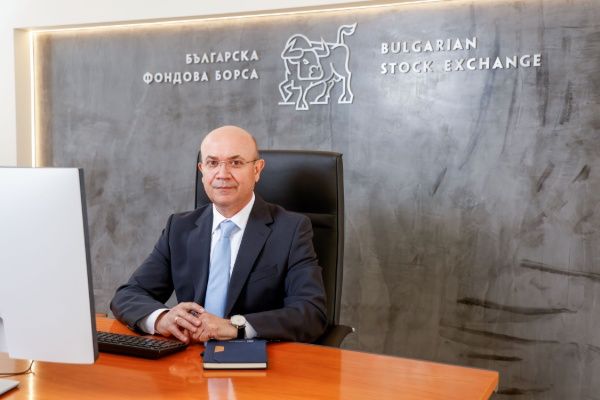
The measure of a successful career is in the assessment of others!
Introduce yourself in a few words.
I am Manyu Moravenov, executive director of Bulgarian Stock Exchange. My name comes from Emanuil/Manuel and is common in the Rose Valley. My family is from a Koprivshtitsa lineage. I work at the intersection of regulations, technologies, and numbers from the capital markets — with a small but wonderful team, united by the goal of developing the capital market and making it larger, more useful, and more accessible for businesses and investors in our country.
How would you describe your career in a few words?
It is built on a solid value system and a few core principles that I do not compromise on. For example, I lead with inspiration and regard for people, not with an authoritarian style. I believe this has helped me grow a lot – through personal attention and care. Additionally, discipline and consistency are important for results in a clear long-term direction. My entire professional path is connected with the capital markets and investments — from an expert in the first Commission on Securities, through Director of Trading at BSE, investment business, and investment brokerage to executive director of BSE. Concurrently, I am also developing an academic career.
What was the most important choice that shaped your path?
There are several choices that shaped my path. One of them is the choice to start a family with my wife Natalia – naturally, this led to even greater responsibility and proper planning of priorities. And this, in turn, somehow naturally organized my professional path – trust in the team increases when values are organized. From the perspective of my professional orientation, the most important choice was my decision to become an economist instead of an engineer. My secondary education is from an elite technical school. The reason for this decision of mine was the change of regime in our country from socialism to democracy. It happened while I was in the army. I decided that the moment was more suitable to learn about business, as this was something completely new for our society.
What would you like to have known at the beginning of your career that no one told you?
That it is not enough to be a good professional to have a successful career and to be a successful leader. Leadership requires building and constantly maintaining authority and trust. People follow those whom they accept as authorities and whom they trust.
How can a person understand which profession is suitable for them?
This is strictly individual. Some people know very well from a young age what they want to do. Others, to which I belong, understand it during their professional development. I believe that if practicing a profession can bring you satisfaction and a sense of belonging, then it is the right one.
Which skills do you think will be key in the next 10 years?
I believe that first and foremost will be proper communication and combinatorial thinking. The ability to quickly adapt to technologies and all other novelties in a world that is changing at a much faster pace than what we have known so far. Otherwise, in every historical period, financial literacy, the ability to keep track of proper management and direction of finances – personal or corporate – is a key skill that needs to be developed. And not least – the ability to navigate well in a vast amount of information and extract what you need from it, without wasting time and getting scattered.
How to build a network of useful contacts without appearing interested?
Contacts have always been extremely important, but they cannot be created aimlessly and without content. A network of useful contacts is a dynamic thing that develops throughout life. These are contacts with people with whom you have built mutual trust. Proper communication, diplomacy, and adherence to common interests are the tools for this.
What is the biggest mistake you have made in your career, and what did you learn from it?
Making mistakes is part of our growth, both as people and as professionals. It is very important to recognize our mistakes, analyze the reasons for them, and draw the right conclusions when necessary and correct ourselves. If we manage to do this, it means we are developing and becoming better. The biggest mistake I made in my career was trusting mainly my personal contact to start a new business initiative, without analyzing the other purely entrepreneurial and financial risks well enough. My conclusion is that regardless of whether you are pressed by certain circumstances, professional decisions should be made primarily based on expertise, appropriate risk and benefit analysis, and, of course, analysis and knowledge of the direct stakeholders.
How to recognize a toxic work environment and when is it time to leave?
In my opinion, this happens when you feel that despite putting in enough effort, you cannot uphold your beliefs, values, and principles. An environment in which you feel oppressed and demotivated is toxic for you. The best solution in such cases is to seek change.
What would you do differently if you could start over?
I would invest in accumulating knowledge at as early a stage as possible.
How to maintain our motivation in times of stagnation?
In such moments, I rearrange priorities or change the scale – often the two are related. I start from something measurable that provides a good foundation for achieving a quick result. In times of stagnation, always look for suitable new opportunities or ideas for realization.
How to achieve a balance between professional and personal life?
I believe that the search for this balance continues throughout life. If professional commitments and career development are discussed in the family and the support and understanding of the partner are sought, balance is achievable.
When is it time to change our career, not just the job?
I believe that this is rather a strictly subjective decision, based on many personal qualities and circumstances. Such a decision is very rarely justified solely based on professional motives. I myself have changed jobs and sectors, driven by the desire to develop and learn more. And I have left when I felt that there was nothing more I could do or change. I see a general career change as an opportunity in two hypotheses. The first is the hypothesis where you realize that your job does not bring you satisfaction and motivation, with the reason being the nature of the job/profession itself, not something else. The second is the hypothesis when your professional development and personal accumulations are sufficient to make the decision to start your own business, including in the form of managing your investments.
If you had to give only one piece of advice to people seeking success, what would it be?
Be persistent and consistent in the pursuit of success. Never give up, no matter how hard it is for you. Rather, in difficulties, seek new opportunities and know that if you overcome them, you will be even stronger and more confident in yourself.
What is your definition of a “successful career”?
My definition is that a successful career is truly proven when those around you sincerely believe that your career is indeed successful. In other words, a “successful career” is a recognition we receive from others – our colleagues, our loved ones, and our social environment.