Success makes sense only when you are greater than it
· Nikolai Naydenov
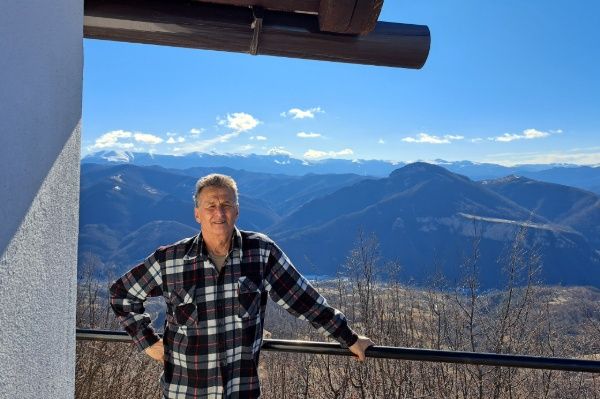
If success overwhelms you, it means you have exceeded your zone of competence!
Introduce yourself in
few words…
Nikolai Naydenov - sociologist by education, political scientist by
position, anthropologist by way of thinking, lecturer in the Department of Political Science at
Sofia University “St. Kliment Ohridski”. I am the author of university monographs “Feudalism
and Patriarchy“, “Anthropology of Patriarchal Language“ and “Audience and Politics“,
as well as three poetry collections: “Kinship“, “Tibet“ and “Far from Words“.
How would you describe your career in a few words?
A permanent clash with the imperatives of the status quo. The two
doctorates, the associate professorship, and the professorship have been achieved despite the resistance of
circumstances.
What was the most important choice that shaped your path?
My path has not allowed me to reveal the maximum of my
potential. Rather, I would say that I have reached this point “on reserve”. It takes
great success for me to be able to talk about some fateful choice. It is easier for me to
talk about choices I did not make and for which I am not satisfied with
what I have achieved. Still, I would mention two individuals who have influenced my path in
science and poetry. (1) In Momchilgrad, where I served, there was an intelligent
old soldier, Zlati Viktorov Konstantinov. He was fine and did not have the physical
attributes that commanded respect in the army. But he once said something that sounds roughly like: “There is a science whose principles, if I use them, I could make everyone in the company do what I want.” I asked him
what this science is, and he said: sociology. The following year, in the
applicant student directories of Sofia University, this specialty appeared for the first time, and
I placed it first. I was accepted, and this determined my professional
development. Much later, I realized that long before I knew about this science, I had
been inclined to think in the terms of sociology and political anthropology.
(2) As a student, I published three poems in the high school magazine “Rodna
Rech”. In this regard, I went twice for consultation with an editor in
the magazine (Stefan Mihalkov), who wrote prose but gave me extremely valuable
advice on how the synthetic expression characteristic of
poetry should look. This not only detached me from the imitations of Bulgarian classics from the end
of the 19th and the first half of the 20th century, but became a step that allowed me
to reach important personal conclusions about the concentration of meaning in poetry. In
a certain sense, the advice of this person is somewhere deep within me to this day.
What would you like to know at the beginning of your career that no one told you?
Academically, at the very beginning of my career, I would have liked to know how to limit a scientific study so that it
says the important things in the most convincing way. Practically, after the beginning
of the transition, it would have been important to know how to write a research project according to
Western standards so that it would be successful. This would have increased my chances of
success in applying for some research scholarships in the West and thus
for serious academic development.
How can a person understand which profession is suitable for them?
At the earliest age, by realizing whom they would like to resemble (a person from real life or a character from literature and cinema). At
one next stage, by realizing which intellectual, organizational, and
other efforts would bring them the greatest satisfaction. And at a more mature phase,
when they begin to develop in the direction in which they feel they have some
social mission and even that they bear their historical responsibility.
Which skills do you think will be key in the next 10 years?
(1) To extract the potential of the global communication
network and in particular – of artificial intelligence. But with one condition – by consistently following one’s own
logic of thinking and intellectual development.
(2) To apply the successful algorithm to any
situations and areas of activity.
(3) To quickly identify potential sources of
profit – a quality that carries risks for morality and honesty.
How to build a network of useful contacts without appearing interested?
By starting from the actual community with others along the lines of
interests, ways of thinking, moral styles, etc.
What is the biggest mistake you have made in your career, and what did you learn from it?
Basically, that I did not change my opinion, even if
everyone thinks differently or goes in another direction. This was not because
I wanted to stand out, but simply because the other point of view did not seem
justified to me; otherwise, I would have accepted it. This trait created for me in
my youth the image of a lone wolf, but the consequences of this are felt to
today. Although I understand the practical damage that this approach causes, I still
would not change much in this regard because the truth is a supreme value for me.
If I do not see the path to another truth, I would not give up my own. What I
would correct in my younger years is to make the defense of
my truth more elegant. However, there is one technical mistake I regret. I did not realize
in time what I needed to do to take advantage of the academic
perspectives for research realization in the West that emerged after
the fall of the communist regime.
How to recognize a toxic work environment and when is it time to leave?
The main indicator is the substitution of professional
arguments and goals with arguments ad hominem. I personally left
without warning my position as senior coordinator at the International
Anti-Corruption Academy (IACA) in Vienna, precisely when the behind-the-scenes intrigues and traps crossed
certain boundaries.
What would you do differently if you could start over?
I would start by researching the most emblematic cases of
a political system, instead of always starting with an analysis of the entire system,
which is labor-intensive, with uncertain success and provokes greater resistance.
How to maintain our motivation in times of stagnation?
In creative fields, it would be good to recall our initial
enthusiasm, our high goals, and the success of the steps when we believed in the meaning
of those goals.
In practically oriented fields, it would be useful to engage in the necessary technical actions for our work, such as gathering and systematizing
necessary information, classifying what we have done and what others have done in
the field, analyzing what would happen if we stopped working in this
direction. With such steps, a person is very likely to return to the path of
success.
How to achieve a balance between professional and personal life?
By not separating from the very beginning one from the other,
that is, by not thinking of our professional career as an end in itself. We need to
set ourselves in advance that our professional successes ultimately are
means to improve our personal life and receive their greatest,
final recognition from it.
When is it time to change our career, not just our job?
If the goals are significant enough and require lifelong dedication – never. One of the indicators of such goals is the feeling that they are
our personal mission. In other cases, such a radical change is justified
when a person has become saturated with what their career has brought them and sees
the most valuable in another direction.
If you had to give just one piece of advice to people seeking success, what would it be?
Success makes sense only when you are greater than
it. If success overwhelms you, it means you have exceeded your zone of
competence and the position you occupy may generate unpredictable negative
consequences for you and others. Losing contact with former friends and
colleagues, as well as accumulating critical voices, are among the possible indicators
that your behavior in the dreamed high position is inadequate.
What is your definition of a “successful career”?
A career that gives the feeling that a person has realized
the maximum of their abilities.