Viktor Asenov: to see with your heart, not with your eyes
· Viktor Asenov - InVICtus
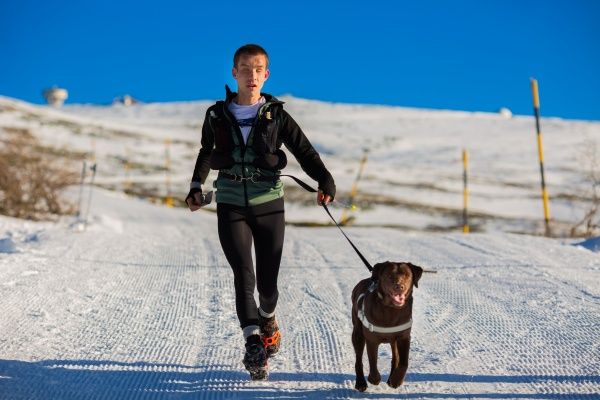
When faith is stronger than fear: the story of Viktor Asenov!
Who is Viktor
Asenov outside of titles and achievements?
I am a dreamer. A person who sets goals and strives to follow and achieve them. I love nature, I love to challenge myself and this leads me to many adventures. The fact that people see inspiration in me gives me additional strength, but it also carries responsibility because I want to use this opportunity to change the environment and attitudes of people. I want to show that every person has the power to be, to overcome boundaries, and to achieve their goals. I work hard for society to open up to people with disabilities and to improve the urban environment.
Otherwise
– I am Viktor Asenov, 30 years old, blind by birth. The only blind
mountain ultramarathon runner in Bulgaria, hoping to pass on my experience to
others to be like me. I love meeting students to tell them about
the challenges, motivation, the lives of people with disabilities, and guide dogs. In a professional capacity, I give motivational lectures in companies and do
corporate massages in offices.
When and how
did your sports journey begin and what attracted you to sports?
My sports journey is long. I have engaged in many sports. I have tried judo, I have tried all sorts of things. I started mountain running in 2022, with my first participation being in the park – 5 km in Borisova Gradina at “Svetulki Run” - a charity run for the guide dog school. That was my first attempt.
Otherwise, before that, I was involved in tourism in the mountains and judo in school and at university. Additionally, I have gone caving, skydived, climbed rocks, and ascended to 5000 meters in Nepal.
What does it mean
for you to be a blind athlete? More of a challenge or more of a source
of strength?
For me, it is more of a source of strength because you can show people that nothing is impossible. Yes, the challenge is involved, as you have to convince different people that a person with a disability can do something.
What is your
strongest internal motivation when it is hardest for you?
I am more of an extrovert, meaning I allow someone to motivate me, someone to say something to me in difficult moments. In races, I sometimes go through such stages and I rely on the pacer who is with me.
The
internal motivation is perhaps the realization that you can. This is the faith in your own
abilities. Also, the realization that since I have made it this far, it means I will
succeed in continuing.
In
difficult moments, there comes a time when I say to myself: “Come on, Viktor, you can, and in
the end, things will turn out, as they should.”
Has there been a
moment when you doubted whether to continue and what made you not give
up?
Yes, there have been such moments. In every longer run, I go through such. At that moment, I rely on the support from the pacers. Last year during the Everest climb with my 19 consecutive ascents of Cherni Vrah, without sleeping, there was a moment when I didn’t want to eat anything, I didn’t want to nibble or smell any gels, bars, or anything. After that, I calmed down and continued. These are the moments when doubts and questions arise: “Why am I doing this?”.
The pleasure
is precisely then to look within yourself and discover that strength that pulls you
forward. Of course, it is important to have someone to rely on.
What are your
biggest challenges that you face daily - not only in sports but also in
life?
In life, what I encounter is that I want even more people to know that they can accept people with disabilities. Misunderstanding in any form - whether it’s refusals to enter somewhere, for access for me and my guide dog, refusals for some participations, before I started my own business, difficulty finding a job – I have tried at quite a few places. We still have a lot to learn. I am aware that the process is two-sided – both from the society and from the people with disabilities themselves, who must want to be part of this society and fight.
I want us to change attitudes towards people with disabilities. Yes, we cannot drive a car, for example, but there is a significant percentage of things we can do fully. The fact that we do not have sight does not mean that we cannot do things. Just because others cannot imagine it. They just need to ask at that moment. I personally do not mind any questions. And in some cases, later we will laugh together, especially if the person opposite is open-minded and has a sense of humor. You will have fun, but at least you will know and learn something new, and then you will pass it on to other people. So yes, for me, the challenges are related to misunderstanding and non-acceptance, and that is more what I encounter.
How do you see
the world? Through which senses and sensations do you perceive it most
strongly?
I perceive the world through all the other senses. Perhaps many times I trust my intuition, my inner self. A little on… subconsciousness sometimes. Sometimes I take risks and make mistakes. Yes, I make them. Sometimes I trust a certain person, but it turns out that things are different.
I love
to communicate with the person opposite, to hear them, not to text, so I can feel
their dynamics.
Are there things
that you think sighted people often do not notice, but you sense very
clearly?
Yes, there are things that people do not notice because they, looking with their sight, sometimes miss sensing – how it smells, touching it, feeling it, feeling the energy of the person next to them. They look at external beauty, but not always at the energetic side.
What is the
most important skill you have developed thanks to being blind?
I have managed to develop many skills or rather I have tried to develop them. The most important for me is to be able to orient myself in any conditions, in any situations. I relax to “explore” unfamiliar places - once I pass with the white cane and then I am already without anything. Yes - I orient myself only with my feet and hands sometimes, and even sometimes I allow myself to run in such places. It’s a bit stressful for other people, but everyone develops their senses in different ways, everyone defines for themselves how far their comfort zone is. I do not force anyone to start doing these things - neither sighted nor blind, because they may not feel okay. But if they want, they can try. For example, recently in the gym, I told my trainer: “Why don’t you try training with your eyes closed, running up the stairs on the treadmill” and he said that the idea is not bad. He just hadn’t thought about it.
What do you want to
achieve in sports?
I have not set specific goals. Rather, I am focused on the idea of climbing peaks because I love the mountains a lot - to climb specific peaks, to go over 8000 meters, to do many long races of over 200 km running and with the tandem bike. I would be happy to try, to experiment on very long distances. Of course, I will be with another person because I cannot climb alone.
I love
to challenge myself and accept all kinds of ideas. Last year, that’s how the
proposal to do the Everest climb came. It was a great adventure, but here I am, I
managed. And I am happy because many people see it as unattainable – how can it be
19 consecutive ascents of Cherni Vrah in the snow and without sleeping. There are people who have never
been to Cherni Vrah.
That’s why
it’s important for me to try. Just someone throws me an idea and I’m ready. And in
this way, to show that every person can. It’s not necessary for everyone to start climbing
peaks or running 100-200 km. But to discover what energizes them – it can
be singing, painting, architecture.
How do you
imagine your development after active sports? In what direction would you like to
continue?
After active sports, we can still do sports, just more moderately - at shorter distances. I want to continue motivating people, to go to the peaks, to be in nature.
Also,
I want to continue my meetings with students because they will be able to learn many
things and will see that the world is beautiful and that they can also contribute to
make it an even better place.
What role
do technologies play in your life and what technological changes or innovations would
you like to see?
Technologies play a very big role for me. I mainly use a laptop, a phone that has software that reads everything from the screen. Here I open a parenthesis - that’s why it’s important, when a company decides to make a website, to comply with accessibility requirements, so that it can be much easier for a blind person.
I am open
to technologies and find them interesting. I would be happy if in the future Elon Musk
develops Neuralink – which works for a blind person to see completely after
implanting a chip. I would like to try - I have nothing to lose in my case. If
it can be injected into me, to be one of the testers, it would be cool and later I could do things much more freely. Because, in some of the sports
achievements, I need more than one person, maybe two, three, four, or five, depending on how long it is. But we have not reached five, most of the time it has been up to three or four at the same time.
So,
yes, I would try, for example, Neuralink, I would try other such interesting
achievements that science strives to achieve.
I would also try with an autonomous car – as far as I know, in the States, such a car has been tested that moves on both asphalt roads and dirt roads, and in the snow. If this can happen, to come to Bulgaria, I would be very happy. I don’t know how it would perform in our conditions, given the disregard for rules, but if this happens, I could live outside Sofia.
Is society ready
to accept diversity as a strength, not as a disadvantage?
To some extent,
yes. It is ready. Most people are starting to open up to this understanding. And that’s
actually why I give motivational lectures to students, so that it can become even
more ready. Because now we meet and discuss, some are still young - in fourth,
fifth grade, and learn things. Others are in the higher grades and are just entering
society and becoming a workforce, they are already full-fledged participants in society.
They, de facto, will be able to contribute to changing the understandings of their relatives and
their surroundings. Thus, society will become better prepared.
There is much to be desired, I see it, but there is progress. A person must look positively. Sometimes I get angry, yes, that things happen more slowly, but that’s my case. I have to accept that it will probably happen at a moderate pace.
Who are the people
around you that you call your most loyal helpers and support?
My grandmother Lidia has been with me throughout my conscious life – my paternal grandmother. She raised me, has always been by my side, and has fully dedicated herself to me.
Bojidar Kartunov from “Heroes of the Future” is also with me, who actually helps me with the building of my image, with managing social networks, with my projects. He is like my manager. He handles all the communication, which is not small at all. Our relationship has developed and is now friendly – we talk about interesting, different topics, which makes me happy.
Of course, in sports, my most loyal helpers and support during my competitions are all the pacers. These are the people who have been with me at different moments.
What is the role
of trust in yourself and in others in your life?
This question is specific. I am very trusting of people - a little more than I should be. There is another perspective – that of trust in oneself, that I can achieve things. Because yes, sometimes I find myself in some holes, difficult moments, and then I have to pay attention to myself - I do meditations, I play music and that’s how I cope. I am still learning to trust myself and I think I will succeed in achieving it.
What would you say
to young people with disabilities, who should first seek their path?
To young people, I would say not to give up, to try, to experiment. It’s not easy. It really isn’t easy. People need to know that in order to succeed in some way, they must always try. It has never been easy for me either. Neither with job refusals, nor refusals for admission to certain places and what else. At some point, these refusals made me feel like there was no point in fighting. But that’s not true! At that moment, a person must try because if they don’t try, they will always ask themselves what would have happened if they had tried. These are valuable lessons.
Here
with running – now I am the only one in Bulgaria, but I would be happy to pass on what I
know to others, to spare them many difficulties that I have gone through.
I want other blind people to start running, to go to the mountains.
What do you want
people to know about people with disabilities?
I want them to know that they should treat them like everyone else. To be equal, not to make assumptions and conclusions. And not to put everyone under a common denominator – if, for example, they have had a person with a disability in their company who did not cope, that is not a reason to close the door for others. They should give the individual a chance, not put them in groups based on a certain characteristic. That is, if you have an employee who is trying - you give them a chance, because they are just trying, not because they are or are not blind. If you have a bad experience with a blind person, do not stigmatize them and put them in a common box, but say, okay, let’s ask the new person, things will be different.
Because if we stigmatize everyone, I could say that all sighted people in society are the same. This is what I would like people to learn, that we are all different. Just as sighted, so blind, as well as a person with any kind of disability. Everyone deserves a chance.
If now all the
people in the world hear you, what is the message you want to send?
People, be inspired, do not give up, challenge yourselves, of course moderately and without unnecessary risks. Success, forward and upward. Dare and always be inspired and give a chance to every new endeavor, no matter what it is.