VR: The Place Where Leaders Make Mistakes Without Paying the Price
· Ivaylo Ivanov - VR Nautics
How VR Turns Experience into a Competitive Advantage!
Ivaylo, to start, please introduce yourself and tell us how the idea for VR Nautics was born. What problem did you want to solve when you created the company?
I have been involved in sales and Human Resources, but until now I have not found anything more interesting than conducting training sessions. This is what I have been doing with pleasure for the last 20 years or so. Virtual reality turned out to be a great temptation for me. The idea for VR Nautics – I tried a multiplayer game in virtual reality for the first time in 2018. Back then, things were still happening with VR glasses that had to be connected via cable to a desktop computer, but I was extremely impressed. I decided that something interesting could surely be devised for training, not just for gaming. In virtual reality, you can experiment with different solutions and reflect on the effects immediately. This makes VR glasses a very powerful training tool, as we usually learn best from our experiences, but in reality, experience is also the most expensive teacher. What problem are we solving – we can make even the most conservative audience enter a mode of searching, learning, and experimenting. Even when people feel they have solid experience and think they have nothing new to learn, with our application for learning soft skills “Book of Secrets” they find themselves provoked to realize things about themselves and their productivity in relationships with others. We often work with an audience that enters with the mindset “the problem is everywhere around me, but never in me.” VR helps people meet themselves in a friendly way and, without unnecessarily irritating the ego, reach certain ideas about what they would like to change in their own approach to topics such as “People Management,” “Decision Making,” “Giving and Receiving Feedback,” “Negotiation.”

How has VR Nautics evolved from the initial concept to today’s solutions for training and developing leaders through virtual reality?
In 2019, when we started, VR games played a major role, and it was exotic to explain to clients that we use Virtual Reality for behavioral training. However, today it turns out that the segment of training with Virtual Reality is developing even faster than games. VR training is a sector driven mainly by the needs of industries such as healthcare and manufacturing, which are looking for more effective and safer methods for preparing personnel.
What were the biggest challenges along the way – both technological and related to convincing businesses that virtual reality has a place in people’s development?
There is a prejudice that VR technology is for “young people,” but it turned out that we have worked with an audience between 19 and 65 years old. Today, the technology is very simplified and easy to use, and at the same time, the experience in Virtual Reality can ignite almost anyone as soon as they try it.
In one of your recent posts on social media, you say that trust is “the most valuable currency of leadership.” Why do you think trust has become such a critical factor for the success of organizations today?
In today’s competitive market, many organizations offer a cash bonus if you bring a friend to apply at the company, but do you trust that the company is a good enough place to attract your friend or loved one? Or the opposite?
Changes are coming (new product, new system, new organization of work, etc.), but do you trust the company and the management that these painful transformations will be for the better?
Everyone expects you to learn quickly and develop, but do you trust your manager and colleagues enough to share when you need help and support (or do we rather discover the warm water several times simultaneously in the team)?
Today, topics like motivation, communication, and leadership are often discussed, but at the core of how productive people are in the organization is the trust they build among themselves, towards the management, and towards the company as a whole.
Many managers talk about trust, but few manage to build it sustainably. Where does the connection between intentions and actual leadership behavior most often break down?
At the core is trust in oneself. How do you see yourself? As someone whom people would deceive or as someone whom people would trust? If the first type of mindset dominates, you start to feel the need to check and control. And if people feel checked, do they trust? Quite the opposite. That’s why it is said that trust is always “on credit.” Are we able to set our own boundaries? Can we prioritize self-care? Do we keep the promises we make to ourselves? Do we talk/thinking positively about ourselves? Are we aware of our own emotions? – These are the five key things that determine whether we develop trust in ourselves.
What does the term “leadership productivity debt” mean and why do you think organizations are starting to pay an increasingly higher price for it?
The term “leadership productivity debt” describes the hidden cost that an organization pays when its leaders choose quick compromises and short-term comfort over long-term effectiveness.
This is the managerial equivalent of the well-known “technical debt” in software engineering. Just as hastily written code saves time today but makes the system cumbersome and difficult to change tomorrow, leadership debt accumulates when management postpones difficult decisions, neglects to solve organizational problems, or simply avoids uncomfortable conversations.
How does this debt accumulate? Usually, it happens unconsciously, in the rush of everyday life – 1) Delayed, irregular, and unconstructive feedback; 2) Conducting meetings where people report activities but we are unable to discuss and make decisions together; 3) In the rush, roles and responsibilities are not communicated or are blurred, resulting in our inability to progress and make decisions.
This “Leadership Debt” towards productivity is not initially very obvious in the company’s results. But soon, its influence is visible in the form of high stress and burnout among people, slowing or declining results, and loss of trust.
In your publication, you talk about the need for leaders to develop their intuition in high-stakes situations. Can intuition be trained and how does virtual reality help with that?
If an experienced leader says “I sense something is off here,” their brain has actually analyzed the situation in milliseconds, compared it to thousands of past situations from their experience and identified discrepancies. However, this happens unconsciously. In other words, yes – intuition can be trained. But this does not happen through passive reading or listening to lectures, but through accumulating quality, concentrated, and simulated experience. This is how Virtual Reality (VR) becomes the most powerful tool for this purpose.
Tell us more about the new extension of Book of Secrets. What real management situations does it recreate and what skills does it develop?
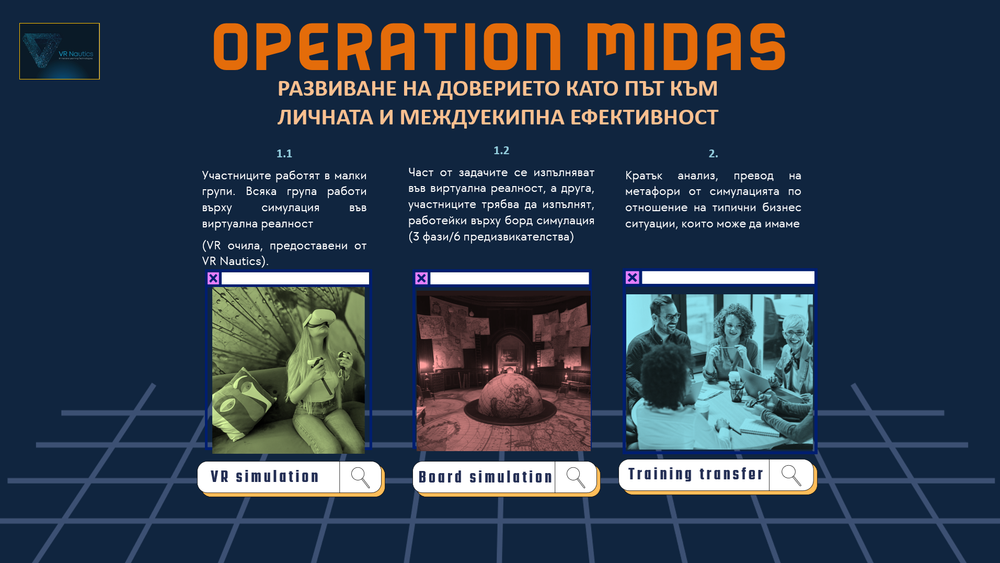
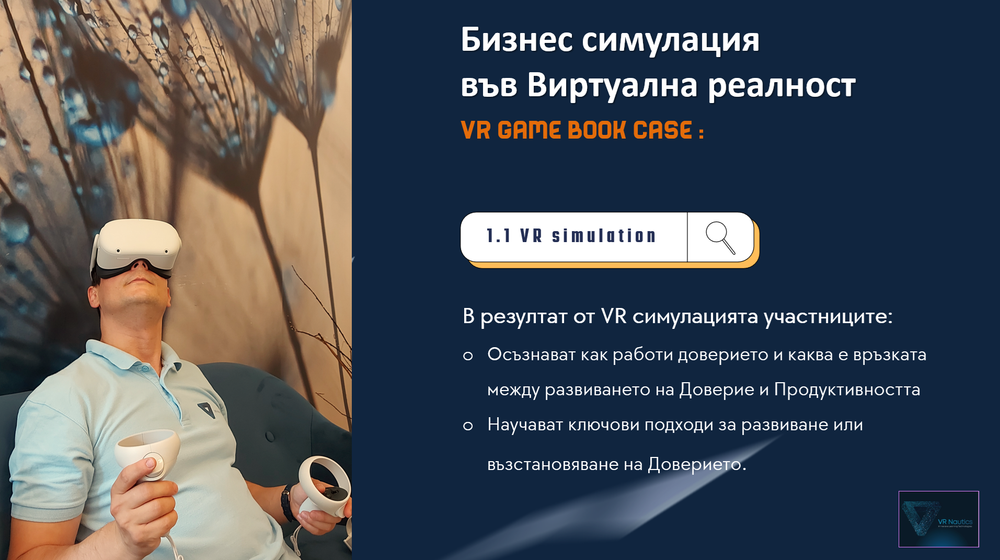
The application works similarly to a “choose-your-own-adventure book,” where participants choose possible continuations for the main characters in specific situations. Behind each of the situations in which we make decisions in the game lies a metaphor for a challenge we would otherwise encounter in life regarding how we lose or gain trust and how this affects our productivity. Participants play the game in Virtual Reality, and then a facilitator follows up with an analysis, allowing us to realize key challenges regarding how we approach gaining trust or where the risks are for losing trust in relationships with others.
Why did you choose the theme of trust as the main focus in the new solution? What do you observe among leaders and organizations in recent years?
Trust is the fuel in relationships between people to generate results, whether as a team or as an organization. I often observe companies functioning in “One Brain Company” mode – one leader gives short commands and the other leaders are task dispatchers. This leads to mass avoidance of responsibility, passivity, and distrust, both towards oneself and towards the organization as a whole.
How does virtual reality change the way managers learn and make decisions compared to traditional training and case studies?
Knowledge today is extremely accessible. Trainings are not to share knowledge, but to create an experience in which people first realize what they need to learn or change in their behavior. In this regard, tools with mixed and virtual reality are extremely powerful because they allow you to make decisions in a protected, simulated environment and reflect on the effects immediately. The brain recognizes the experience in virtual reality as real experience, making the method much more impactful compared to normal training in a 2D environment.
Moral courage is another important element you mention. Why is it becoming increasingly important for leaders in the modern business environment?
We can assume that traditional courage in business is often associated with taking market risks or investing in innovations. But moral courage is more inward-looking. It is related to our ability to say “No for example, to a toxic but profitable practice, or to acknowledgem a systemic problem that everyone else prefers to ignore. In a sense, this is the courage to lose approval in the short term to avoid accumulating “leadership productivity debt,” as mentioned above.
To what extent do the decisions people make in a virtual environment reflect their behavior in real life? Have the results of such simulations surprised you?
In our application for learning interpersonal skills, people make decisions on behalf of a main character (in the style of “what would you advise the main character to do in this situation”), but they actually decide as they are used to in life. In virtual reality, you can experiment with the effects of different decisions, while in reality, this is either impossible or too expensive.
What are the most common mistakes you see among managers and leadership teams when it comes to building trust in organizations?
Trust is a two-way street. More often, we can encounter people who expect the other party to trust them as if by job description. But trust is not built with grand gestures. It is nurtured slowly through small, consistent actions demonstrating competence, integrity, and goodwill, including after conflict, when it is necessary to acknowledge a mistake.
What is the relationship between trust and productivity? Can the lack of trust be measured as a real business cost?
Trust can act as a catalyst, but also as a brake on results. When there is trust in an organization, processes happen quickly and easily, which leads to less time and resource expenditure. When trust is lacking, everything happens with difficulty, with much resistance, persuasion, or pressure – results are achieved with much more effort and resources.
More and more companies are investing in technology and artificial intelligence. Do you think that with the development of AI, human skills such as empathy, trust, and moral judgment will become even more valuable?
AI is a powerful tool in the hands of people to be more productive. But the ultimate responsibility always lies with natural intelligence. Yes, empathy (our ability to imagine things through the eyes of another, without judgment or condemnation) is one of the key elements for gaining trust.
What are the most interesting trends you observe in the field of leader training and organizational development in 2026?
Well-known online seminars are quickly giving way to trainings created with next-generation technologies. For example, thanks to AI, dynamic scenarios can be created in real-time. Avatars in VR no longer follow a fixed script. Thanks to language models (LLMs), virtual characters in the simulation respond authentically to the tone, words, and even micro-variations in the voice of the trainee.
What companies and industries show the most interest in the solutions from VR Nautics today?
Our clients are mostly global companies, but I am very pleased that we already have some interesting Bulgarian companies among our clients as well. In terms of sectors, these are usually Manufacturing, Banking, FMCG, Pharmaceutical companies, and of course, Technology companies.
Do you have examples of organizations that have managed to improve leadership effectiveness, communication, or trust in their teams thanks to your solutions?
Results in Leadership effectiveness are usually not achieved with single events or trainings. Companies that achieve visible results are those that invest in long-term programs that engage people in short modules of up to 3 hours, once a week, but over a period of at least 6 - 8 months.