EDUCATION AND AI: How are we preparing the professionals of the future?
· University of National and World Economy - UNWE
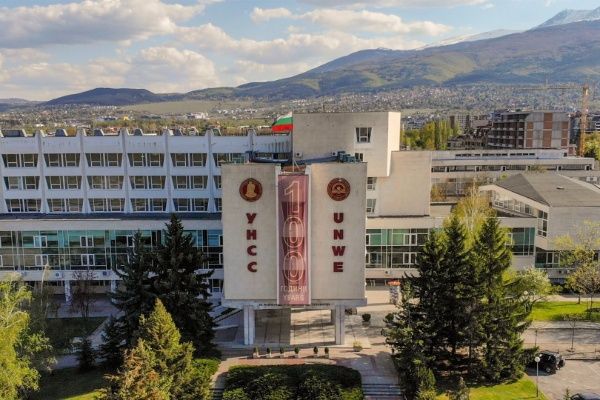
"We are seeking the perspective of academic leaders and leading professors from Bulgarian universities on how AI will change the way we learn, teach, and prepare future professionals. We start with UNWE."
In the last month Career Daily News published some of its largest projects dedicated to artificial intelligence and its impact on professions such as PR, HR and Marketing. What do leading employers think? What does the future hold for medicine?
Over 150 experts shared their views in a series of materials totaling over 120 pages.
How will education change in the next 2–3 years in the age of AI?
As a continuation of our topic, we seek the perspective of academic leaders and leading professors from Bulgarian universities on how AI will change the way we learn, teach, and prepare future professionals.
We start with UNWE.
Prof.
Dr. Dimitar Dimitrov
– Rector of the University of National and World Economy (UNWE)
Artificial
intelligence is already fundamentally changing the economy, business, and the labor market, and
in the next 2–3 years its influence on education will be even more
pronounced. It will not just be about using new digital
tools or another step in digitalization. We are undergoing a deep
transformation that will change the very model of education – from the way we
teach and learn to the creation, sharing, and application of new
knowledge.
AI
has the potential to address some of the biggest challenges facing
modern education. It allows learning to be more personalized,
interactive, and flexible, tailored to different needs, interests, and paces of
learning. In a world where access to information is a matter of seconds, higher
education will increasingly focus its efforts on developing the skills that
make humans irreplaceable – critical thinking, the ability to analyze and
evaluate information, to find solutions in complex situations, and to think creatively.
AI
should not scare either teachers or students. On the contrary – it can
be a catalyst for a new stage in the development of education and science. To
fully utilize this opportunity, we all need to learn to work with
artificial intelligence adequately, wisely, critically, and responsibly. In the future,
the advantage will not simply belong to those who use AI, but to those who know when,
how, and for what purpose to use it and to direct its potential.
At
UNWE, we are already building this vision. We have created an Institute for Artificial Intelligence in
economics because we believe that the university should not just observe
the technological transformation but be among the places that conceptualize,
research, and shape it. The Institute is becoming a meeting space between
scientific research, modern education, and the real needs of
business and society. We are developing specialties and programs in which students
acquire not only theoretical knowledge but also practical skills for applying
modern technologies in finance, marketing, logistics,
accounting, management, and big data analysis.
The
future of work will be increasingly intertwined with technology – it will be a natural
part of how we work, make decisions, and create value in
every sector. Therefore, the university of the future must prepare not just
specialists for today’s jobs, but people with flexible thinking, capable of
adapting to the unknown, creating new solutions, new business models, and new
opportunities for society.
In
this process, the human factor does not lose significance – on the contrary, it becomes even
more important. We should not fear technology, but learn to
use it wisely, ethically, and responsibly. Ultimately, the future will belong
to those who can combine the capabilities of technology with human
intelligence, knowledge, creativity, values, and the ability to take
responsibility. They will not simply adapt to changes – they will be
the ones who will create the future.
Implementing AI without a strategy is like buying a plane without a pilot
Prof. Dr.
Tsvetana Stoyanova
Vice-Rector
for Institutional and Business Cooperation
“Education must stop teaching
people to accumulate knowledge. In the AI era, knowledge is no longer the ultimate goal – it is
the raw material from which a person must be able to create something that does not yet
exist. This distinction
may seem small, but it actually implies a radical rethinking of almost everything
we today call education. For centuries, knowledge has been an asset. We accumulate it, store it,
demonstrate ownership through exams and diplomas, and subsequently turn it into
a professional advantage. The entire architecture of education – subjects,
programs, lectures, textbooks, exams - is built around this logic. AI renders it meaningless and fundamentally changes it.
Knowledge
gradually ceases to be an asset that we must possess and becomes a
resource that we must know how to use. This
means that the educational system does not need yet another update of
curricula. It needs a change in the very principle by which they are
created. The future belongs not
necessarily to the person who knows or even understands the most, but to the one who
can do the most with the available knowledge – to discover it, combine it,
question it, transform it, and turn it into a solution, product, action, or
new question.
Therefore,
a large part of fundamental knowledge must cease to be the goal of
education. It should become the infrastructure of education – a constantly
accessible resource that a person works with.
This
implies a radical change even in schools. Instead of
history classes measuring how many facts and dates a student can reproduce,
it could require them to work with different sources, discover
contradictions, check AI-generated theses, and build their own
reasoned interpretation. In mathematics, the focus should gradually shift
from mechanically performing operations to modeling real
problems, choosing an approach, and critically evaluating the obtained result. The curriculum should shift
from "What should the student know?" to "What should the student be able to achieve
when all necessary knowledge is available?". And if part of the traditional content
must give way, other areas must become fundamental. Digital literacy
and innovation should be foundational subjects even in schools. I am not talking about training on how to use
specific software or a few hours dedicated to entrepreneurship.
Digital literacy now means the ability to understand the world in which
algorithms, data, and AI mediate between humans and information, decisions, and
reality. And innovation should teach young people how to recognize a problem,
how to create an idea, how to experiment, how to work with uncertainty, and how
an idea becomes a real solution. These
are skills that no longer belong to a single profession.
Therefore,
in university education, digital literacy and innovation must
be a mandatory part of the preparation regardless of the specialty. The future
doctor must study them. The engineer – as well. The architect, economist, lawyer,
teacher – as well. Not because everyone should become technology specialists or
entrepreneurs, but because there will almost be no professional field in which a person
can create value without understanding the technological environment and without being able
to change the existing. This
is a completely different educational philosophy. It
inevitably breaks down the boundaries between subjects. Real problems do not have
disciplines. Climate crisis, business creation, urban environment, demographic
problem, new medical product, or ethical dilemma around AI cannot be
solved within a single subject. Therefore, multidisciplinarity will not
be an addition to education. It will be its natural format.
The same
rethinking must happen in universities. The university of the future will likely not
be an institution that a person "graduates" from. I envision a model in which we enter a university, but graduation ceases to be
a one-time moment after three, four, or five years. It becomes a much
longer process – five, ten, or more years, during which a person simultaneously
works, changes roles, participates in real projects, and periodically returns to an academic
environment. Not to listen to
another 30 hours of lectures. But to
solve problems for which there is still no ready answer. To work with people from
other professions. To use new technologies. To participate in simulations and
experiments. To update the way they think at the moment when the world
around them has changed.
Thus,
education ceases to be preparation before life and becomes a
permanent part of life. And
this will change the very role of the university. Its most valuable capital will no
longer be the content it possesses. Content will be everywhere.
Its value will be in the intellectual environment, the people, the problems,
experiments, the connections between different fields, and the ability to continuously
place a person in situations that compel them to develop their next level
of abilities. Here emerges one
of the great paradoxes of the AI era. The more
accessible intelligence becomes, the more important the qualities that
education has struggled to measure become. Curiosity.
Imagination. Judgment. Adaptability. Initiative. The ability to formulate
a problem before seeking a solution. The ability to work with other people and with
intelligent machines. The courage to question the given answer. And
the ability to act when there is no single correct answer.
Therefore,
in my opinion, the conversation about whether students should use
AI is almost overdue. The real
question is: Why do we continue to
build education around the accumulation of knowledge when the world is already
beginning to reward the ability to use it?
The next
great educational reform will not be the digitalization of existing
education. It will not be more technology in the classroom. It will not be
adding "AI skills" to existing programs. It will be a rejection of the idea that
education is a process of accumulation. In
a world where knowledge is practically an unlimited resource, the real deficit will
be the ability of a person to turn this resource into something that did not
exist before. And this is what we must
start teaching.“
The Power of History: When HR, PR, Marketing, and Employer Branding Speak Together
Prof. Dr.
Lyuben Boyanov – UNWE, expert in information technology, digitalization,
artificial intelligence, and cybersecurity
“In my
opinion, artificial intelligence (AI) is already changing and will continue to change
education much more in the next two or three years than the familiar
digital technologies have done in the past two decades. The most important
change will be in the way students learn, teachers
teach, and universities assess knowledge and skills.
First,
AI will become the first assistant in learning (for students). Instead of using it
only for generating text or answering questions, students will increasingly
use it as a personal tutor/assistant. AI systems can
explain complex concepts at different levels, provide examples, offer
instant feedback, translate materials, and help students discover their
weaknesses. This makes learning more personalized and accessible.
A student who does not understand a given concept after a traditional lecture can
ask the AI bot to explain it more simply, provide a practical example, or
generate exercises for additional practice.
Second,
the role of teachers will change significantly. I do not believe that
artificial intelligence will simply replace teachers. Rather, teachers will
spend less time on routine activities such as preparing basic
materials, creating simple tests, summarizing information, and answering
repetitive questions. This will allow them to spend more time on
discussions, creativity, project work, and developing students’ critical thinking.
Assessment
will likely undergo one of the biggest changes. Traditional tasks, where
students submit an essay written at home, will become increasingly difficult to
use as evidence of individual knowledge and effort, as AI can create all kinds of complex texts and solve tasks. Therefore,
universities will need more assessments based on presentations,
projects, practical tasks, oral exams, problem-solving, and real-time activities (rather than generating somewhere/sometime) and also – discussing and debating
presented projects/presentations/tasks. The important change will be from "Can
the student provide an answer?" to "Does the student understand the answer and know how
to apply it?"
Serious
risks are many. Easy access to AI is already diminishing students’ desire to put in
effort, to grapple with difficult problems, to search and
analyze independently, or to develop their own ideas. If students use
AI as a substitute for thinking rather than as an assistant in learning, education will
become less effective, and it may even lose its meaning (what is the point of
copy-paste?). There are also many concerns about inaccurate/wrong information,
plagiarism, privacy, dependence on technology, and inequalities between students who have access to better AI tools
(e.g., paid) and those who do not.
It is clear that
literacy in AI will become just as important as traditional digital literacy. Learners will need to learn how
to formulate questions more effectively, verify AI-generated
information, recognize errors and biases, protect their personal data, and use AI in an ethical manner. Teachers will need similar
skills (but from the other perspective), as well as new methods for developing
training and assessment, supported by AI.
In the next
two to three years, I expect education to move towards a hybrid model,
combining the human factor and AI. Artificial intelligence will provide
personalization, instant feedback, automation, and access to information,
while teachers will continue to be essential for motivation,
human interaction, ethical guidance, creativity, and the development of
social and professional skills.
The biggest
challenge will not be to decide whether education should use
AI – that process has already begun and cannot be stopped. The enormous
challenge is and will be how to learn to use AI without
losing the human, curiosity, critical thinking, and interaction that
give meaning to education. In my opinion, the institutions (including schools
and universities, but this applies to all) that will succeed will not be those
that use AI the most, but those that find the most effective balance between
artificial intelligence and human intelligence, those who manage to adapt to
the dynamics of this relationship and maintain that balance.“
Prof.
Dr. Valentin Stefanov Kisimov
UNWE, Department of "Information Technologies and Communications"
Faculty of "Applied Informatics and Statistics" “Higher education, and especially that at
UNWE, is one of the areas that has been and will be significantly affected by the advent
of Artificial Intelligence - AI (regardless of the abbreviation AI or SI). Here, it is
not about the digitalization of higher education, because UNWE is perhaps
the most digital university in Bulgaria with a history and significant results from
more than 15 years.
Perhaps UNWE is
the only university in Bulgaria where a Strategy for
using AI in the university was created about 5 years ago. Based on this, numerous activities were directed at UNWE, which led to certain concrete
results that I will present below.
At UNWE,
an Institute for Artificial Intelligence in economics was created, which is aimed not only
at the activities that the university performs but also at providing assistance to
the business in Bulgaria for the application of AI.
Under
the leadership of UNWE, a Center for Competence in the field of big data was also created and is being worked on for the practical use in
business, where the application of AI is a natural approach, and several
Prototype applications have been created, whose published results have high international
value – published in the Q1 category.
If we consider
that the activity of a university is in 3 areas: education, scientific research, and
management of university processes, then UNWE has directed the application of AI in
all three areas. With the help of IBM Bulgaria and its business partner, a
special Agent is currently being developed to assist prospective students in orienting
towards the numerous bachelor's and master's programs at UNWE. After the first
results from the work of this agent, we plan to develop automation
through AI for serving students in other administrative processes. With
the assistance of Microsoft Bulgaria, we have directed our efforts towards creating
CoPilot Agents to assist teachers and students in the learning process,
called “Agents for teachers and students in the respective specialty.” We are still
exploring how AI will help the teacher in conducting lectures, considering that certain results can already be applied, but they apply to small student groups (up to 30-50 people),
while at UNWE we have a main group of streams that have 200 or more students. This
requires a totally different approach, which we are yet to create as a methodology and
as practical use of AI. For conducting scientific research, UNWE has created an approach with already obtained certain results, for applying
over 15 different AI tools that support the conduct and results
of specific scientific research.
These are our
current results from the application of AI at UNWE, which will definitely change
the work of UNWE as a university. Regarding the use of AI in the next 2-3
years at UNWE, we anticipate that the application of AI
will not lead to a reduction in the number of teachers, AI will not replace the work
of teachers, but will only assist their activities, creating conditions
for better scientific results and the application of new approaches in presenting and
acquiring new knowledge and skills, and will also help for more intelligent
service to students.“
Assoc. Prof. Dr.
Nikolay Shterev,
Department
"Industrial Business", Business Faculty of UNWE-Sofia
Chairman
of the Association of Teachers in Economics and Management in Industry /APIUI/
Chairman
of the Council "Circular Economy - Green Alternative for Bulgaria", BTPP
“Artificial intelligence can already be
defined as the generative economic and social reality. Why? All
economic and social processes have gradually been moved from the real to the
virtual world with the mass entry of social media and social business
media into people's daily lives and their businesses. It is precisely for this reason that modern
people spend more time in this generative reality than in the physical
one.
This changes not only societal
attitudes and expectations, the relationship and perception of "new" things in
economic and social life, but also changes the way these processes are managed and most importantly – the way students are taught at UNWE. In
this regard, working with different AI tools can enter the teaching process in several ways:
1.
In preparing educational materials that have good
visual content, on which the teacher leads the lectures, including developing video educational materials, through which the practical application of economic science is taught. For the teacher, it remains to
teach the "philosophy" of business, which will allow students to understand
the basic mechanisms of economic and social theory;
2.
In preparing for exams and specifically in the part of
developing specific course works using the capabilities of
digital twins to perform economic and social simulations, and for students to analyze the results of these digital simulations. This will enable them in the future to be not only passive users of these
AI tools but to be active "programmers" of the development of
AI tools.
3.
In preparing for the actual exams, according to the instructions of the teachers, AI tools can simulate
questions, tests, and developments and assess the "white" spots in the knowledge
of each student.
All of this places us
teachers in a new light: we must outpace the widespread
adoption of artificial intelligence by building this business philosophy
that does not deny AI but uses it to enhance the mental and moral
capacity of both ourselves and our students. I believe that achieving this
symbiosis between the philosophy of business and the automation of
economic and social processes through AI is the key to the success of future
economists.”
Prof. Dr. Dimitar Georgiev Velev, Department of "Informatics",
UNWE
In the next 2–3 years, we will witness a transition from
mass, standardized education to a personalized and immersive experience.
·
The first major change is the mass
introduction of multimodal AI mentors. Every student should have a personalized digital teacher who not only adapts the speed
of material acquisition but recognizes emotional states and levels of
cognitive load in real time. Curricula will be generated
dynamically.
·
The second transformation affects the role of the teacher.
Freed from the routine of checking knowledge and the monotonous dictation of
facts, teachers will become "architects of learning" and emotional
mentors. Their
main task will be to develop critical thinking, empathy, ethics, and conflict resolution skills - competencies that AI cannot authentically replicate.
·
The third and inevitable change is the end of traditional assessment. Due to the fact that generative AI has made standard essays and tests
obsolete, systems will shift to continuous assessment based on
practical projects and digital portfolios. AI will allow for instant creation
of virtual (VR) simulations, in which students will interact with real-time generated 3D environments.
Education will transform from a "factory for knowledge" into a flexible
ecology, where technology bears the burden of adaptation, while humans
retain their role as inspirers.“
Prof. Dr. Plamena Venceslavova Zlateva, Department of "Informatics",
UNWE
Three
key predictions for the transformation of education in the next 2–3 years:
1.
Collapse of language barriers and
hyperlocalization of knowledge: Within 2–3 years, AI will provide perfect,
contextual translation and adaptation of educational materials in real time. Students will have access to the same interactive
courses from top universities around the world, but generated and taught in their
native language, with local cultural examples and tailored to the local curriculum.
2.
Further development
ofstandard
curricula
and rise of “just-in-time learning”: Traditional bachelor’s and master’s programs will be actively further developed using AI. AI
will analyze the labor market in real time and identify the exact skills
that a given student lacks.
Instead of long academic cycles, universities
will offer dynamic, AI-generated “micro-modules”. Acquired knowledge and skills will be complemented by a continuously updated
digital portfolio of competencies, which AI helps to keep current
throughout the professional's lifetime.
3.
The new literacy: Learning
will focus not only on how to use AI, but on how to think together with it. A new fundamental discipline will emerge, focused on the synergy between
human intuition and machine computational power. Students will be trained to recognize
AI hallucinations, verify sources, and understand how algorithms
arrive at a given answer. The goal is to turn them from passive consumers of
technology into active managers
of algorithmic processes, capable of delegating routine but maintaining control
over ethics and ultimate truth.“
Dr. Zornitsa
Yordanova, Associate
Professor, University
of National and World Economy, Sofia, Industrial Business Department, Business Faculty (Innovation Management & Business
Information Systems)
“The university
of the future will not be an institution that a person "graduates" from.
Education will cease to be preparation for life and will become a
permanent part of it.”
“Education
must stop teaching people to accumulate knowledge. In the AI era, knowledge is no longer the ultimate goal – it is the raw material from which a person must be able to create something that does not yet exist. This
distinction seems small, but it actually implies a radical rethinking of
almost everything we today call education. For centuries, knowledge has been an asset. We accumulate it, store it,
demonstrate ownership through exams and diplomas, and subsequently turn it into
a professional advantage. The entire architecture of education – subjects,
programs, lectures, textbooks, exams - is built around this logic. AI renders it meaningless and fundamentally changes it.
Knowledge
gradually ceases to be an asset that we must possess and becomes a
resource that we must know how to use. This
means that the educational system does not need yet another update of
curricula. It needs a change in the very principle by which they are
created. The future belongs not
necessarily to the person who knows or even understands the most, but to the one who
can do the most with the available knowledge – to discover it, combine it,
question it, transform it, and turn it into a solution, product, action, or
new question.
Therefore,
a large part of fundamental knowledge must cease to be the goal of
education. It should become the infrastructure of education – a constantly
accessible resource that a person works with.
This
implies a radical change even in schools. Instead of
history classes measuring how many facts and dates a student can reproduce,
it could require them to work with different sources, discover
contradictions, check AI-generated theses, and build their own
reasoned interpretation. In mathematics, the focus should gradually shift
from mechanically performing operations to modeling real
problems, choosing an approach, and critically evaluating the obtained result. The curriculum should shift
from "What should the student know?" to "What should the student be able to achieve
when all necessary knowledge is available?". And if part of the traditional content
must give way, other areas must become fundamental. Digital literacy
and innovation should be foundational subjects even in schools. I am not talking about training on how to use
specific software or a few hours dedicated to entrepreneurship.
Digital literacy now means the ability to understand the world in which
algorithms, data, and AI mediate between humans and information, decisions, and
reality. And innovation should teach young people how to recognize a problem,
how to create an idea, how to experiment, how to work with uncertainty, and how
an idea becomes a real solution. These
are skills that no longer belong to a single profession.
Therefore,
in university education, digital literacy and innovation must
be a mandatory part of the preparation regardless of the specialty. The future
doctor must study them. The engineer – as well. The architect, economist, lawyer,
teacher – as well. Not because everyone should become technology specialists or
entrepreneurs, but because there will almost be no professional field in which a person
can create value without understanding the technological environment and without being able
to change the existing. This
is a completely different educational philosophy. It
inevitably breaks down the boundaries between subjects. Real problems do not have
disciplines. Climate crisis, business creation, urban environment, demographic
problem, new medical product, or ethical dilemma around AI cannot be
solved within a single subject. Therefore, multidisciplinarity will not
be an addition to education. It will be its natural format.
The same
rethinking must happen in universities. The university of the future will likely not
be an institution that a person "graduates" from. I envision a model in which we enter a university, but graduation ceases to be
a one-time moment after three, four, or five years. It becomes a much
longer process – five, ten, or more years, during which a person simultaneously
works, changes roles, participates in real projects, and periodically returns to an academic
environment. Not to listen to
another 30 hours of lectures. But to
solve problems for which there is still no ready answer. To work with people from
other professions. To use new technologies. To participate in simulations and
experiments. To update the way they think at the moment when the world
around them has changed.
Thus,
education ceases to be preparation before life and becomes a
permanent part of life. And
this will change the very role of the university. Its most valuable capital will no
longer be the content it possesses. Content will be everywhere.
Its value will be in the intellectual environment, the people, the problems,
experiments, the connections between different fields, and the ability to continuously
place a person in situations that compel them to develop their next level
of abilities. Here emerges one
of the great paradoxes of the AI era. The more
accessible intelligence becomes, the more important the qualities that
education has struggled to measure become. Curiosity.
Imagination. Judgment. Adaptability. Initiative. The ability to formulate
a problem before seeking a solution. The ability to work with other people and with
intelligent machines. The courage to question the given answer. And
the ability to act when there is no single correct answer.
Therefore,
in my opinion, the conversation about whether students should use
AI is almost overdue. The real
question is: Why do we continue to
build education around the accumulation of knowledge when the world is already
beginning to reward the ability to use it?
The next
great educational reform will not be the digitalization of existing
education. It will not be more technology in the classroom. It will not be
adding "AI skills" to existing programs. It will be a rejection of the idea that
education is a process of accumulation. In
a world where knowledge is practically an unlimited resource, the real deficit will
be the ability of a person to turn this resource into something that did not
exist before. And this is what we must
start teaching.“
Assoc. Prof. Dr.
Alexandrina Murdjeva – Dean of the Faculty of "Applied Informatics and Statistics" and
Head of the Department of "Information Technologies and Communications" at UNWE,
Deputy Director for Research Activities at the Institute for Artificial
Intelligence in Economics.
“Education
is a system that struggles to accept promises of future benefits and slowly adapts to
new ideas.
But it is increasingly
challenged by the need to promise educated future
generations, to preserve and pass on the increasing human knowledge.
Artificial
intelligence (AI) is the futuristic narrative from the future that education, as
a well-prepared student, must retell today with a serious dose of
reflection. And this retelling will need to include answers to several
questions:
- Why must education adapt? It is not
relevant to ask whether AI should be used in education.
The real question is not why, but when and how. AI in education is a matter of
adapting a conservative system to the present day. Every adaptation
is a process in which balance is extremely important. The balance for AI in
education lies in defining reasonable boundaries and forms for its
use, in which the thinking and creative person remains at the center of
the educational universe.
- What are the new dimensions of
the knowledgeable and educated person?
The knowledgeable and educated person is the thinking and creative person. Fortunately, we are
witnessing a rapid development in all fields of science, new knowledge is being created - in traditional and new areas, at a speed we have not even
thought of. The facts that prove this knowledge may not be the most valuable capital
of the knowledgeable and educated person, but the meaning they hide and the logic for
their discovery. Education will be challenged to change its perspective, to orient itself towards meaning and logic, because the natural course
of time will place people in the impossible situation of grasping, remembering,
and reproducing an unmanageable amount of facts. Let us define this
transition from "How to" to "Why".
- And in this regard: what are the new
skills (or perhaps well-forgotten old ones) that education should emphasize?
Analytical and critical thinking, asking the right questions,
distinguishing fact from opinion, assessing credibility,
technological and AI knowledge, and adaptability. Or in other words - by asking the right questions that we have formulated with our analytical
and critical thinking, we will be able to navigate the ocean of facts (knowledge) with
the help of our technological and AI knowledge, adapting to
the challenges of the day.
- But how then will knowledge be shared and
transmitted? How will it be taught and learned? Today we are all on the shore of
a huge ocean of facts. We all have access to it. But to the horizon
reaches the one who manages to build a ship. We will share the facts with the help of
technologies, and AI will help make the horizon look closer and
more achievable, and we will turn facts into knowledge by provoking thought.
- And how will knowledge be assessed? To assess, we must understand
the new essence of knowledge. The value of encyclopedic personalities,
capable of reproducing an incredible amount of facts, is indisputable. But in
the coming years, the value of thinking and creative personalities will increase,
because they will be able to cope/navigate with the ever-increasing volume
of factual information. Assessing knowledge in this direction will require educators to
apply the same new skills, asking the right questions that we have
formulated with our analytical and critical thinking. We will be able to
provoke logical and creative thinking with the help of our
technological and AI knowledge, but always preserving human communication as
the most reliable way of assessment.
Will AI change
education in the next two to three years? The answer will likely be
more modest than the promises and deeper than the fears. We will not see
classrooms and teachers disappearing, replaced by algorithms. We will see something more difficult and
more important: education that gradually shifts its question from "What do you know?" to
"How do you think?".
If we return
to the image of the good student who today must retell the narrative of
the future, the most valuable part of this retelling will not be the literal repetition. What will be valuable
is the understanding, that "Why" that turns facts into knowledge. AI can
provide us with faster canvases and more accurate maps. But the direction of the ship, the courage to
set sail, and the skill to recognize the shore remain human.
Therefore,
the real change will not be in technology, but in us: in the readiness of
education to set reasonable boundaries without raising walls, to use
new tools without ceding thinking to them, and to assess without losing
the human conversation. If we manage to keep the thinking and creative person at the center
of the educational universe, artificial intelligence will not be a threat to
education. It will be yet another challenge that makes it
better.“
Assoc. Prof. Dr. Silvia Georgieva
Department
"Entrepreneurship"
Deputy Director for Research at the Institute of
Entrepreneurship, UNWE
“The transformation in methods and approaches in
education, in the intensity of knowledge transfer, in the level of
accessibility, but not in values, can be expected as a result of the development of
technologies and especially of artificial intelligence. "The spirit makes the strength" is the motto
of UNWE – a university with a 106-year history that is and will continue to be
relevant, even amidst turbulent technological progress. The process of constant
change and the capacity for adaptation will likely be major challenges
in the coming years. Undoubtedly,
artificial intelligence is a powerful
tool. The effects – positive or negative – of its use
are determined today, as well as in the future, by the level of preparedness,
the degree of personal and social responsibility. In this regard, education
has and will continue to play a leading role and, of course, must meet these
expectations. Promoting humanity and curiosity, forming
systematic approaches to acquiring interdisciplinary knowledge, building skills
for analysis and critical assessment, creativity, and the desire for achievement are
likely among the key tasks facing the educational system. In fact,
the added value of technology in every field will be greater if it
is used by people prepared with the necessary competencies and completed in
the personal plan, whose professional and personal goals are based on high
moral and ethical standards. Besides the family, education is called to
shape these standards, as it is much more than providing knowledge and
building skills. However, we must acknowledge that the charm of the time we live in
is largely due to the impossibility of giving a more categorical forecast for the future,
even in shorter time horizons. The transformations that are constant companions in our daily lives often provoke
concerns among the unprepared, but for the prepared, they are an opportunity. It is education
that can change the ratio between the feeling of fear of the future and the joy
of the new opportunities received.“
Assoc. Prof. Dr. Shteryo
Nozharov
Chief
Secretary for Budget and Finance at UNWE
Vice-Chairman
of SDSN Bulgaria
"Digital
meritocracy: Delegating academic growth to AI as a guarantee of
objectivity
In the next
2–3 years, artificial intelligence (AI) will change higher education in a way
that goes beyond the digitalization of the educational process. The most significant and
urgent transformation that AI must bring is the infusion of absolute
objectivity and transparency into academic growth and management. As
a teacher and chief secretary for budget and finance at UNWE, I see in
technology the only tool for imposing true meritocracy.
In the academic
world, artificial intelligence has the potential to finally eliminate the subjective
factor that has historically fueled internal intrigues and career growth
based on personal connections and contacts. It is extremely harmful to the academic
community when key leadership positions – such as department head
or dean – are filled based on lobbying and circumstantial dependencies.
Such figures do not possess real authority and cannot establish one
among colleagues and students, simply because they lack the necessary scientific qualities. This
blocks the development of the entire university because the main asset of a
university - is its researchers and teachers. When they are
competent - they attract funding for scientific projects from businesses, attract
the interest of international organizations to the university, and attract
prospective students from around the world for education. When they are incompetent, they repel
all these groups.
My
categorical view is that conducting academic competitions, assessing
scientific growth, as well as deep checks for plagiarism in scientific
publications should be entirely delegated to AI algorithms. Artificial intelligence
can analyze scientific contributions and publications without emotions, without lobbying, and without
predefined dependencies. When the assessment of scientific work and
intellectual property passes into the hands of an impartial digital
system, subjective appointments will become impossible.
Instead of a threat,
AI is the best opportunity for institutional cleansing of the system.
The future of higher education belongs to universities that have
the courage to be the first to implement these radical digital standards to
ensure that titles, positions, and management posts are the result solely and
exclusively of real scientific results, expertise, and high morals."
Assoc. Prof. Dr. Daniel
Stoyanov Yordanov, lecturer in the Department of "Transport and Energy Economics", UNWE
“As at
present, so in the next two to three years, artificial intelligence (AI) will actively change the way we learn and teach. Teaching has already
started to feel its role; AI can provide explanations of difficult concepts in a much shorter time, generate a project response to a complex
mathematical model, and provide a project response to a given task, where
under normal conditions more time is required. From the perspective of learning, the greatest opportunity is for education to become more personalized. AI
can offer exercises according to
progress and provide feedback. Thus, the student will be able to receive
instructions tailored to their level of preparation.
The role of
the teacher will not stop, but rather
will need to develop. AI will assist
in part of the preparation of materials and checking routine tasks. This would
free up time for discussions, creative projects, and individual work. We as
teachers need to start changing the philosophy of teaching; we will
need to remain the necessary mentor,
who develops thinking and responsibility.
However, change
brings risks. Ready-made answers can weaken independent thinking, and a
convincingly written text is not always correct. Therefore, a challenge for
education in the emerging era of AI is how to verify information, to protect
personal data, and to use AI honorably. In assessment, emphasis will need to be
placed on the argumentation and process of achieving the result in
the given work..
AI can make
knowledge more accessible if it supports human curiosity and efforts to
understand the world. But success will not depend on technologies, but on their reasonable
application.”
Assoc. Prof. Dr. Nikolay Dragomirov,
Head of the Department
"Logistics and Supply Chains", UNWE
In
logistics, AI specialists must have an interdisciplinary profile
Artificial
intelligence is increasingly entering logistics and supply chain management. Today, systems of several AI agents can be built and
prepared for operation literally in minutes. The real challenge, however, is not
the creation of technology, but its training, integration, and adaptation to
specific business processes.
For example,
in inventory management, an AI system can analyze huge volumes
of data, forecast demand, suggest optimal inventory levels, and
argue its decisions through numerous graphs, indicators, and scenarios. But does
the proposed solution actually fit the specific company?
Does it take into account market peculiarities, customer behavior, supply constraints, and the strategic goals of the organization?
Here lies
the role of the specialist. The future belongs to professionals with
interdisciplinary profiles who combine knowledge of artificial intelligence,
data analysis, and information technology with a deep understanding of logistics
processes and the business environment. Their task will not be simply to use AI, but
to evaluate, interpret, and direct the decisions it offers.
In logistics,
the competitive advantage will increasingly depend not only on the technologies implemented,
but on the people who can turn data and information into correct
management decisions. It is precisely for this reason that logistics graduates are increasingly sought
after in the labor market. They possess a solid foundation in managing logistics
systems, transportation, warehousing, procurement, distribution, customer service,
recycling, operations, and supply chains. On this
basis, they can relatively easily build new competencies related to
artificial intelligence, data analysis, and automation.
Technologies are
developing at an extraordinary pace, but understanding logistics processes, business
logic, and the real challenges facing organizations remains key. It is this
combination of logistics knowledge and skills for working with AI that will distinguish successful
specialists in the coming years.